
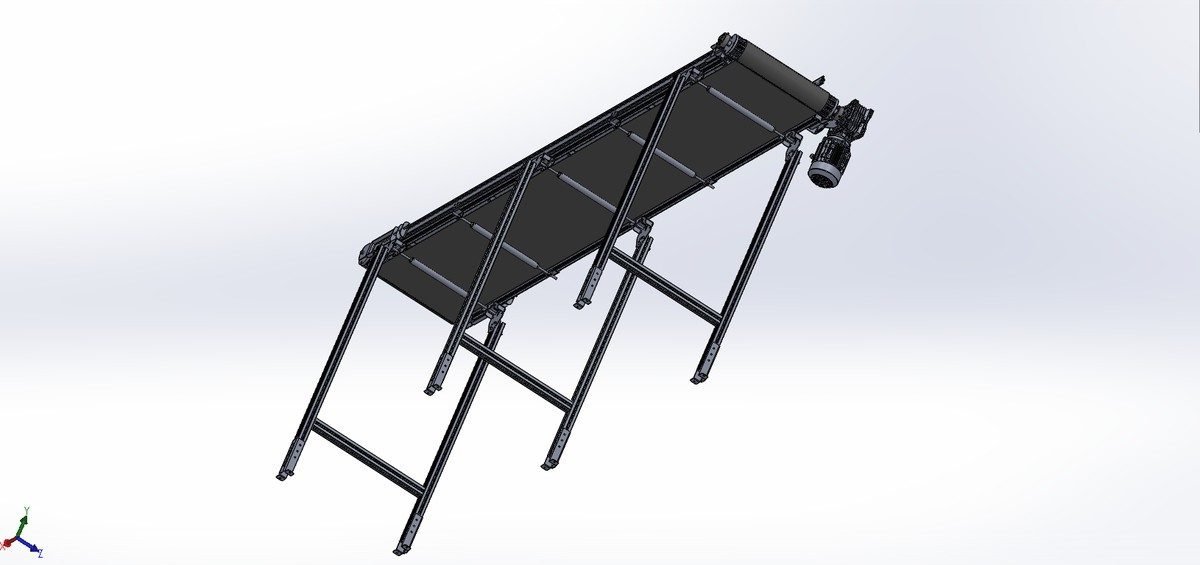
Belt conveyors move materials continuously in factories, mines, warehouses, airports and food plants. A conveyor consists of an endless belt running over rollers (idlers and drums), driven by a motor. The belt must carry the load without stretching or tearing, and the rollers must support it without bending or wearing out. Choosing the right materials for both makes a conveyor stronger, longer-lasting and more efficient. This project designs a conveyor and studies different materials for its belt and roller.
Conveyor Belt and Roller Materials
Most conveyor belts are made of rubber reinforced with fabric, because it is flexible, grips well and is cheap. Fibre-reinforced materials such as carbon fibre reinforced polymer (CFRP) and basalt fibre are much stronger and stiffer, and basalt fibre is made by melting crushed basalt rock at about 1500 °C and drawing it into fine filaments. Rollers are usually steel, but stainless steel resists corrosion and aluminium alloys are lighter.
About the Project
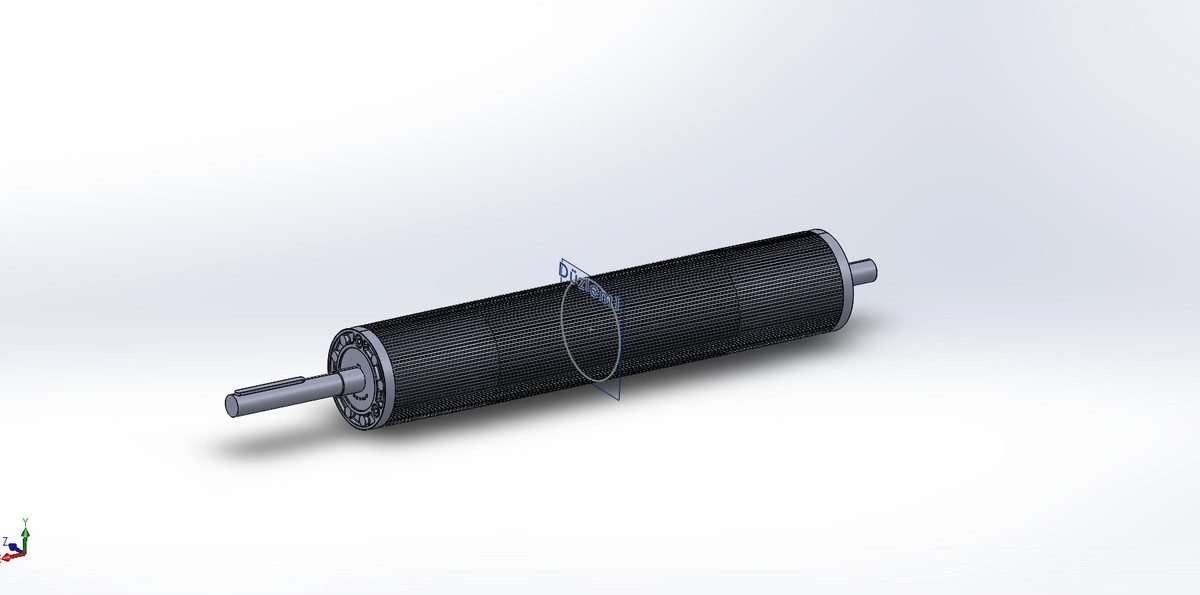
The conveyor, belt and roller are modelled in CAD and analysed in FEA:
- Belt: three materials are compared: rubber, CFRP and basalt fibre. The rubber belt is analysed with a load of 40 N, and the CFRP and basalt fibre belts with a load of 850 N.
- Roller: three materials are compared: steel, SS-304 and Al-7075, with the roller supported at its shaft ends and a pressure of 4.1 MPa applied on its surface.
The report also includes design calculations for belt speed (0.1–1.25 m/s range), roller speed and load.
Software Used
- CAD: conveyor, belt and roller modelling
- FEA: static structural analysis
Analysis Results
Key Results (Preview)
| Belt material | Load (N) | Stress (MPa) | Safety factor |
|---|---|---|---|
| Rubber | 40 | 20.854 | 1.4386 |
| CFRP | 850 | 347.88 | 1.7247 |
| Basalt fibre | 850 | 350.17 | 2.4274 |
| Roller material | Deformation (mm) | Stress (MPa) | Safety factor |
|---|---|---|---|
| Steel | 0.0041692 | 148.11 | 1.6879 |
| SS-304 | 0.0039707 | 148.11 | 2.5656 |
| Al-7075 | 0.012497 | 157.49 | 3.1939 |
The fibre-reinforced belts carry more than twenty times the load of the rubber belt. The strain results and the final belt and roller combination recommended are explained in our live class or recorded video for this project.
Real-World Applications
- Mining and quarries: long conveyors carrying coal, ore and stone.
- Manufacturing and packaging lines: moving parts and products between workstations.
- Airports and warehouses: baggage handling and parcel sorting.
- Food and agriculture: carrying grain, fruit and packaged food, where corrosion-resistant rollers are important.
Key Concepts Covered
- Conveyor design calculations: belt speed, roller speed and load.
- Composite materials: why CFRP and basalt fibre are stronger than rubber.
- Safety factor: comparing stress with each material’s strength.
Project Workflow
- Study conveyor systems and select belt and roller materials.
- Model the conveyor, belt and roller in CAD.
- Analyse the belt with rubber, CFRP and basalt fibre.
- Analyse the roller with steel, SS-304 and Al-7075 at 4.1 MPa.
- Compare all results in the report.
Why This Project Matters
Conveyors are part of almost every industry, so conveyor design is a very practical skill. This project is a good final-year choice for mechanical and industrial engineering students.
Related Projects
Explore more design and analysis projects on similar topics:
- Bottle Mould Design and Analysis: Core and Cavity in H13 Tool Steel (Static and Transient Thermal, CAD and FEA)
- Modelling and Analysis of a Milling (Impact) Crusher Rotor with Al-2024, Al-7475 and Al-7075 (CAD and FEA)
- Design and Analysis of a Pipe Bending Machine Using a Motorized Scissor Jack: Mild Steel vs SAE 1020 (CAD and FEA)
- Multipurpose Agriculture Machine: Ploughing, Seed Sowing and Watering in One Pass
What Support You Get
- Design guidance: how to build the CAD model yourself – CAD 3D models of the conveyor, belt and roller (with STEP files)
- Analysis guidance: how to set up and run the analysis yourself – FEA static structural analysis files for all belt and roller materials
- Report guidance: how to structure your own report – methodology, results and conclusion
- Live class: a step-by-step explanation of the method while you work on your own licensed software, so you can understand it and present your work confidently
Studying abroad? We guide you too – learn to build projects like this in our live classes, on your own licensed software.
Who Is This Project For?
This project is a good learning example for B.Tech and B.E. final year students, diploma students who want to learn design and analysis, and M.Tech students who want to learn a method they can extend in their own thesis. It is also useful for anyone who wants to learn conveyor design calculations and static structural analysis in FEA on a real engineering problem instead of a textbook example.
Frequently Asked Questions
Which belt materials are compared?
Rubber, carbon fibre reinforced polymer (CFRP) and basalt fibre belts are compared.
Which roller materials are compared?
Steel, SS-304 stainless steel and Al-7075 aluminium alloy rollers are compared.
What loads are used?
The rubber belt is analysed at 40 N and the CFRP and basalt fibre belts at 850 N. The roller is analysed with a 4.1 MPa surface pressure.
What is basalt fibre?
It is a fibre made by melting crushed basalt rock at about 1500 °C and drawing it into fine filaments. It is strong, heat resistant and used in composites.
Learn the Belt Conveyor Project With Us
Want to learn this project for your final year, mini project or M.Tech work? Message us with your university, branch and deadline, and we will share a learning plan – live classes and step-by-step guidance while you build it yourself.
Enquire about this project on WhatsApp or use the enquiry form on our home page. Browse more mechanical projects or 60+ mechanical engineering project ideas.
Interested in this project? Get the details, files and guidance from our team.
Enquire on WhatsApp