
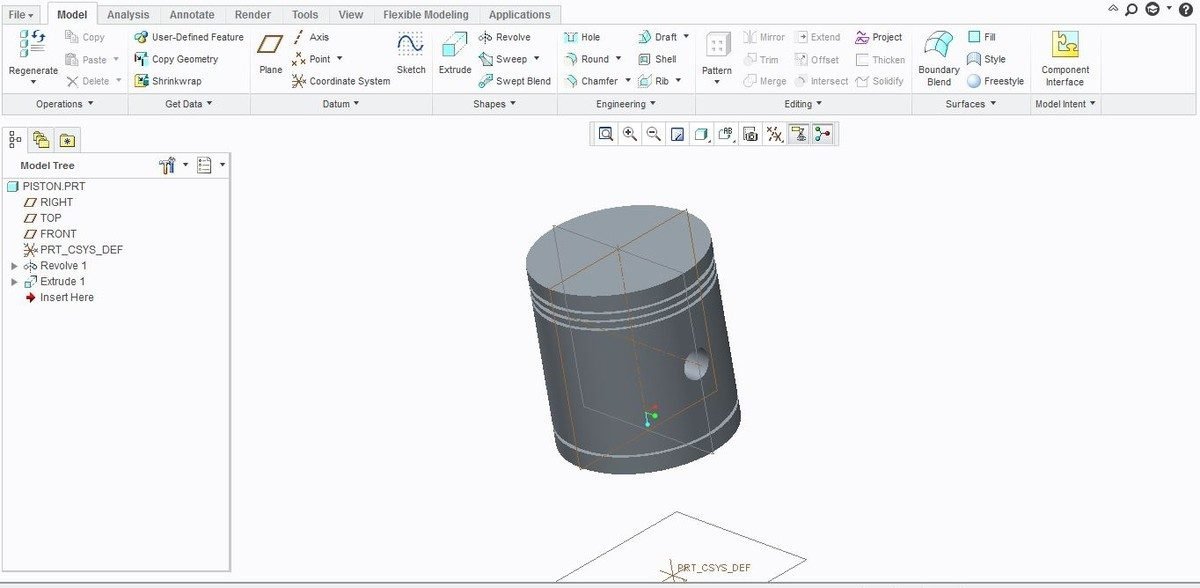
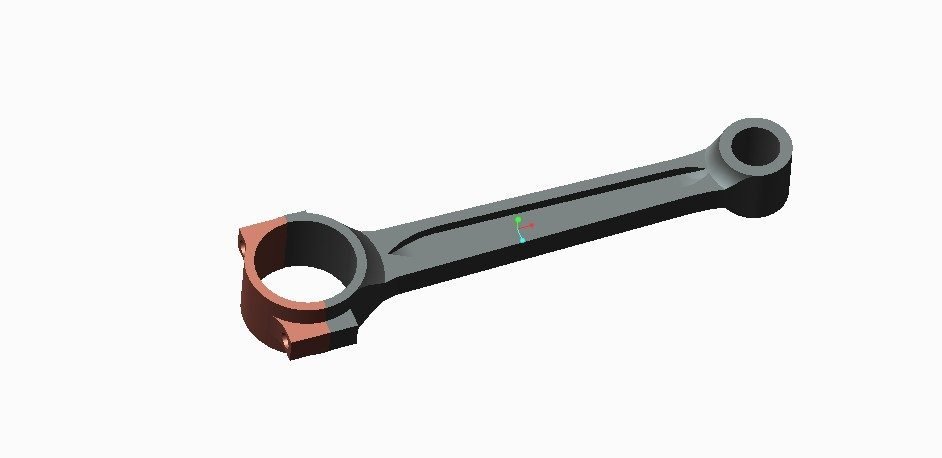
The piston receives the push of the burning gases in the cylinder and passes it to the crankshaft through the connecting rod. The piston crown faces combustion temperatures and pressures on every power stroke, while also having to carry heat away to the cylinder walls through its rings. The connecting rod carries the gas force as compression and the inertia of the piston as tension. Both parts must be strong and light, because lighter reciprocating parts allow higher engine speeds with less vibration.
Design Calculations
The piston and connecting rod are designed for a two-wheeler engine with a maximum power of 13.8 bhp at 8500 rpm and a maximum torque of 13.4 Nm at 6000 rpm. From the engine data, the maximum gas pressure works out to about 15.4 N/mm², and the main dimensions of the piston crown, ring lands, skirt and pin are calculated from standard design equations.
About the Project
The parts are modelled in CAD and analysed in FEA:
- Piston static analysis: a gas pressure of 12 MPa on the crown, for the original piston and for a modified piston with the ring thickness reduced by 2 mm.
- Piston thermal analysis: convection at 650 °C on the crown (7 × 10⁻⁴ W/mm²·°C), and at 225 °C and 180 °C on the ring and skirt areas.
- Connecting rod static analysis: a pressure of 8 MPa.
The piston is compared in steel and aluminium alloy. The connecting rod is compared in an aluminium alloy and an aluminium composite reinforced with silicon carbide and fly ash.
Software Used
- CAD: piston and connecting rod modelling
- FEA: static structural and steady-state thermal analysis
Piston Static Results
| Piston design | Material | Stress (MPa) | Shear stress (MPa) | Safety factor |
|---|---|---|---|---|
| Original | Steel | 261.2 | 137.86 | 1.072 |
| Original | Aluminium alloy | 255.77 | 135.1 | 1.388 |
| Modified rings | Steel | 163.48 | 88.195 | 1.7127 |
| Modified rings | Aluminium alloy | 159.3 | 86.091 | 2.288 |
Piston Thermal Results
| Piston design | Material | Max temperature (°C) | Total heat flux (W/mm²) |
|---|---|---|---|
| Original | Steel | 288.6 | 0.63589 |
| Original | Aluminium alloy | 252.37 | 1.1611 |
| Modified rings | Steel | 292.76 | 0.91837 |
| Modified rings | Aluminium alloy | 258.59 | 1.5507 |
Connecting Rod Results
| Material | Deformation (mm) | Stress (MPa) | Safety factor |
|---|---|---|---|
| Aluminium alloy (Al-3600) | 0.2476 | 111.8 | 1.5206 |
| Al-SiC-fly ash composite | 0.21226 | 111.8 | 3.247 |
Reducing the ring thickness lowers the piston stress for both materials. The full discussion and the final recommendation are explained in our live class or recorded video for this project.
Real-World Applications
- Motorcycles and scooters: single cylinder engines.
- Cars: multi-cylinder petrol and diesel engines.
- Small generators and pumps.
- Aluminium metal matrix composites for lightweight engine parts.
Key Concepts Covered
- Piston design calculations from engine power and torque.
- Design optimisation by changing ring geometry.
- Thermal loading of piston crowns.
- Metal matrix composites: SiC and fly ash reinforcement.
Project Workflow
- Calculate piston and connecting rod dimensions from engine data.
- Model the piston, modified piston and connecting rod.
- Run static and thermal analysis of the piston in steel and aluminium alloy.
- Run static analysis of the connecting rod in two materials.
- Compare results in the report.
Why This Project Matters
The piston and connecting rod are among the most stressed parts of any engine. This project combines design calculations, optimisation and FEA, a complete package for mechanical and automobile students.
Related Projects
Explore more design and analysis projects on similar topics:
- Engine Rocker Arm Design and Analysis: Static and Modal with Steel and Carbon Steel
- Single Cylinder Crankshaft Design and Analysis: Cast Iron, EN9, SAE 1045 and SAE 1137
- Petrol Engine Flywheel Design and Analysis: Steel, 440C, CFRP and Al-7075
- Design and Thermal Analysis of a Radial Engine Master Rod and Articulated Rod: Mild Steel vs Mg-8Al-0.5Zn and ZK60 (CAD and FEA)
What Support You Get
- Design guidance: how to build the CAD model yourself – CAD models of the original and modified piston and the connecting rod, with design calculations
- Analysis guidance: how to set up and run the analysis yourself – FEA static structural and steady-state thermal files for the piston, and static files for the connecting rod
- Report guidance: how to structure your own report – methodology, results and conclusion
- Live class: a step-by-step explanation of the method while you work on your own licensed software, so you can understand it and present your work confidently
Studying abroad? We guide you too – learn to build projects like this in our live classes, on your own licensed software.
Who Is This Project For?
This project is a good learning example for B.Tech and B.E. final year students, diploma students who want to learn design and analysis, and M.Tech students who want to learn a method they can extend in their own thesis. It is also useful for anyone who wants to learn engine component design calculations, CAD modelling and FEA structural and thermal analysis on a real engineering problem instead of a textbook example.
Frequently Asked Questions
Which engine is the piston designed for?
A two-wheeler engine with 13.8 bhp at 8500 rpm and 13.4 Nm at 6000 rpm.
How is the piston optimised?
The piston ring thickness is reduced by 2 mm and the modified piston is analysed with the same loads.
What thermal loads are applied?
Convection at 650 °C on the crown, with lower temperatures of 225 °C and 180 °C on the ring and skirt areas.
Which materials are used for the connecting rod?
An aluminium alloy and an aluminium composite reinforced with silicon carbide and fly ash.
Learn the Piston and Connecting Rod Project With Us
Want to learn this project for your final year, mini project or M.Tech work? Message us with your university, branch and deadline, and we will share a learning plan – live classes and step-by-step guidance while you build it yourself.
Enquire about this project on WhatsApp or use the enquiry form on our home page. Browse more mechanical projects or 60+ mechanical engineering project ideas.
Interested in this project? Get the details, files and guidance from our team.
Enquire on WhatsApp