
Wheeled robots move fast on flat floors but struggle on rough ground, steps and loose soil. Legged robots can climb over obstacles, but they usually need many motors and complex control. A six-leg robot with C-shaped (half-circle) legs sits between the two: each leg rotates like a wheel, yet its curved shape lets it step over rocks and edges. This project presents the design of such a six-leg robot and a structural check of its main body.
Design Concept
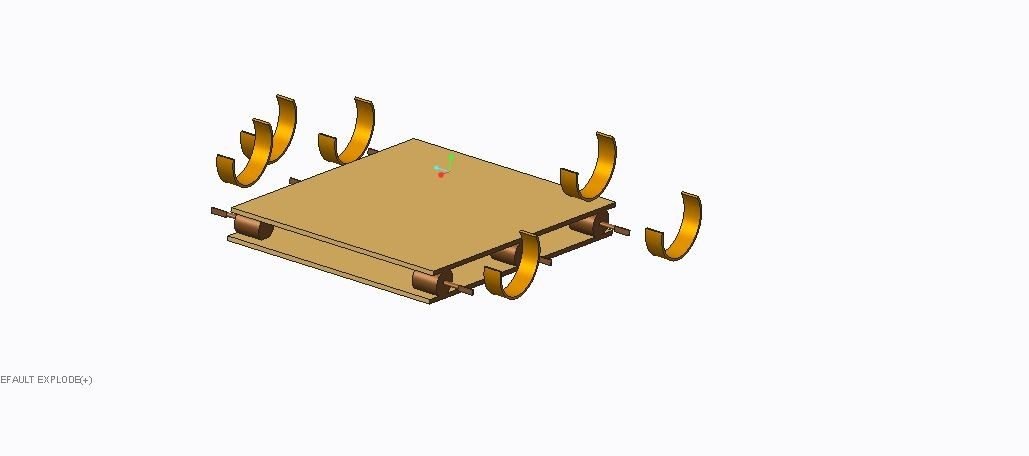
The robot was modelled in Creo. It has a flat rectangular body made of two parallel plates, with three C-shaped legs on each side – six legs in total. Each leg is driven by its own shaft, so the robot can walk forward by rotating the legs in an alternating pattern, keeping three legs on the ground at any time for stability.

Main Components
- Body plates – a top and a bottom plate that carry the motors, battery and electronics.
- C-shaped legs – six curved legs that act as both wheels and feet.
- Leg shafts and mounts – connect each leg to its drive through the side of the body.
- Spacers – hold the two body plates at a fixed gap.

C-Leg Design
The leg is drawn as a curved strip with a defined inner radius and width. The open half-circle shape lets the leg roll smoothly on flat ground and hook over an obstacle when it meets one. Because the leg is a single curved part, it can also flex slightly and absorb shocks while walking.

Structural Analysis of the Body
The body plate carries every other component, so it was checked in ANSYS static structural analysis. The plate was supported at the leg mounting points and loaded with the weight of the parts it carries. Total deformation and equivalent (von Mises) stress were calculated to see where the plate bends most and where the stress is highest.
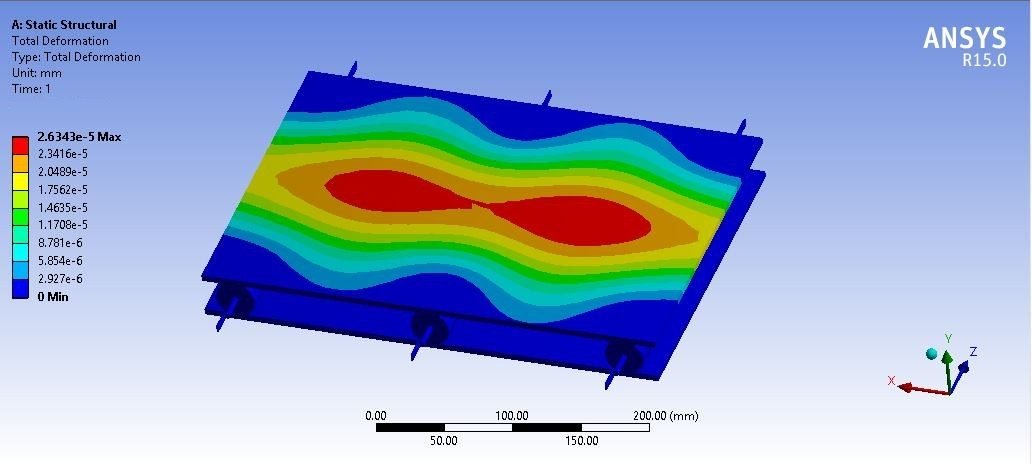
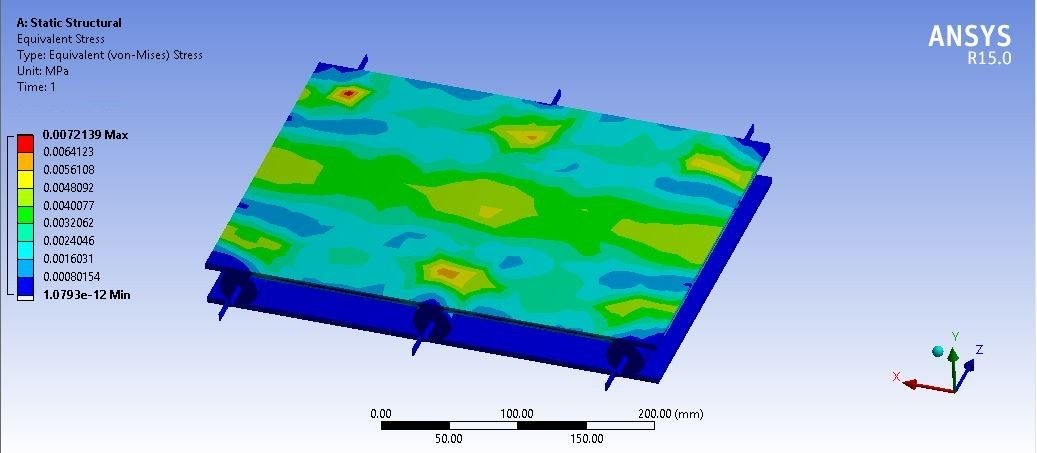
The contours show the deflection concentrated in the middle of the plate between the supports, while stress gathers around the mounting points. The load values, material choice and full result values are explained in the project report.
Why This Design Matters
C-leg robots need only one motor per leg, which keeps them simple and light compared with robots that have two or three joints per leg. That makes them a popular choice for student projects, search-and-rescue prototypes and field robots that must cross uneven ground. Checking the body plate early makes sure the frame is stiff enough before motors and electronics are added.
Real-World Applications
- Search-and-rescue robots for rubble and debris
- Inspection robots for pipes, farms and construction sites
- Planetary and terrain-exploration prototypes
- Mechatronics and robotics final-year projects
Related Projects
Explore more design and analysis projects on similar topics:
- Pipeline Inspection Robot Design: Self-Adjusting Wheeled Mechanism for 140–200 mm Pipes (Creo)
- Design and Analysis of a Rocker Bogie Mechanism: Acrylic vs Aluminium Alloy Links with Rubber Wheels (Creo and ANSYS)
- Design and Analysis of a Robot Arm Through Topology Optimization: Square vs Circular Arm with Steel, Al-2048 and Kevlar (SolidWorks and ANSYS)
- Topology Optimization of a Mobile Transport Robot Using Steel 4340, Al 7075 and CFRP (SolidWorks and ANSYS)
What You Get
- Design files: Creo assembly, exploded view and C-leg design of a six-leg robot
- Analysis files: ANSYS static structural analysis of the body plate
- Project document: complete report with methodology, results and conclusion
- Class explanation: a session that explains what was done in the project, step by step, so you can understand and present it confidently
Who Is This Project For?
This project suits B.Tech and B.E. final year students, diploma students looking for a strong design and analysis project, and M.Tech students who need a base model they can extend for their thesis. It is also useful for anyone who wants to learn How C-leg robots walk and how the body frame is checked for deformation and stress on a real engineering problem instead of a textbook example.
Frequently Asked Questions
What is a C-leg robot?
It is a legged robot whose legs are half-circle shaped, so each leg rotates like a wheel but can also step over obstacles.
How many legs does this robot have?
Six legs, three on each side, which keeps three legs on the ground at a time for stable walking.
Which software was used?
Creo for the 3D design and ANSYS for the static structural analysis of the body plate.
Are the analysis results included?
Deformation and stress contours are shown here; the loads, material and full results are explained in the project report.
Get the Six Leg Robot Project
Want this project for your final year, mini project or M.Tech work? Message us with your university, branch and deadline, and we will share the exact scope, files and report format.
Enquire about this project on WhatsApp or use the enquiry form on our home page. Browse more mechanical projects or 60+ mechanical engineering project ideas.
Interested in this project? Get the details, files and guidance from our team.
Enquire on WhatsApp