
The rocker bogie mechanism is the suspension system used on NASA’s Mars rovers, including Sojourner, Spirit, Opportunity, Curiosity and Perseverance. It lets a six-wheeled vehicle climb over rocks and obstacles nearly as tall as its wheel diameter while keeping all six wheels on the ground, without using any springs. Today, the same idea is used in planetary rovers, stair-climbing robots, military and rescue robots, and even wheelchairs. This project models a rocker bogie mechanism and analyses its links and wheels to find a stronger material combination.
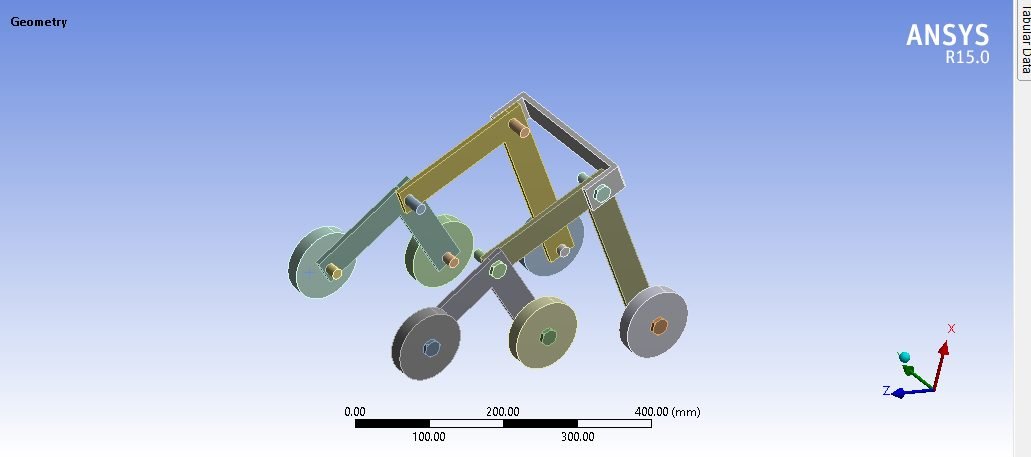
How the Rocker Bogie Works
On each side of the vehicle, a large link called the rocker is connected to the body by a pivot. One end of the rocker carries a wheel, and the other end carries a smaller link called the bogie, which holds two more wheels. The two rockers are connected to each other through a differential so that when one side rises, the body tilts by only half as much. Because there are no springs, the wheels push evenly on the ground, giving good grip and a stable body even on very rough terrain.
About the Project
The rocker, bogie, links and wheels are modelled in Creo using reference dimensions and assembled into the complete mechanism. The model is imported into ANSYS Workbench, meshed with a tetrahedral volume mesh and supported at the wheels. A moment of 2000 N-mm is applied, along with forces of 100 N, 120 N and 150 N to represent increasing payloads.
Two material combinations are compared:
- Existing: acrylic links (yield strength 30 MPa) with rubber wheels (yield strength 7 MPa)
- Modified: aluminium alloy links (yield strength 250 MPa) with rubber wheels
For each load and material combination, the total deformation, equivalent stress, strain and shear stress are calculated. A modal analysis then finds the natural frequencies of both designs to check their behaviour under vibration.

Software Used
- Creo: modelling and assembly of the rocker bogie mechanism
- ANSYS Static Structural: deformation, stress, strain and shear stress
- ANSYS Modal: natural frequencies and mode shapes
Analysis Results
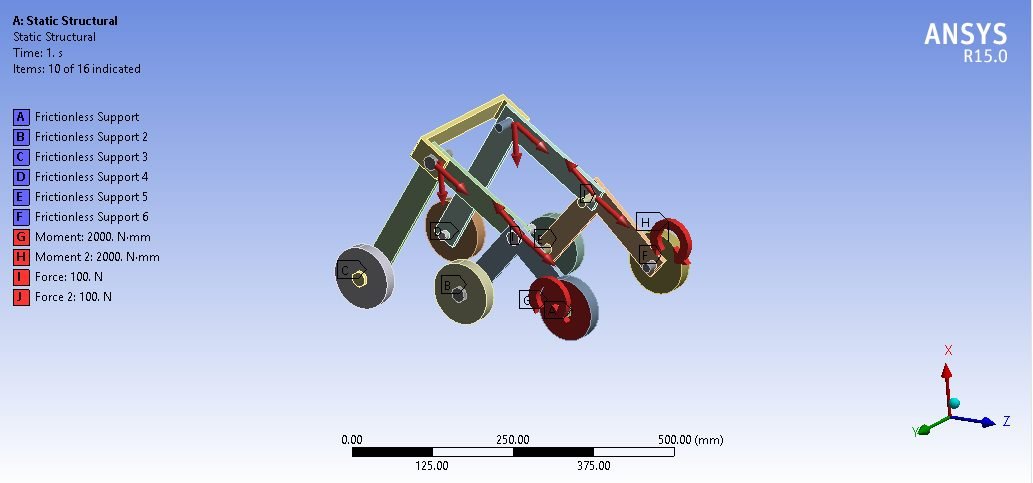


Key Results (Preview)
Acrylic links with rubber wheels:
| Load | Deformation (mm) | Stress (MPa) | Shear stress (MPa) |
|---|---|---|---|
| 100 N | 0.59014 | 5.3213 | 3.0107 |
| 120 N | 1.1893 | 6.4027 | 3.62222 |
| 150 N | 1.4866 | 7.9834 | 4.51663 |
Changing the link material reduces the stress values by up to 46%, and the modal analysis shows a large difference in the natural frequency range of the two designs. The full comparison is explained in the project report.
Why This Project Matters
Rover and robot design is an exciting area that combines mechanical design, robotics and space engineering. The rocker bogie is a classic mechanism that is easy to build as a working model and easy to explain in a presentation. This project adds a strong analysis component, showing how material choice affects strength and vibration, which makes it a great choice for mechanical, aeronautical and robotics students.
Related Projects
Explore more design and analysis projects on similar topics:
- Design and Analysis of a Robot Arm Through Topology Optimization: Square vs Circular Arm with Steel, Al-2048 and Kevlar (SolidWorks and ANSYS)
- Topology Optimization of a Mobile Transport Robot Using Steel 4340, Al 7075 and CFRP (SolidWorks and ANSYS)
- Omni Wheel Design and Analysis: Two Omni-Directional Wheel Designs in Nylon and PBT (SolidWorks and ANSYS)
- Design and Analysis of a Versatile Drone and Rover for Crop Care and Farm Optimization (SolidWorks and ANSYS)
What You Get
- Design files: Creo models of the rocker bogie links, wheels and full assembly
- Analysis files: ANSYS Workbench static structural and modal analysis files for both material combinations
- Project document: complete report with methodology, results and conclusion
- Class explanation: a session that explains what was done in the project, step by step, so you can understand and present it confidently
Who Is This Project For?
This project suits B.Tech and B.E. final year students, diploma students looking for a strong design and analysis project, and M.Tech students who need a base model they can extend for their thesis. It is also useful for anyone who wants to learn rover suspension design, link analysis and modal analysis in ANSYS on a real engineering problem instead of a textbook example.
Frequently Asked Questions
Where is the rocker bogie mechanism used?
It is best known from NASA Mars rovers such as Curiosity and Perseverance. It is also used in planetary and lunar rovers, stair-climbing robots, military and rescue robots, agricultural robots and some all-terrain wheelchairs.
Why does the rocker bogie not use springs?
Without springs, the links pivot freely so every wheel keeps contact with the ground, and the body does not bounce. This gives even wheel loading, good traction and a stable platform for cameras and instruments on rough terrain.
What loads are applied in the analysis?
A moment of 2000 N-mm is applied along with forces of 100 N, 120 N and 150 N, representing increasing payloads. The wheels are supported so that the response of the links and wheels can be studied.
Which CAD software is used in this project?
The rocker bogie model is created in Creo using reference dimensions, and it is analysed in ANSYS Workbench for static structural and modal behaviour.
Get the Rocker Bogie Mechanism Analysis Project
Want this project for your final year, mini project or M.Tech work? Message us with your university, branch and deadline, and we will share the exact scope, files and report format.
Enquire about this project on WhatsApp or use the enquiry form on our home page. Browse more mechanical projects or 60+ mechanical engineering project ideas.
Interested in this project? Get the details, files and guidance from our team.
Enquire on WhatsApp