
Farming has moved from manual labour with simple tools to machines, automated irrigation and precise inputs. The next step is smart farming, where drones and ground robots monitor crops, spray only where needed and reach places that are hard or unsafe for people. This project designs a versatile drone and rover that work together for crop care and farm optimization, and that can also support disaster management by surveying damaged areas and delivering aid over rough terrain.
Why a Drone and a Rover Together?
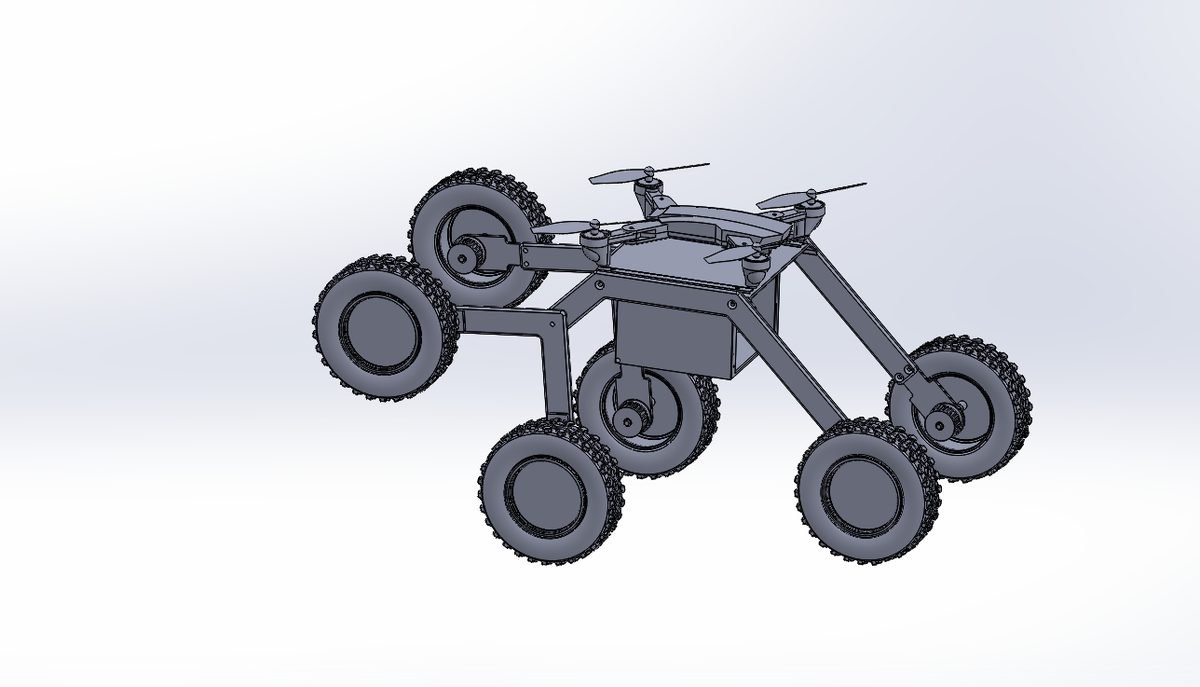
A drone can cover a large field quickly from the air, take images, find stressed or diseased crop patches and spray small areas. However, it has limited battery life and payload. A rover moves on the ground, can carry heavier loads such as fertiliser, seeds or sensors, and can work for longer. When the two are combined, the drone finds the problem from above and the rover carries out the heavier work on the ground, giving farmers a complete and efficient system. In this design, the drone can sit on top of the rover, so the rover also acts as its carrier and landing base.
About the Project
Both machines are modelled in SolidWorks. The drone is a quadcopter with a central body, four arms and propellers. The rover has a six-wheel, rocker-type chassis suited to uneven farm ground. The models are imported into ANSYS Workbench, where boundary conditions and loads are applied to simulate real use, and the deformation, stress, strain and safety factor of the main load-carrying parts are calculated.
Two materials are compared for each machine:
- Drone frame: ABS plastic (density 1050 kg/m³, yield strength 40 MPa) and polycarbonate (density 1200 kg/m³, yield strength 65 MPa)
- Rover chassis: SAE 1020 steel (density 7870 kg/m³, yield strength 350 MPa) and Al-7475 aluminium alloy (density 2810 kg/m³)


Software Used
- SolidWorks: 3D modelling of the drone, rover and combined assembly
- ANSYS Workbench Static Structural: deformation, stress, strain and safety factor
Analysis Results


Key Results (Preview)
| Drone frame | ABS | Polycarbonate |
|---|---|---|
| Total deformation (mm) | 9.7041 | 8.7776 |
| Equivalent stress (MPa) | 27.086 | 27.479 |
| Safety factor | 1.4768 | 2.3654 |
| Rover chassis | SAE 1020 steel | Al-7475 |
|---|---|---|
| Total deformation (mm) | 0.14344 | 0.040276 |
| Equivalent stress (MPa) | 10.787 | 8.0233 |
The results show clear differences between the materials in both machines. The detailed discussion and the final material recommendation for the drone and the rover are given in the project report.
Applications
- Crop health monitoring and field surveying
- Targeted spraying of fertilisers and pesticides
- Carrying seeds, tools and sensors across the field
- Surveying flood or disaster areas and delivering aid supplies
Why This Project Matters
Drones and agricultural robots are among the fastest-growing technologies in India, supported by government schemes for drone use in farming. This project lets students work on both an aerial and a ground vehicle in one study, covering design, material selection and structural analysis. It fits well for mechanical, aeronautical and agricultural engineering students who want a modern, application-focused project.
Related Projects
Explore more design and analysis projects on similar topics:
- Stair Climbing Robot Trolley Design and Analysis – Steel, SS 304, SS 316 and Al-7075
- Six-Leg Robot with C-Shaped Legs – Design in Creo and Body Structural Analysis
- Pipeline Inspection Robot Design: Self-Adjusting Wheeled Mechanism for 140–200 mm Pipes (Creo)
- Design and Analysis of a Black Hawk UH-60 Helicopter Rotor Blade with SC1095 and SC1095-R8 Airfoils Using GFRP and Flax Fibre (SolidWorks and ANSYS)
What You Get
- Design files: SolidWorks models of the drone, the six-wheel rover and the combined drone-rover assembly
- Analysis files: ANSYS Workbench static structural files for the drone (ABS, polycarbonate) and rover (SAE 1020, Al-7475)
- Project document: complete report with methodology, results and conclusion
- Class explanation: a session that explains what was done in the project, step by step, so you can understand and present it confidently
Who Is This Project For?
This project suits B.Tech and B.E. final year students, diploma students looking for a strong design and analysis project, and M.Tech students who need a base model they can extend for their thesis. It is also useful for anyone who wants to learn drone design, robotic vehicle design and structural analysis in ANSYS on a real engineering problem instead of a textbook example.
Frequently Asked Questions
How can drones help in agriculture?
Drones can survey large fields quickly, capture images to find stressed or diseased crops, and spray fertilisers or pesticides only where needed. This saves water, chemicals and labour, and gives farmers faster information about their crops.
Why is a rover combined with the drone?
A drone has limited battery life and payload, while a ground rover can carry heavier loads and work for longer. Together, the drone finds problems from the air and the rover does the heavier work on the ground, and the rover can also carry the drone.
Which materials are compared for the drone and rover?
For the drone frame, ABS plastic and polycarbonate are compared. For the rover chassis, SAE 1020 steel and Al-7475 aluminium alloy are compared. Each is checked for deformation, stress, strain and safety factor in ANSYS.
Which software is used?
SolidWorks is used to model the quadcopter drone, the six-wheel rover and the combined assembly, and ANSYS Workbench Static Structural is used for the structural analysis of the main load-carrying parts.
Get the Agriculture Drone and Rover Design Project
Want this project for your final year, mini project or M.Tech work? Message us with your university, branch and deadline, and we will share the exact scope, files and report format.
Enquire about this project on WhatsApp or use the enquiry form on our home page. Browse more mechanical projects or 60+ mechanical engineering project ideas.
Interested in this project? Get the details, files and guidance from our team.
Enquire on WhatsApp