
A heat exchanger is a device that transfers heat from one fluid to another without letting them mix. The double pipe heat exchanger is the simplest type: one pipe runs inside a larger pipe, the hot fluid flows through one of them and the cold fluid through the other, and heat passes through the wall of the inner pipe. It is cheap, rugged, easy to clean and handles high temperatures and pressures well, so it is widely used in chemical plants, food processing, oil coolers and HVAC systems. This project uses CFD to compare parallel flow and counter flow arrangements and to check whether adding Al2O3 nanoparticles to water improves heat transfer.

Parallel Flow vs Counter Flow
In a parallel flow heat exchanger, the hot and cold fluids enter at the same end and move in the same direction. The temperature difference is large at the inlet but shrinks quickly along the length, so the cold fluid can never get hotter than the hot fluid’s outlet temperature. In a counter flow heat exchanger, the two fluids enter from opposite ends and move in opposite directions. This keeps a more even temperature difference along the whole length, so counter flow can usually transfer more heat for the same size. Comparing the two in CFD shows these differences clearly in the temperature contours.
About the Project
The hot pipe, cold pipe and full assembly are modelled in SolidWorks. A static structural analysis in ANSYS first checks that the pipes can safely take an internal pressure of 5 MPa, comparing steel and EN-9 steel. The model is then analysed in ANSYS Fluent with these boundary conditions:
- Cold fluid inlet temperature: 298 K, mass flow rate 0.017 kg/s
- Hot fluid inlet temperature: 333 K, mass flow rate 0.0238 kg/s
Three working fluids are compared in both parallel and counter flow:
- Water (thermal conductivity 0.6 W/m-K)
- Water + 0.025% Al2O3 nanoparticles
- Water + 0.1% Al2O3 nanoparticles
For each case, the pressure, temperature and velocity in the hot and cold domains, the inlet and outlet temperatures and the heat transfer coefficient are found.

Software Used
- SolidWorks: 3D models of the pipes and assembly
- ANSYS Static Structural: deformation, stress and safety factor under 5 MPa
- ANSYS Fluent: CFD analysis of pressure, temperature and velocity
Analysis Results
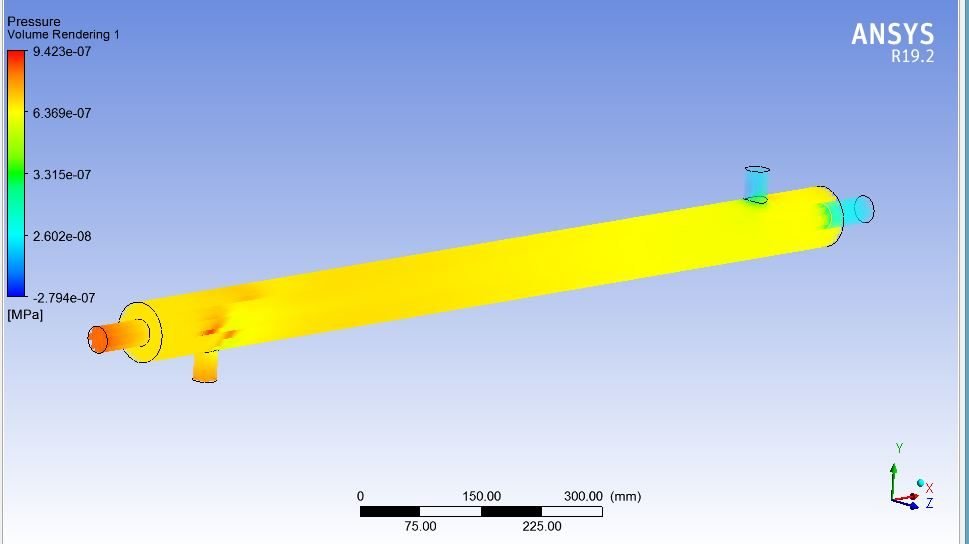

Key Results (Preview)
| Outlet temperatures (K) | Water | Water + 0.025% Al2O3 | Water + 0.1% Al2O3 |
|---|---|---|---|
| Parallel flow, cold outlet | 309.972 | 319.287 | 319.27634 |
| Parallel flow, hot outlet | 311.932 | 310.936 | 310.886 |
| Counter flow, cold outlet | 325.51438 | 330.94579 | 330.924 |
| Counter flow, hot outlet | 298.57866 | 299.33165 | 299.3064 |
The nanoparticles increase the fluid velocity and the pressure on the walls, but the pressure stays well under the yield limit. The full pressure, velocity and heat transfer coefficient results, and the final recommendation on which flow arrangement benefits from Al2O3 nanofluids, are given in the report.
Why This Project Matters
Heat exchangers are found in almost every industry, and even a small improvement in their performance saves energy and cost over years of operation. Nanofluids are an active research area for compact, high-performance cooling. This project teaches the basics of heat exchanger flow arrangements, CFD setup for two fluid domains, and how to judge whether a new working fluid really helps, making it a solid choice for thermal engineering students.
Related Projects
Explore more design and analysis projects on similar topics:
- Improving the Heat Transfer Rate of an AC Condenser Using Al2O3 & TiC Nanofluids (CFD and Structural Analysis in ANSYS)
- CFD and Thermal Analysis of a Car Radiator Using MgO–Silver and MgO–Graphene Hybrid Nanofluids (SolidWorks and ANSYS Fluent)
- Air Conditioner Efficiency Improvement Using Condensate Water Subcooling
- Li-ion Battery Pack Thermal Management with Paraffin PCM and Copper Tube Water Cooling (SolidWorks and ANSYS)
What You Get
- Design files: SolidWorks models of the hot pipe, cold pipe and double pipe heat exchanger assembly
- Analysis files: ANSYS Fluent CFD files for parallel and counter flow with water and both Al2O3 nanofluids, plus static structural files
- Project document: complete report with methodology, results and conclusion
- Class explanation: a session that explains what was done in the project, step by step, so you can understand and present it confidently
Who Is This Project For?
This project suits B.Tech and B.E. final year students, diploma students looking for a strong design and analysis project, and M.Tech students who need a base model they can extend for their thesis. It is also useful for anyone who wants to learn heat exchanger design, CFD analysis and nanofluid heat transfer in ANSYS Fluent on a real engineering problem instead of a textbook example.
Frequently Asked Questions
What is a double pipe heat exchanger?
It is the simplest heat exchanger, made of one pipe inside another. The hot fluid flows through one pipe and the cold fluid through the other, and heat passes through the wall of the inner pipe without the two fluids mixing.
Which is better, parallel flow or counter flow?
In counter flow, the fluids move in opposite directions, which keeps a more even temperature difference along the length, so it usually transfers more heat for the same size. This project compares both arrangements in ANSYS Fluent to show the difference clearly.
What nanofluids are used in this project?
Two Al2O3 (aluminium oxide) nanofluids are used: water with 0.025% Al2O3 and water with 0.1% Al2O3. Their results are compared with plain water in both parallel and counter flow.
What boundary conditions are applied?
The cold fluid enters at 298 K with a mass flow rate of 0.017 kg/s, and the hot fluid enters at 333 K with a mass flow rate of 0.0238 kg/s. A static structural check is also done with an internal pressure of 5 MPa.
Get the Double Pipe Heat Exchanger CFD Project
Want this project for your final year, mini project or M.Tech work? Message us with your university, branch and deadline, and we will share the exact scope, files and report format.
Enquire about this project on WhatsApp or use the enquiry form on our home page. Browse more mechanical projects or 60+ mechanical engineering project ideas.
Interested in this project? Get the details, files and guidance from our team.
Enquire on WhatsApp