
The rotor blades of a helicopter do the work of both the wings and the propeller of an aeroplane. As the engine turns the rotor hub, each blade moves through the air and, because it has an airfoil shape, it produces lift. By changing the angle of the blades, the pilot can make the helicopter climb, hover, or fly forward, sideways and backward. While producing lift, the blades also carry heavy bending and centrifugal loads along their length, so their shape and material must give good aerodynamic performance and high structural strength. This project designs a rotor blade for the Sikorsky UH-60 Black Hawk helicopter and compares two airfoil shapes and two composite materials.
About the UH-60 Black Hawk
The UH-60 Black Hawk is a four-blade, twin-engine medium-lift utility helicopter used by many armed forces around the world for troop transport, medical evacuation and search and rescue. Its main rotor blades use the SC1095 family of airfoils, which were developed specially for helicopter rotors to give good lift with low drag and low pitching moment. The SC1095-R8 is a variant with extra camber, used on the inner part of the blade for higher lift.
About the Project
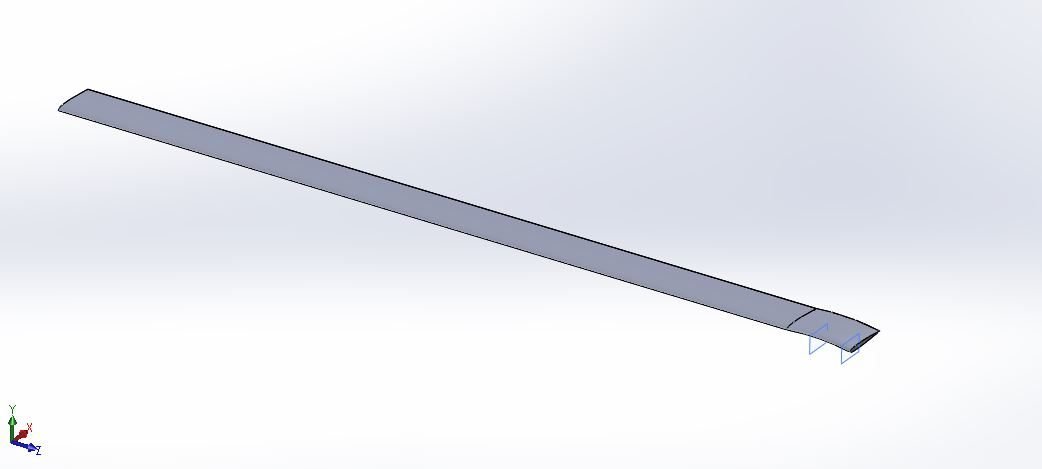
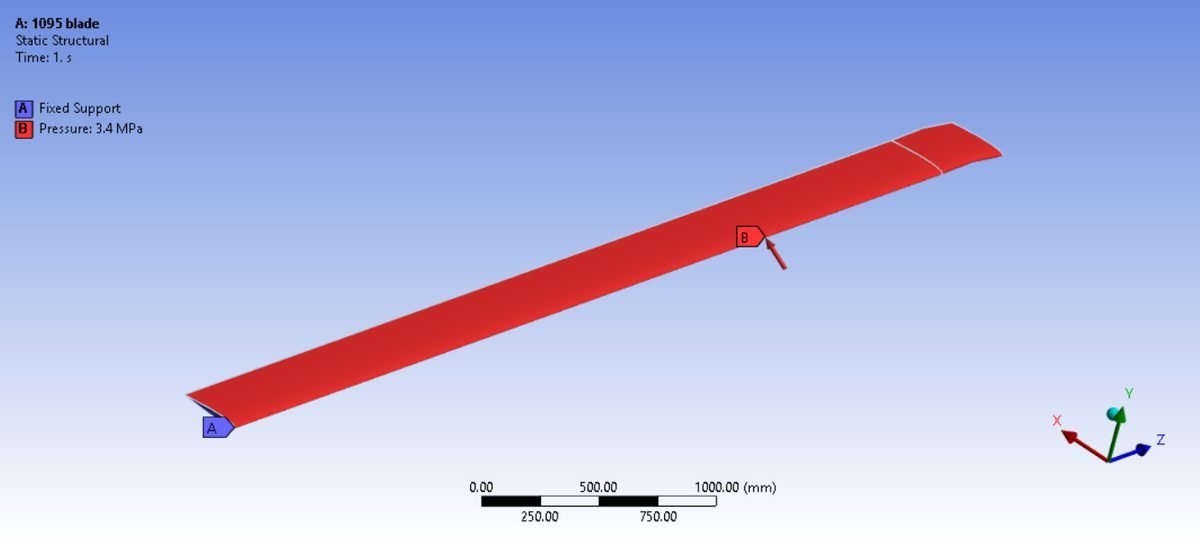
The coordinates of both airfoils are imported as key points into SolidWorks, and each airfoil is extruded into a blade 4.6 metres long. The loft feature is used to create the blade tilt angle. The two blade models are imported into ANSYS Workbench, meshed and analysed with the blade root fixed and pressure applied on the blade surface.
Two composite materials are compared for each airfoil:
- GFRP (glass fibre reinforced polymer): a strong, stiff and impact-resistant synthetic composite widely used in aerospace
- Flax fibre composite: a natural-fibre composite that is lighter and more eco-friendly
Two types of analysis are carried out:
- Static structural analysis: total deformation, stress, strain and safety factor
- Modal analysis: the first six natural frequencies and mode shapes, which show how the blade will vibrate as it rotates

Software Used
- SolidWorks: airfoil import and rotor blade modelling
- ANSYS Static Structural: deformation, stress, strain and safety factor
- ANSYS Modal: natural frequencies and mode shapes
Analysis Results


Key Results (Preview)
| SC1095 blade | Flax fibre | GFRP |
|---|---|---|
| Total deformation (mm) | 115.93 | 180.21 |
| Equivalent stress (MPa) | 529.81 | 569.95 |
| Safety factor | 1.8875 | 2.1055 |
Each material has its own strength: one deforms less, while the other gives a higher safety factor. The SC1095-R8 results, the modal frequencies for all four cases and the recommended airfoil and material combination are explained in the project report.
Why This Project Matters
Rotor blade design is one of the most challenging areas of aerospace engineering, combining aerodynamics, composite materials and vibration. Natural fibre composites like flax are a growing research topic because they can reduce weight and environmental impact. This project gives aeronautical and mechanical students hands-on experience with real helicopter airfoils, composite material comparison and modal analysis, and it is a strong base for an M.Tech thesis.
Related Projects
Explore more design and analysis projects on similar topics:
- Aircraft Disc Brake Rotor Design and Analysis: Al Metal Matrix Composite vs Al-7075 and CFRP (Structural, Thermal and Modal, ANSYS)
- Optimization and Analysis of an Aircraft Wheel Hub with Lightweight Aluminium Alloys and Development of a Prototype Model (SolidWorks, ANSYS and FDM)
- Propeller (Drive) Shaft Design and Analysis: Steel vs EN-9, Al-2024, CFRP, Kevlar and More (Static, Modal and Harmonic, ANSYS)
- Engine Cooling Fan Design and Analysis: Static, Modal and CFD
What You Get
- Design files: SolidWorks models of the SC1095 and SC1095-R8 rotor blades, with airfoil key point files
- Analysis files: ANSYS Workbench static structural and modal analysis files for both airfoils and both materials
- Project document: complete report with methodology, results and conclusion
- Class explanation: a session that explains what was done in the project, step by step, so you can understand and present it confidently
Who Is This Project For?
This project suits B.Tech and B.E. final year students, diploma students looking for a strong design and analysis project, and M.Tech students who need a base model they can extend for their thesis. It is also useful for anyone who wants to learn helicopter rotor blade design, composite material analysis and modal analysis in ANSYS on a real engineering problem instead of a textbook example.
Frequently Asked Questions
What airfoils are used on the UH-60 Black Hawk rotor blade?
The UH-60 main rotor uses the SC1095 family of airfoils. The SC1095-R8 is a variant with extra camber for higher lift. This project builds one blade with each airfoil so that their structural behaviour can be compared.
Why compare GFRP and flax fibre?
GFRP is a proven aerospace composite with high strength and stiffness. Flax fibre composite is a natural, lighter and more eco-friendly alternative. Comparing them shows whether a natural fibre can compete with a synthetic composite in a demanding application.
What is the length of the blade model?
Each airfoil is extruded into a blade 4.6 metres long in SolidWorks, and the loft feature is used to create the blade tilt angle before the model is imported into ANSYS.
Why is modal analysis important for rotor blades?
A rotor blade spins continuously, so if its natural frequency matches a forcing frequency from the rotor, it can resonate and fail. Modal analysis finds the first six natural frequencies so designers can make sure the blade avoids resonance.
Get the Black Hawk UH-60 Rotor Blade Project
Want this project for your final year, mini project or M.Tech work? Message us with your university, branch and deadline, and we will share the exact scope, files and report format.
Enquire about this project on WhatsApp or use the enquiry form on our home page. Browse more mechanical projects or 60+ mechanical engineering project ideas.
Interested in this project? Get the details, files and guidance from our team.
Enquire on WhatsApp