
An internal combustion engine turns only part of its fuel energy into useful work. A large share, roughly 30 to 35 percent of the heat released in the combustion chamber, has to be carried away by the cooling system, otherwise the engine overheats. The engine cooling fan is a key part of that system. It pulls air through the radiator, or blows it over the fins of an air-cooled engine, so that heat leaves the engine fast enough. Because the fan spins continuously at high speed, its blades must be strong enough to resist the air loads and centrifugal force, and stiff enough not to vibrate dangerously. This project designs a cooling fan and checks its structural and aerodynamic behaviour.
Fan Design
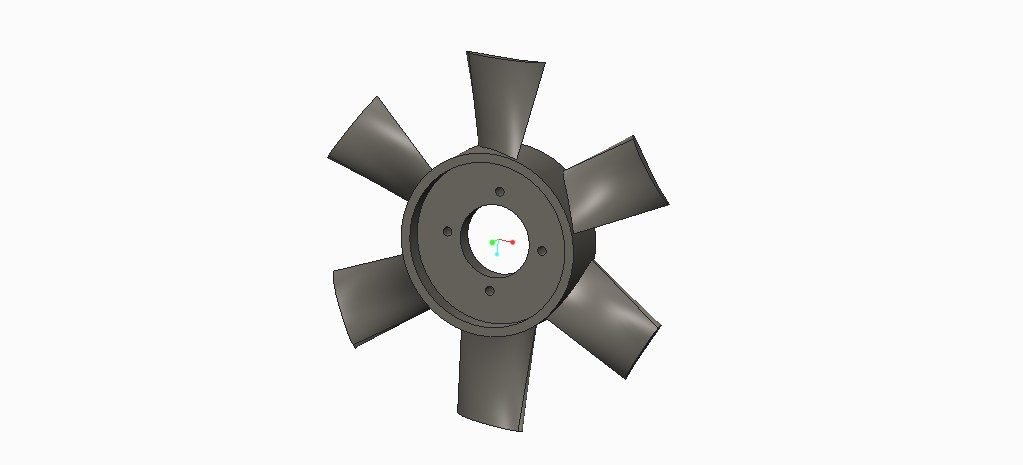
The fan has a central hub with six twisted blades. A blade is twisted because the speed of the air relative to the blade changes from the hub to the tip. The design uses blade angles calculated at the hub, middle and tip:
| Blade section | Angle α (= Φ) | Angle β (= θ) |
|---|---|---|
| At hub | 1.5° | 53° |
| At mid | 2.2° | 54.6° |
| At tip | 3° | 56° |
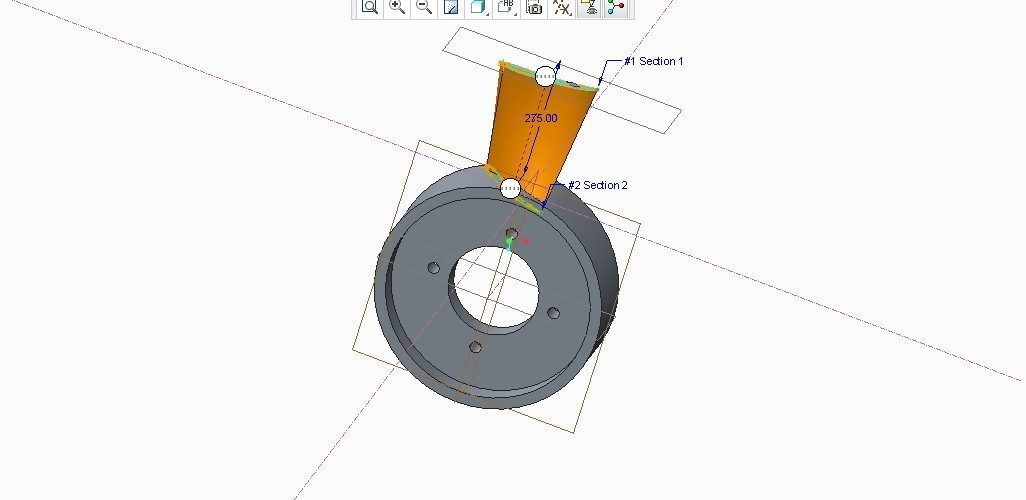
The hub and one blade are modelled first, and the blade is then patterned around the hub to form the complete fan.
About the Project
The fan is modelled in CAD and analysed in FEA in three stages:
- Static structural analysis: the centre hole of the hub is fixed, a pressure of 12.5 MPa is applied on the blades and the fan rotates at 2500 rpm. This gives deformation, stress, strain and safety factor.
- Modal analysis: the first six natural frequencies and mode shapes, to check that the fan does not resonate in service.
- CFD analysis: the fan is placed inside an air domain with an inlet speed of 32.6 m/s (violent-storm wind speed) and a fan speed of 4500 rpm, at a temperature below 60 °C, to study the pressure and velocity of the air around the blades.
Lightweight materials that are easy to cast or mould are compared with the existing fan material, because a lighter fan needs less power to drive and puts less load on the bearings.
Software Used
- CAD: hub, twisted blade and fan modelling
- FEA: static structural and modal analysis
- CFD software: CFD of airflow around the fan
Analysis Setup
The structural, modal and CFD results for each material, with the comparison and final recommendation, are provided in our live class or recorded video for this project.
Real-World Applications
- Automotive radiators: engine-driven and electric radiator fans in cars, trucks and buses.
- Air-cooled engines: fans that blow air over the cylinder fins of small engines and generators.
- Aircraft engines: cooling airflow for piston engine bays and accessory zones.
- Industrial cooling: fans for heat exchangers, compressors and cooling towers.
Key Concepts Covered
- Blade twist: why blade angles change from hub to tip.
- Centrifugal loading: stresses caused by high-speed rotation.
- Natural frequency: avoiding resonance in rotating parts.
- CFD setup: air domain, inlet and outlet conditions and rotating fan.
- Material selection: reducing weight while keeping strength.
Project Workflow
- Study engine cooling systems and fan design.
- Calculate blade angles at the hub, middle and tip.
- Model the hub and twisted blades and build the six-blade fan.
- Run static and modal analysis in FEA at 12.5 MPa and 2500 rpm.
- Run CFD and compare all results in the report.
Why This Project Matters
Better cooling fans mean cooler engines, lower power loss and less noise. This project combines blade design, FEA and CFD, so it is a complete final-year project for mechanical and automobile students.
Related Projects
Explore more design and analysis projects on similar topics:
- Steam Turbine Blade with NACA 4412 and 6515: Coupled Field and CFD Analysis
- Gas Turbine Blade Design with NACA 2412, 4412 and 8412: Static, Thermal and CFD
- Centrifugal Compressor Impeller with Splitter Blades: CFD with R134a
- V6 Engine Design in CAD with Ceramic-Coated Piston Concept
What Support You Get
- Design guidance: how to build the CAD model yourself – CAD models of the hub, twisted blades and complete six-blade cooling fan
- Analysis guidance: how to set up and run the analysis yourself – FEA static structural and modal analysis files, and CFD software CFD files for the fan in an air domain
- Report guidance: how to structure your own report – methodology, results and conclusion
- Live class: a step-by-step explanation of the method while you work on your own licensed software, so you can understand it and present your work confidently
Studying abroad? We guide you too – learn to build projects like this in our live classes, on your own licensed software.
Who Is This Project For?
This project is a good learning example for B.Tech and B.E. final year students, diploma students who want to learn design and analysis, and M.Tech students who want to learn a method they can extend in their own thesis. It is also useful for anyone who wants to learn CAD blade modelling, FEA structural and modal analysis and CFD software CFD on a real engineering problem instead of a textbook example.
Frequently Asked Questions
What does an engine cooling fan do?
It moves air through the radiator or over the engine fins so that the 30 to 35 percent of combustion heat handled by the cooling system can be carried away.
Which software is used?
The fan is modelled, analysed for static and modal behaviour, and studied for airflow.
What loads are applied in the static analysis?
The hub centre is fixed, a pressure of 12.5 MPa is applied on the blades, and the fan rotates at 2500 rpm.
What conditions are used in the CFD analysis?
The fan sits in an air domain with an inlet speed of 32.6 m/s and a fan speed of 4500 rpm, at a temperature below 60 °C.
Learn the Engine Cooling Fan Project With Us
Want to learn this project for your final year, mini project or M.Tech work? Message us with your university, branch and deadline, and we will share a learning plan – live classes and step-by-step guidance while you build it yourself.
Enquire about this project on WhatsApp or use the enquiry form on our home page. Browse more mechanical projects or 60+ mechanical engineering project ideas.
Interested in this project? Get the details, files and guidance from our team.
Enquire on WhatsApp