
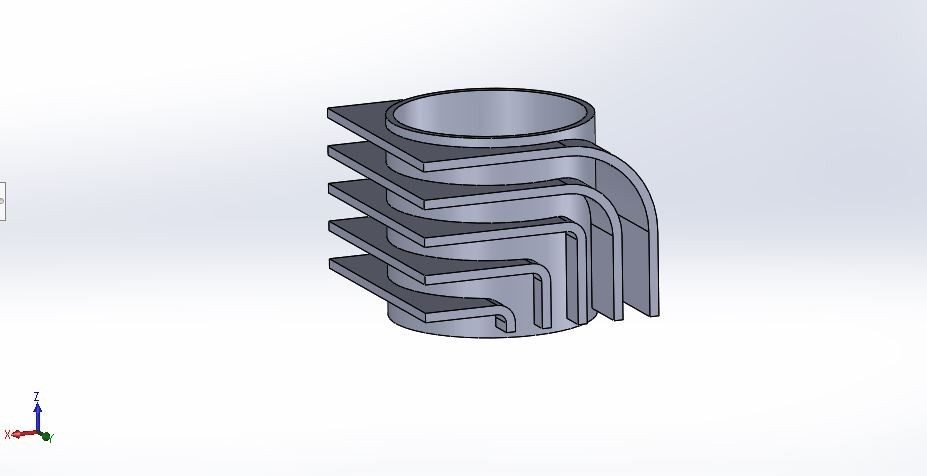
Bikes, scooters, generators and small aircraft engines are often air-cooled. Instead of a water jacket, the cylinder has thin fins on its outside that increase the surface area exposed to air, so that the heat from combustion can escape. If the fins do not remove heat fast enough, the cylinder overheats, the oil breaks down and the engine loses power or seizes. The fin thickness, the gap between fins and the material all affect how well the cylinder cools. This project studies curved fins, which follow the shape of the cylinder head area and guide the airflow around the cylinder.
Fin Designs Studied
Three curved fin designs are modelled with different combinations of fin thickness and gap between fins:
- Design 1: 2.5 mm fin thickness with a 7.5 mm gap.
- Design 2: 2.6 mm fin thickness with a 5.5 mm gap.
- Design 3: 2.25 mm fin thickness with a 7.75 mm gap.
Thicker fins conduct heat better, while wider gaps let more air pass between them, so each design balances these effects differently.
About the Project
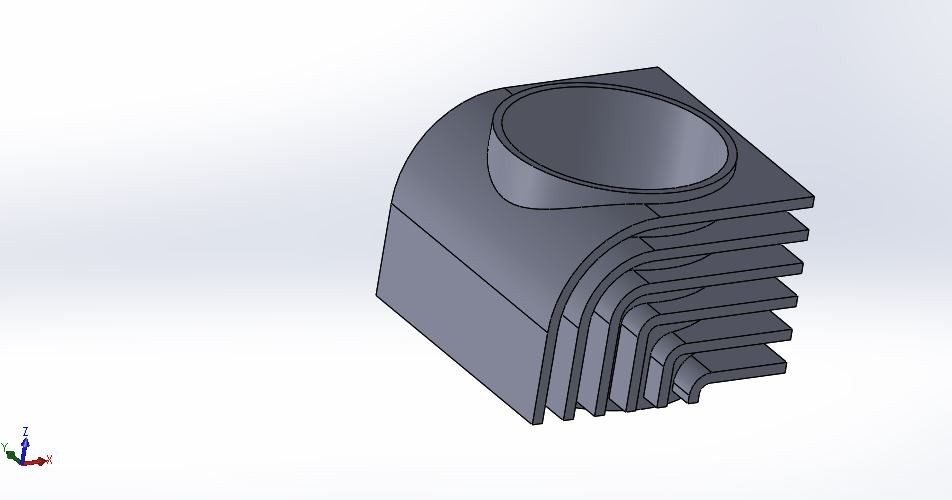
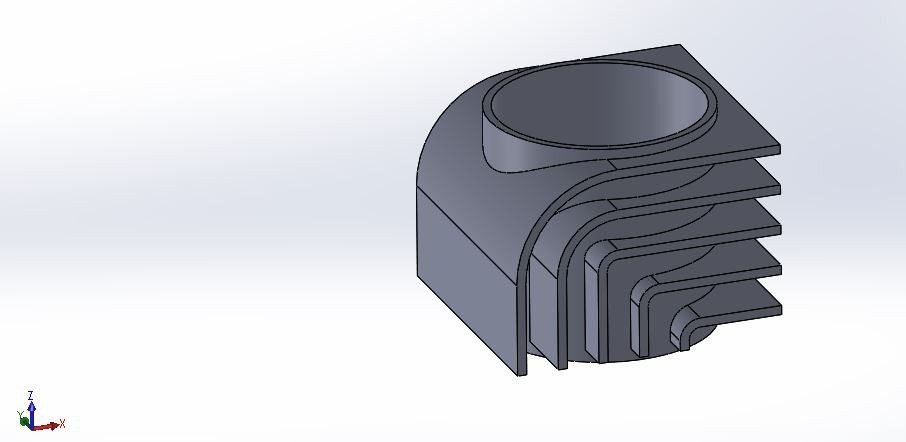
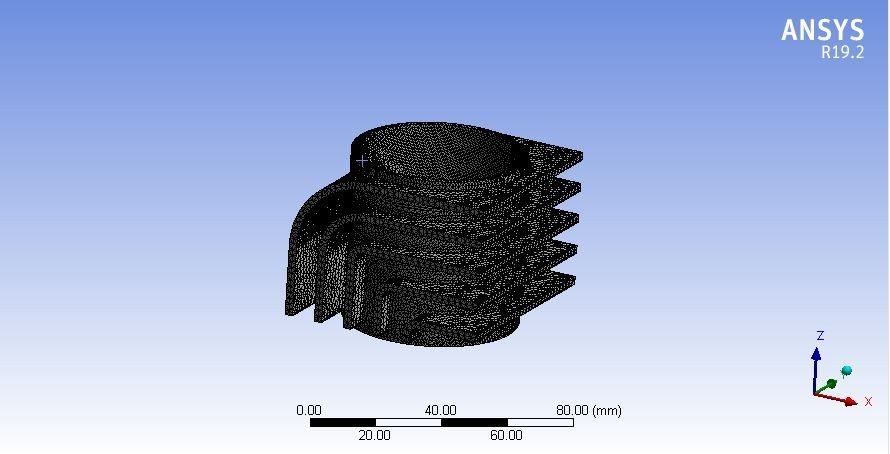
The cylinder and fins are modelled in SolidWorks and analysed in ANSYS in three stages:
- Static structural analysis: a combustion pressure of 10 MPa on the inner bore, to find deformation, stress and safety factor.
- Steady-state thermal analysis: an inner heat flux of 2.5 × 10⁻³ W/mm² with convection to air at 25 °C (film coefficient 2.5 × 10⁻⁶ W/mm²·°C).
- CFD analysis in ANSYS Fluent: forced convection of air over the fins to study pressure, velocity and heat transfer.
Three aluminium alloys are compared: Al-6061 (yield 276 MPa), Al-2024 (yield 325 MPa) and Al-5059 (yield 300 MPa).
Software Used
- SolidWorks: cylinder and curved fin modelling
- ANSYS Workbench: static structural and steady-state thermal analysis
- ANSYS Fluent: forced-convection CFD
Analysis Setup
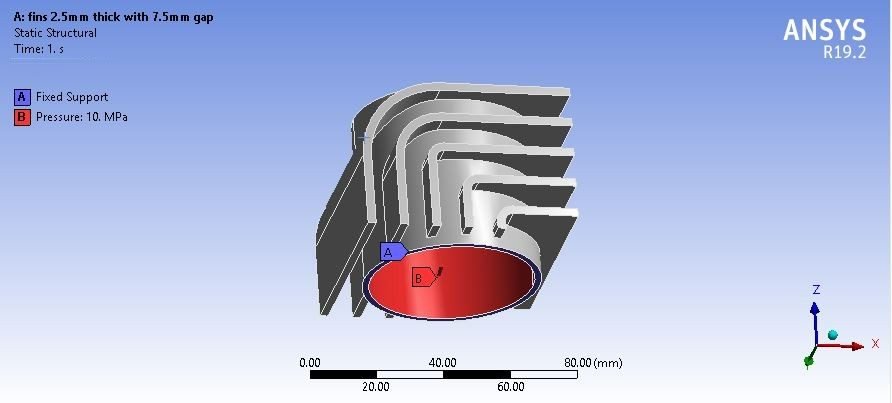
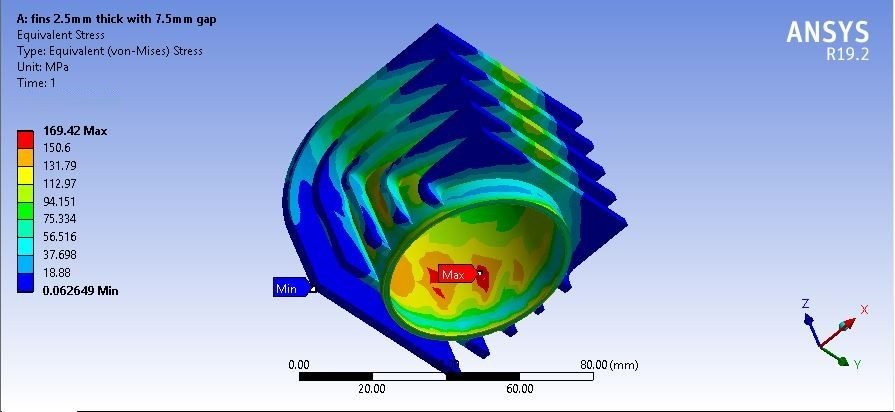
Static Structural Results
| Design | Material | Deformation (mm) | Equivalent stress (MPa) | Safety factor |
|---|---|---|---|---|
| 2.5 mm / 7.5 mm | Al-6061 | 0.08266 | 169.42 | 1.6291 |
| 2.5 mm / 7.5 mm | Al-2024 | 0.077911 | 170.04 | 1.9183 |
| 2.5 mm / 7.5 mm | Al-5059 | 0.08254 | 170.27 | 1.7707 |
| 2.6 mm / 5.5 mm | Al-6061 | 0.084668 | 164.78 | 1.6749 |
| 2.6 mm / 5.5 mm | Al-2024 | 0.079659 | 164.75 | 1.9727 |
| 2.6 mm / 5.5 mm | Al-5059 | 0.084768 | 164.98 | 1.8184 |
| 2.25 mm / 7.75 mm | Al-6061 | 0.088438 | 167.42 | 1.6486 |
| 2.25 mm / 7.75 mm | Al-2024 | 0.083212 | 167.38 | 1.9417 |
| 2.25 mm / 7.75 mm | Al-5059 | 0.088508 | 167.64 | 1.7895 |
Thermal Results
| Design | Material | Max temperature (°C) | Max heat flux (W/mm²) |
|---|---|---|---|
| 2.5 mm / 7.5 mm | Al-6061 | 307.06 | 0.032917 |
| 2.5 mm / 7.5 mm | Al-2024 | 301.55 | 0.032311 |
| 2.5 mm / 7.5 mm | Al-5059 | 301.78 | 0.032268 |
| 2.6 mm / 5.5 mm | Al-6061 | 272.02 | 0.027657 |
| 2.6 mm / 5.5 mm | Al-2024 | 272.51 | 0.027561 |
| 2.6 mm / 5.5 mm | Al-5059 | 272.7 | 0.027527 |
| 2.25 mm / 7.75 mm | Al-6061 | 301.07 | 0.034696 |
| 2.25 mm / 7.75 mm | Al-2024 | 301.72 | 0.034557 |
| 2.25 mm / 7.75 mm | Al-5059 | 301.95 | 0.034508 |

The CFD results and the final choice of fin design and material are explained in the project report.
Real-World Applications
- Two-wheelers: air-cooled motorcycle and scooter engines.
- Portable generators and pumps: small single-cylinder engines.
- Light aircraft: air-cooled piston engines.
- Compressors: finned cylinders on air compressors.
Key Concepts Covered
- Extended surfaces: how fins increase heat transfer.
- Fin thickness and spacing: the trade-off between conduction and airflow.
- Heat flux and convection: thermal boundary conditions in ANSYS.
- Forced convection CFD: airflow over fins in Fluent.
- Aluminium alloys: strength and conductivity for engine parts.
Project Workflow
- Study air-cooled engines and fin heat transfer.
- Model three curved fin designs in SolidWorks.
- Run static analysis at 10 MPa for three alloys.
- Run steady-state thermal analysis with heat flux and convection.
- Run forced-convection CFD in Fluent and compare all results in the report.
Why This Project Matters
Better fins mean cooler, more reliable and lighter engines. This project covers structural, thermal and CFD analysis in one study, which makes it a complete final-year project.
Related Projects
Explore more design and analysis projects on similar topics:
- Catalytic Converter with Honeycomb Substrate: Design and CFD Emission Analysis
- Exhaust Manifold Design Optimisation and Analysis: Two Designs, Four Materials (Static, Thermal and CFD in ANSYS)
- CFD Analysis of a Diesel Engine Combustion Chamber with Diesel and Rice Husk Biofuel Blends (SolidWorks and ANSYS Fluent)
- Improving the Heat Transfer Rate of an AC Condenser Using Al2O3 & TiC Nanofluids (CFD and Structural Analysis in ANSYS)
What You Get
- Design files: SolidWorks models of the cylinder with three curved fin designs (thickness and gap variations)
- Analysis files: ANSYS static structural, steady-state thermal and Fluent forced-convection CFD files
- Project document: complete report with methodology, results and conclusion
- Class explanation: a session that explains what was done in the project, step by step, so you can understand and present it confidently
Who Is This Project For?
This project suits B.Tech and B.E. final year students, diploma students looking for a strong design and analysis project, and M.Tech students who need a base model they can extend for their thesis. It is also useful for anyone who wants to learn SolidWorks modelling, ANSYS thermal analysis and Fluent CFD on a real engineering problem instead of a textbook example.
Frequently Asked Questions
Why are fins used on engine cylinders?
Fins increase the surface area of the cylinder so that more heat can be carried away by air, keeping air-cooled engines from overheating.
Which fin designs are compared?
Three curved fin designs: 2.5 mm thick with 7.5 mm gap, 2.6 mm thick with 5.5 mm gap, and 2.25 mm thick with 7.75 mm gap.
Which analyses are done?
Static structural analysis at 10 MPa, steady-state thermal analysis with heat flux and convection, and forced-convection CFD in ANSYS Fluent.
Which materials are used?
Three aluminium alloys: Al-6061, Al-2024 and Al-5059.
Get the Engine Cylinder Curved Fins Project
Want this project for your final year, mini project or M.Tech work? Message us with your university, branch and deadline, and we will share the exact scope, files and report format.
Enquire about this project on WhatsApp or use the enquiry form on our home page. Browse more mechanical projects or 60+ mechanical engineering project ideas.
Interested in this project? Get the details, files and guidance from our team.
Enquire on WhatsApp