
The combustion chamber is the space inside an internal combustion engine where air and fuel mix and burn. The burning mixture creates high pressure that pushes the piston, and this is how the chemical energy of the fuel becomes useful mechanical work. In a diesel engine, there is no spark plug: air is compressed until it becomes very hot, and the fuel ignites on its own when it is injected. This project studies how the flow, temperature and heat transfer inside a diesel engine combustion chamber change when part of the diesel is replaced with rice husk biofuel.

Why Biofuel?
Biofuel is made from vegetable oils, animal fats or agricultural waste such as rice husk. When it is burned, it produces fewer sulphur oxides than fossil diesel, and because it comes from renewable sources it can reduce dependence on crude oil. The main question for engineers is whether a diesel and biofuel blend can run in an existing engine and give performance close to pure diesel. CFD lets us answer this question without building and testing a real engine for every blend.
About the Project
The combustion chamber is sketched in 2D in SolidWorks using dimensions taken from research papers, converted into a surface model, and saved in STEP format for ANSYS. Steel is chosen as the chamber material. In ANSYS Fluent, the model is meshed with a 1 mm element size, and the following boundary conditions are applied:
- Air inlet: mass flow rate 0.0044 kg/s at 25 °C (298 K)
- Fuel inlet: mass flow rate 0.01355 kg/s at 258 °C (535 K)
Before the simulation, the properties of each fuel blend, such as density, viscosity, thermal conductivity and specific heat, are calculated using mixture formulas. Three cases are then analysed:
- 100% diesel
- 80% diesel with 20% rice husk biofuel
- 50% diesel with 50% rice husk biofuel
For each case, the total temperature, velocity, pressure, heat transfer coefficient and pressure drop are found and compared.

Software Used
- SolidWorks: 2D sketch and 3D model of the combustion chamber
- ANSYS Fluent: CFD analysis of temperature, velocity, pressure and heat transfer
Analysis Results

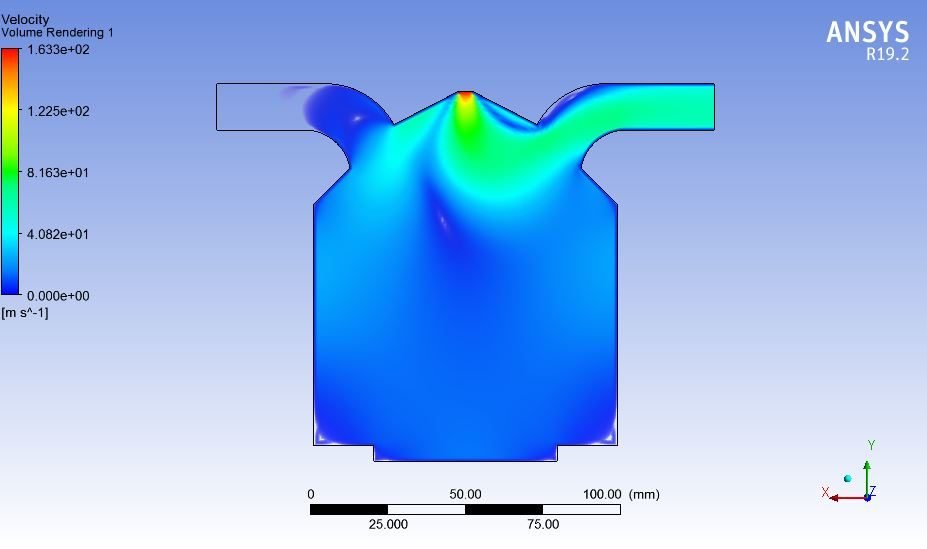
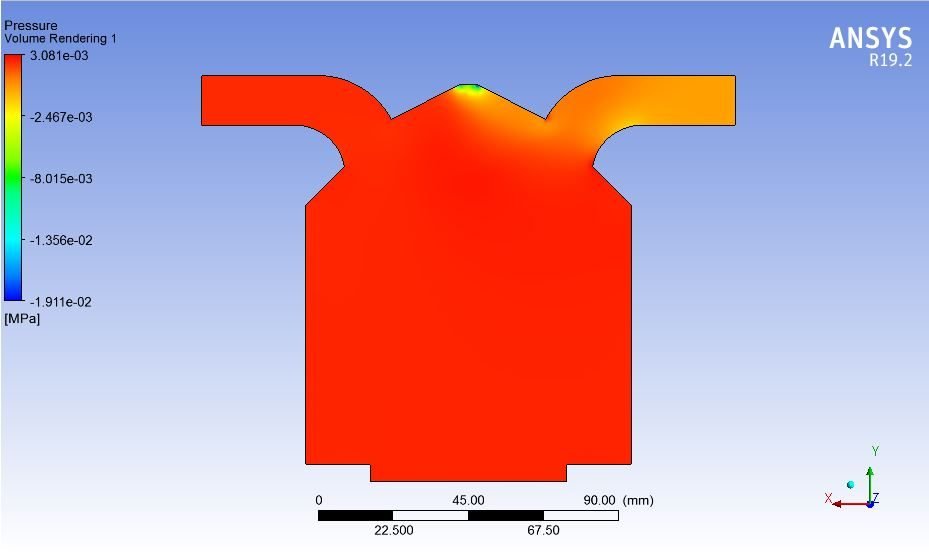
Key Results (Preview)
- Total temperature: 257.9 °C in all three cases
- Velocity: 1.633e2 m/s in all three cases
- Pressure drop: 0.022191 MPa with pure diesel, rising slightly as more rice husk biofuel is added
- Heat transfer coefficient: decreases slightly as the biofuel share increases
The temperature and velocity distributions stay the same when biofuel is blended with diesel, and the changes in pressure drop and heat transfer coefficient are very small. The report explains which blend is recommended as a replacement for diesel and how it can help reduce pollution.
Why This Project Matters
Cleaner fuels are a key part of reducing vehicle and generator emissions, and research on biofuel blends is active in India and around the world. This project combines thermal engineering, fluid mechanics and CFD in one study, and it shows a practical method that can be repeated for other biofuels such as jatropha, karanja or used cooking oil. It is a good choice for mechanical and automobile students interested in IC engines and alternative fuels.
Related Projects
Explore more design and analysis projects on similar topics:
- Design and Analysis of an Engine Mount Bracket: AISI 4140, Al 7075 and Ti-6Al-4V (SolidWorks and ANSYS)
- Reciprocating Compressor Valve Plate Design and Analysis: Five Slot Designs Compared (Creo and ANSYS)
- V6 Engine Design in SolidWorks with Ceramic-Coated Piston Concept
- Air Conditioner Efficiency Improvement Using Condensate Water Subcooling
What You Get
- Design files: SolidWorks model of the diesel engine combustion chamber (with STEP file for ANSYS)
- Analysis files: ANSYS Fluent CFD files for 100% diesel, 80/20 and 50/50 diesel and rice husk biofuel blends, with all contour plots
- Project document: complete report with methodology, results and conclusion
- Class explanation: a session that explains what was done in the project, step by step, so you can understand and present it confidently
Who Is This Project For?
This project suits B.Tech and B.E. final year students, diploma students looking for a strong design and analysis project, and M.Tech students who need a base model they can extend for their thesis. It is also useful for anyone who wants to learn combustion chamber CFD, fluid mixture property calculation and biofuel analysis in ANSYS Fluent on a real engineering problem instead of a textbook example.
Frequently Asked Questions
What is rice husk biofuel?
Rice husk biofuel is a renewable fuel made from rice husk, the outer covering of rice grains that is produced in large amounts as agricultural waste. It can be blended with diesel to reduce the use of fossil fuel and lower some harmful emissions.
Which fuel blends are analysed?
Three cases are studied in ANSYS Fluent: 100% diesel, 80% diesel with 20% rice husk biofuel, and 50% diesel with 50% rice husk biofuel. The fluid properties of each blend are calculated first using mixture formulas.
What boundary conditions are used?
The air inlet has a mass flow rate of 0.0044 kg/s at 25 °C (298 K), and the fuel inlet has a mass flow rate of 0.01355 kg/s at 258 °C (535 K). The chamber is meshed with a 1 mm element size.
What results are compared?
For each blend, the project compares the total temperature, velocity, pressure, heat transfer coefficient and pressure drop inside the combustion chamber to see whether the biofuel blend can perform like pure diesel.
Get the Diesel Engine Combustion Chamber Biofuel CFD Project
Want this project for your final year, mini project or M.Tech work? Message us with your university, branch and deadline, and we will share the exact scope, files and report format.
Enquire about this project on WhatsApp or use the enquiry form on our home page. Browse more mechanical projects or 60+ mechanical engineering project ideas.
Interested in this project? Get the details, files and guidance from our team.
Enquire on WhatsApp