
Natural gas is easiest to transport when it is cooled into a liquid. Liquid methane takes up about 600 times less volume than the gas, but it must be kept at around −160 °C or colder. Road tankers that carry it use a cryogenic pressure vessel: an inner tank holding the cold liquid, an outer shell, and a vacuum insulation space between them that stops heat leaking in. The vessel must withstand internal pressure, the weight of the liquid and road loads, while also coping with a temperature difference of almost 200 °C between the liquid inside and the air outside. This project designs a truck-mounted liquid methane vessel with a maximum payload of 10,000 kg.
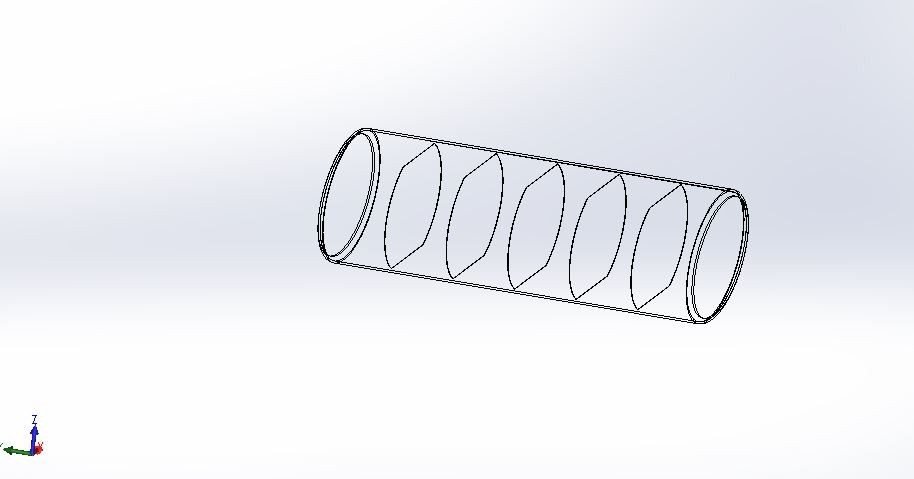
Design of the Vessel
The vessel has an elliptical (oval) cross-section so that it sits low on the truck chassis and keeps the centre of gravity down. Inside, transverse inner walls (baffles) divide the tank. They stiffen the shell against pressure and stop the liquid from surging forwards and backwards when the truck brakes or accelerates. Two inner-wall designs are studied:
- Design 1: inner walls with an 850 mm minor axis.
- Design 2: inner walls with an 800 mm minor axis.
About the Project
The vessel is modelled in CAD from an elliptical sketch extruded into a shell, with the inner walls placed along its length. The model is analysed in FEA in two ways:
- Static structural analysis: the vessel is fixed at its supports and an internal pressure of 0.4 MPa is applied, to find deformation, stress and safety factor.
- Steady-state thermal analysis: the inside is exposed to the cryogenic liquid by convection at −170 °C (film coefficient 2 × 10⁻⁴ W/mm²·°C), while the outside is at ambient temperature, to find the temperature distribution and heat flux.
Three steel materials are compared: the stainless steel used in the existing design, SAE 1020 and SAE 1137.
Software Used
- CAD: vessel shell and inner wall modelling
- FEA: static structural and steady-state thermal analysis
Analysis Setup
Static Structural Results
| Design | Material | Deformation (mm) | Equivalent stress (MPa) | Safety factor |
|---|---|---|---|---|
| Design 1 (850 mm) | Stainless steel | 1.8042 | 156.28 | 1.5997 |
| Design 1 (850 mm) | SAE 1020 | 1.869 | 157.03 | 2.4974 |
| Design 1 (850 mm) | SAE 1137 | 1.8366 | 157.17 | 3.1622 |
| Design 2 (800 mm) | Stainless steel | 1.7921 | 148.26 | 1.6862 |
| Design 2 (800 mm) | SAE 1020 | 1.8563 | 148.79 | 2.6357 |
| Design 2 (800 mm) | SAE 1137 | 1.824 | 148.89 | See report |
Thermal Results
In both designs the minimum temperature is −170 °C on the inside surface. The maximum temperature and heat flux are:
| Design | Material | Max temperature (°C) | Max heat flux (W/mm²) |
|---|---|---|---|
| Design 1 | Stainless steel | 32.591 | 0.46162 |
| Design 1 | SAE 1020 | 33.029 | 0.4129 |
| Design 1 | SAE 1137 | 33.126 | 0.40323 |
| Design 2 | Stainless steel | 30.974 | 0.45756 |
| Design 2 | SAE 1020 | 31.304 | 0.40706 |
| Design 2 | SAE 1137 | 31.378 | 0.39702 |
The comparison of the two designs and three materials, and the final recommendation, are explained in our live class or recorded video for this project.
Real-World Applications
- LNG and liquid methane tankers: road transport of fuel gas.
- Industrial gases: tankers for liquid nitrogen, oxygen and argon.
- LNG fuelling stations: storage tanks for vehicle fuel.
- Rocket propellants: methane is a fuel for modern rocket engines.
Key Concepts Covered
- Cryogenic storage: keeping liquids far below ambient temperature.
- Vacuum insulation: limiting heat leak into the tank.
- Baffles: stiffening the shell and controlling liquid sloshing.
- Pressure vessel stress: hoop and longitudinal stresses in shells.
- Convection boundary conditions: modelling heat transfer from a cold fluid.
Project Workflow
- Study cryogenic tankers and liquid methane properties.
- Model the elliptical vessel with two inner-wall designs in CAD.
- Apply 0.4 MPa pressure and run static analysis for three materials.
- Apply cryogenic convection and run steady-state thermal analysis.
- Compare designs and materials in the report.
Why This Project Matters
LNG is a growing fuel for trucks, ships and power, and cryogenic vessels are central to that supply chain. This project combines pressure vessel design with thermal analysis, which makes it a strong final-year and M.Tech topic.
Related Projects
Explore more design and analysis projects on similar topics:
- Reactor Pressure Vessel Design, Analysis and Cost Estimation: Mild Steel vs SAE 1020, SAE 1137 and Al-2048 (FEA)
- Cryogenic Ball Valve Design and Analysis for LNG: SS-304, SAE 1137 and S45C (Structural, Modal and CFD)
- Multilayer Composite Vacuum Insulated Cryogenic Vessel: Design and Analysis
- Optimization and Analysis of an Aircraft Wheel Hub with Lightweight Aluminium Alloys and Development of a Prototype Model (CAD, FEA and FDM)
What Support You Get
- Design guidance: how to build the CAD model yourself – CAD models of the elliptical cryogenic vessel with two inner-wall (baffle) designs
- Analysis guidance: how to set up and run the analysis yourself – FEA static structural and steady-state thermal files for both designs and three materials
- Report guidance: how to structure your own report – methodology, results and conclusion
- Live class: a step-by-step explanation of the method while you work on your own licensed software, so you can understand it and present your work confidently
Studying abroad? We guide you too – learn to build projects like this in our live classes, on your own licensed software.
Who Is This Project For?
This project is a good learning example for B.Tech and B.E. final year students, diploma students who want to learn design and analysis, and M.Tech students who want to learn a method they can extend in their own thesis. It is also useful for anyone who wants to learn CAD modelling and FEA structural and thermal analysis on a real engineering problem instead of a textbook example.
Frequently Asked Questions
What is a cryogenic pressure vessel?
It is a tank designed to store liquids at very low temperatures, such as liquid methane at around −160 °C, using an inner tank, an outer shell and vacuum insulation between them.
What loads are applied in this project?
An internal pressure of 0.4 MPa is applied for static analysis, and convection at −170 °C is applied on the inside for thermal analysis.
Which materials are compared?
Stainless steel from the existing design, SAE 1020 steel and SAE 1137 steel.
What is the difference between the two designs?
The inner walls have an 850 mm minor axis in Design 1 and an 800 mm minor axis in Design 2.
Learn the Cryogenic Methane Pressure Vessel Project With Us
Want to learn this project for your final year, mini project or M.Tech work? Message us with your university, branch and deadline, and we will share a learning plan – live classes and step-by-step guidance while you build it yourself.
Enquire about this project on WhatsApp or use the enquiry form on our home page. Browse more mechanical projects or 60+ mechanical engineering project ideas.
Interested in this project? Get the details, files and guidance from our team.
Enquire on WhatsApp