
A wind turbine converts the kinetic energy of moving air into useful work. In a wind mill operated water pump, that work is used directly to lift water from a well or tank, which makes it very useful for irrigation and drinking water in villages and farms where grid power is weak or unavailable. The most important part of any wind turbine is its blade: its shape decides how much energy is captured, and its strength decides whether it survives strong winds. This project designs a horizontal axis wind turbine blade using two airfoils and three blade angles, and finds the combination that gives the lowest stress.
Horizontal Axis Wind Turbines and Airfoils
In a horizontal axis wind turbine (HAWT), the rotor shaft points into the wind, like a traditional windmill or a modern wind farm turbine. Each blade has the cross-section of an airfoil, the same kind of shape used for aircraft wings. As wind flows over the airfoil, it creates lift that turns the rotor. The angle at which the blade is set, called the blade angle or pitch, controls how the wind loads the blade. A small change in this angle can change both the power output and the stress in the blade, which is why it is studied carefully in design.
About the Project
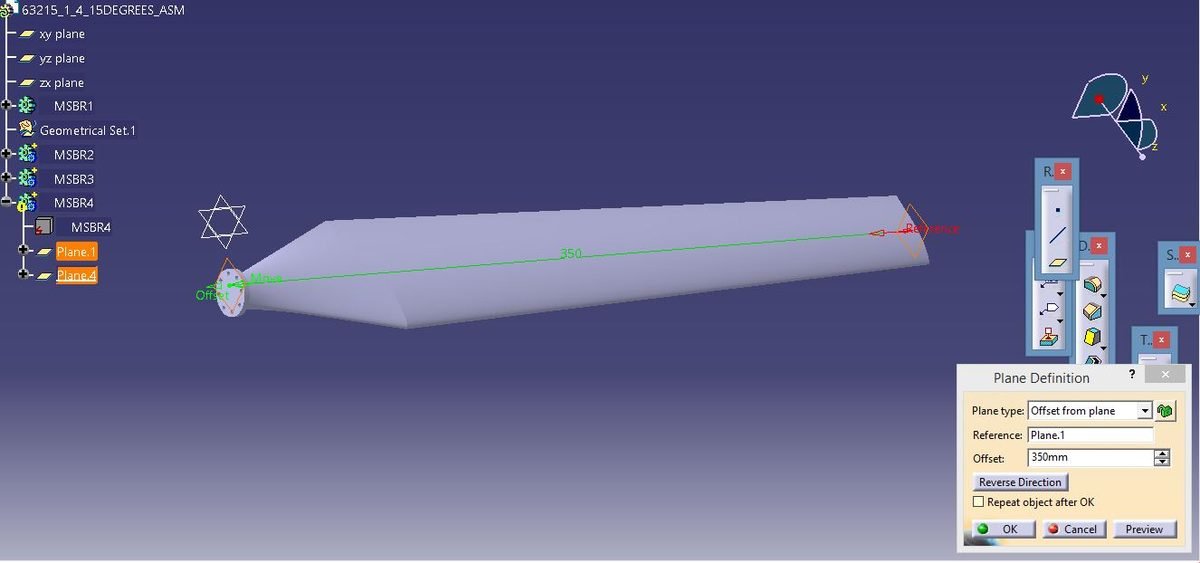
Two NACA six-series airfoils are used: NACA 63215 and NACA 63210. Their coordinates are generated with the DesignFoil software and exported as key points into CATIA V5, where the blades are built. The blade has a root chord length of 70 mm and a tip chord of 35 mm, and the complete blade length is 350 mm, five times the chord. For each airfoil, three blade angles are modelled: 14.5°, 15° and 15.5°, giving six blade models in total.
The blades are saved in IGES format and imported into ANSYS Workbench. A tetrahedral volume mesh is created, and carbon fibre is assigned as the blade material (density 1600 kg/m³, Young’s modulus 70 × 10^9 Pa). A wind pressure of 10000 Pa is applied on the blade surface with the root fixed, and the total deformation, strain and equivalent stress are calculated for every model.


Software Used
- DesignFoil: airfoil coordinate generation
- CATIA V5: 3D blade modelling from airfoil key points
- ANSYS Workbench Static Structural: deformation, strain and stress
Analysis Results


Key Results (Preview)
| Equivalent stress (MPa) | 14.5° | 15° | 15.5° |
|---|---|---|---|
| NACA 63215 | 192.37 | 254.55 | 190.71 |
| NACA 63210 | 181.64 | 181.93 | 209.57 |
For the NACA 63215 blade, changing the angle from 15° to 15.5° reduces the stress by nearly 64 MPa, about 25%. For the NACA 63210 blade, the trend is different, and the 15.5° blade gives the highest stress. The deformation and strain results and the best blade angle for each airfoil are explained in the project report.
Why This Project Matters
Wind-powered water pumps offer free, clean energy for agriculture and rural water supply, and better blades mean more water pumped with less maintenance. This project shows how a small design change, a half-degree change in blade angle, can reduce stress significantly. It teaches airfoil-based blade modelling in CATIA and composite blade analysis in ANSYS, which are useful skills for mechanical, aeronautical and renewable energy students.
Related Projects
Explore more design and analysis projects on similar topics:
- CFD Analysis of Vertical Axis Wind Turbine (VAWT) Blade Airfoils: NACA 0018, NACA 63418, S1046 and S1210 in ANSYS Fluent
- Aircraft Engine Cooling Fan with NACA 0012 and 0016 Blades – Static, Modal and CFD Analysis
- Engine Cooling Fan Design and Analysis: Static, Modal and CFD
- Steam Turbine Blade with NACA 4412 and 6515: Coupled Field and CFD Analysis
What You Get
- Design files: CATIA V5 blade models for NACA 63215 and NACA 63210 at 14.5°, 15° and 15.5°, airfoil coordinate files and IGES files
- Analysis files: ANSYS Workbench static structural files for all six blade models with deformation, strain and stress results
- Project document: complete report with methodology, results and conclusion
- Class explanation: a session that explains what was done in the project, step by step, so you can understand and present it confidently
Who Is This Project For?
This project suits B.Tech and B.E. final year students, diploma students looking for a strong design and analysis project, and M.Tech students who need a base model they can extend for their thesis. It is also useful for anyone who wants to learn airfoil-based blade design in CATIA and structural analysis of composite blades in ANSYS on a real engineering problem instead of a textbook example.
Frequently Asked Questions
What is a wind mill operated water pump?
It is a pump driven directly by a wind turbine rotor instead of an electric motor. The rotating blades drive a mechanism that lifts water from a well or tank, which is useful for irrigation and drinking water where electricity is unreliable.
Why are NACA 63215 and NACA 63210 airfoils used?
Both are NACA six-series airfoils designed for good lift with low drag. Comparing them shows how a change in airfoil thickness affects the deformation and stress of the blade under the same wind pressure.
Why are three blade angles studied?
A small change in blade angle changes how the wind loads the blade. By modelling 14.5°, 15° and 15.5° for each airfoil, the project finds the angle that gives the lowest stress for each blade.
What material and load are used in the analysis?
The blades are made of carbon fibre (density 1600 kg/m³, Young’s modulus 70 × 10^9 Pa). A wind pressure of 10000 Pa is applied on the blade surface with the root fixed in ANSYS Workbench.
Get the Wind Mill Water Pump Turbine Blade Project
Want this project for your final year, mini project or M.Tech work? Message us with your university, branch and deadline, and we will share the exact scope, files and report format.
Enquire about this project on WhatsApp or use the enquiry form on our home page. Browse more mechanical projects or 60+ mechanical engineering project ideas.
Interested in this project? Get the details, files and guidance from our team.
Enquire on WhatsApp