
A spur gear is the simplest and most common type of gear. Its teeth are straight and parallel to the shaft, and it transmits power between two parallel shafts. Spur gears are used everywhere: in car gearboxes, machine tools, clocks, washing machines, conveyors and industrial drives. Because the full power passes through a few teeth at a time, the teeth carry high bending and contact stress, and the gear must be strong, stiff and free from harmful vibration. This project designs a spur gear from real engine data and compares two materials using finite element analysis.

How Gears Transmit Power
When two gears mesh, the teeth of the driving gear push on the teeth of the driven gear. If the gears have different sizes, the speed and torque change in proportion to their diameters, which gives a mechanical advantage. Unlike belts or friction drives, gear teeth do not slip, so the speed ratio stays exact. The design of a gear therefore starts with the power and torque it must carry, then decides the module, number of teeth, face width and material so that the tooth stresses stay within safe limits.
About the Project
The gear is designed using the data of a car engine with a maximum output of 117 hp at 6600 rpm and a maximum torque of 145 Nm at 4600 rpm. From a torque of 145000 N-mm, the tangential force on the teeth is calculated as 3314.28 N, and the gear dimensions, including the pitch circle and base circle diameters, are worked out and checked against allowable stress. The gear, with its hub and keyway, is then modelled in SolidWorks.
The model is imported into ANSYS Workbench and meshed. The bore is fixed and a pressure of 5 MPa is applied on the teeth. Two materials are compared:
- Grey cast iron: cheap, easy to cast and good at damping vibration, widely used for low and medium-duty gears
- High-speed steel M2: a tungsten-molybdenum tool steel with high hardness and strength
Two analyses are carried out for each material:
- Static structural analysis: total deformation, equivalent stress, equivalent strain and safety factor
- Modal analysis: the first six natural frequencies, to check for possible resonance during operation

Software Used
- SolidWorks: spur gear modelling and assembly
- ANSYS Static Structural: deformation, stress, strain and safety factor
- ANSYS Modal: natural frequencies and mode shapes
Analysis Results

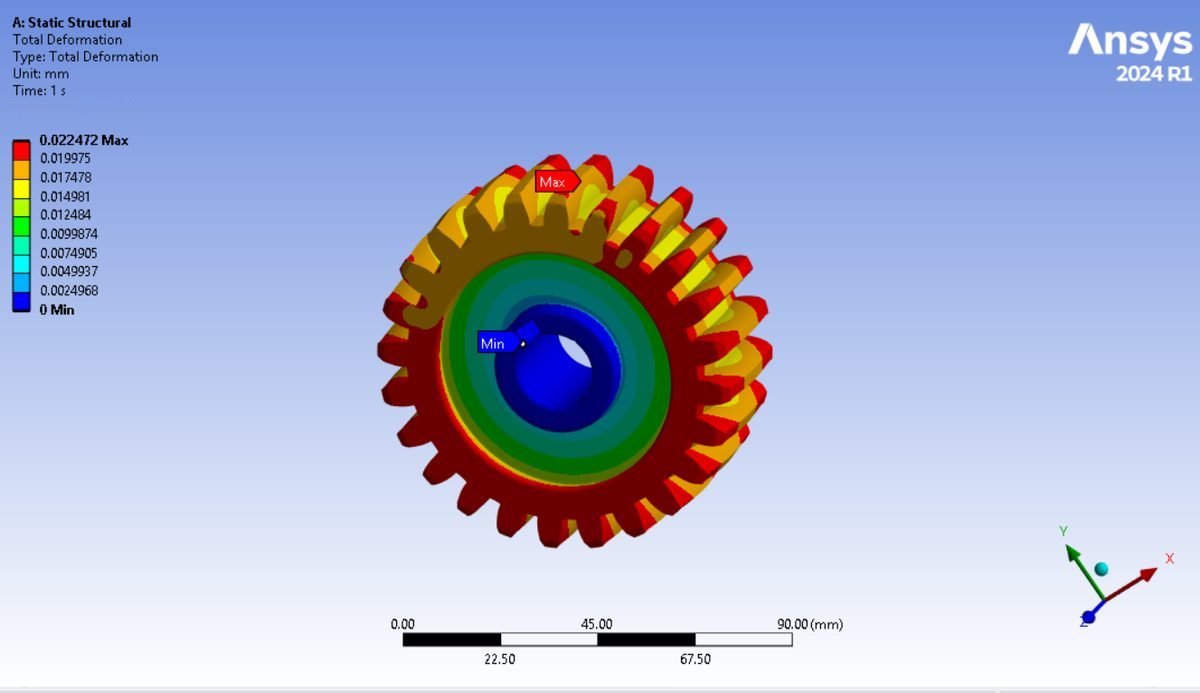

Key Results (Preview)
| Result | Grey cast iron | High-speed steel M2 |
|---|---|---|
| Total deformation (mm) | 0.022472 | 0.017307 |
| Equivalent stress (MPa) | 176.05 | 153.57 |
| Equivalent strain | 0.0015369 | 0.0012965 |
| Safety factor | 1.42 | 1.6279 |
The two materials behave quite differently under the same load. The modal frequency comparison and the recommended material for high-performance gear applications are explained in the project report.
Why This Project Matters
Gear design is a core topic in machine design and is asked about in almost every mechanical engineering interview. This project connects the theory, from torque and tangential force calculations, to a real 3D model and a finite element check of stress and vibration. It is a clear, well-structured project for diploma and B.Tech students and a good starting point for studies on gear materials, tooth profiles or gear failure.
Related Projects
Explore more design and analysis projects on similar topics:
- Design and Analysis of an Electric Vehicle Differential: Mild Steel vs 8620 Steel, Al-356 and Al-7075 (SolidWorks and ANSYS)
- Static and Dynamic Analysis of a Gearbox Casing Cover: Cast Iron vs Al-7075 and CFRP (SolidWorks and ANSYS)
- Tractor Rear Axle Shaft Design and Analysis: Mild Steel, Ni-Chrome and Invar
- Hybrid Ceramic Ball Bearing Design and Analysis: SiC and Zirconia Balls with Stainless Steel and SAE 1020 Races (CATIA and ANSYS)
What You Get
- Design files: SolidWorks spur gear part and assembly (with STEP file) and the gear design calculations
- Analysis files: ANSYS Workbench static structural and modal analysis files for both materials
- Project document: complete report with methodology, results and conclusion
- Class explanation: a session that explains what was done in the project, step by step, so you can understand and present it confidently
Who Is This Project For?
This project suits B.Tech and B.E. final year students, diploma students looking for a strong design and analysis project, and M.Tech students who need a base model they can extend for their thesis. It is also useful for anyone who wants to learn gear design calculations, static structural analysis and modal analysis in ANSYS on a real engineering problem instead of a textbook example.
Frequently Asked Questions
What is a spur gear?
A spur gear is a cylindrical gear with straight teeth parallel to its axis. It transmits power between parallel shafts, is easy to make and very efficient, and is used in gearboxes, machine tools, clocks and many other machines.
How is the gear designed in this project?
The gear is designed from engine data of 117 hp at 6600 rpm and 145 Nm at 4600 rpm. From a torque of 145000 N-mm, the tangential force on the teeth is calculated as 3314.28 N, and the gear dimensions are checked against allowable stress.
Which materials are compared?
Grey cast iron and high-speed steel M2 are compared. Grey cast iron is cheap and damps vibration well, while HSS M2 is a hard, strong tool steel, so the study shows how material choice changes gear performance.
What load is applied in ANSYS?
The bore of the gear is fixed and a pressure of 5 MPa is applied on the teeth. Static structural analysis gives deformation, stress, strain and safety factor, and modal analysis gives the first six natural frequencies.
Get the Spur Gear Design and Analysis Project
Want this project for your final year, mini project or M.Tech work? Message us with your university, branch and deadline, and we will share the exact scope, files and report format.
Enquire about this project on WhatsApp or use the enquiry form on our home page. Browse more mechanical projects or 60+ mechanical engineering project ideas.
Interested in this project? Get the details, files and guidance from our team.
Enquire on WhatsApp