
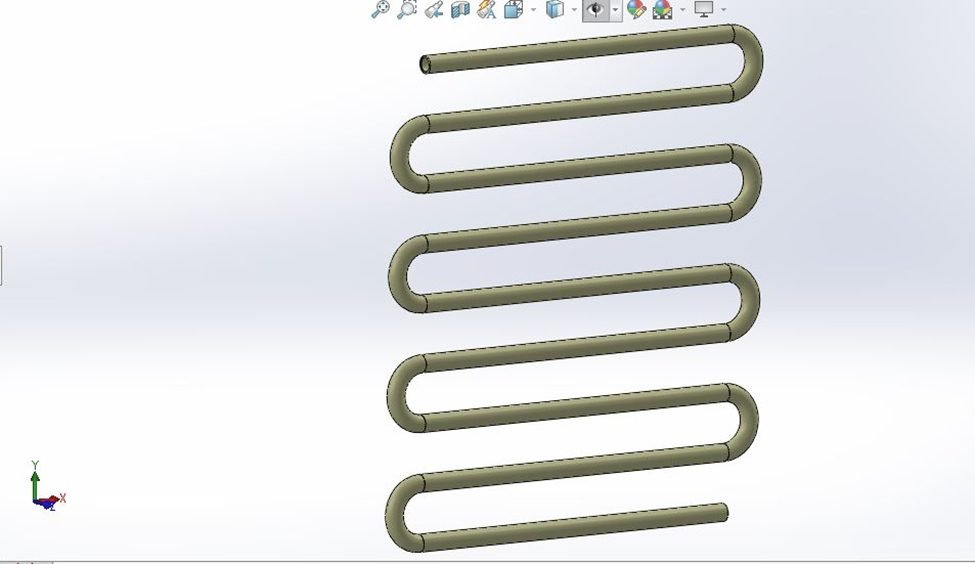
An air conditioner’s condenser takes the hot refrigerant coming from the compressor and removes its heat, releasing it to the outside air. The refrigerant flows through the condenser coil, and because it is hotter than the surrounding air, heat passes from the refrigerant into the air. How quickly this happens depends on the refrigerant, the tube material and the way the fluid flows inside the coil. This project studies how that heat transfer rate can be improved.
How an AC Condenser Works
An air conditioner works on the vapour compression refrigeration cycle. The compressor squeezes the refrigerant vapour, which raises both its pressure and its temperature. This hot, high-pressure vapour then enters the condenser, where a fan blows outside air across the tubes and fins. As the refrigerant gives its heat to the air, it cools down and changes from vapour to liquid. The liquid then passes through the expansion valve and the evaporator, where it absorbs heat from the room, and the cycle repeats. If the condenser cannot remove heat quickly enough, the compressor has to work harder, power consumption goes up and cooling performance drops, which is why improving the condenser’s heat transfer rate matters so much.
Why Nanofluids?
A nanofluid is a normal fluid with very small solid particles, usually less than 100 nanometres in size, mixed into it. Particles such as Al2O3 (aluminium oxide) and TiC (titanium carbide) have much higher thermal conductivity than the base refrigerant, so adding a small amount of them can help the fluid carry heat to the tube walls more effectively. The challenge is to find the right type and percentage of particles, because adding particles also changes the fluid’s density, viscosity and pressure drop.
About the Project
An air-cooled tube condenser used in the vapour compression cycle of an air-conditioning system is modelled in SolidWorks. The coil is 480 mm wide and 640 mm tall, with R40 bends and an 80 mm pitch. R22 is taken as the base refrigerant, and its heat transfer rate, outlet temperature, pressure and velocity distribution are found first.
To improve the heat transfer rate, a mixture of Al2O3 and TiC nanoparticles is added to R22 in different percentages. Each case is simulated in ANSYS Fluent, and the results are compared with plain R22. A static structural analysis is also carried out to see how the coil walls respond to the internal pressure, giving the deformation and factor of safety, so that the condenser can be checked for safe operation. Two tube materials, copper and Al-5054, are analysed, and the best combination of nanoparticles and material is identified.
Design Model


Software Used
- SolidWorks: 3D modelling of the condenser coil and fins
- ANSYS Fluent: CFD analysis of temperature, pressure and velocity
- ANSYS Static Structural: deformation, stress and factor of safety
Analysis Results


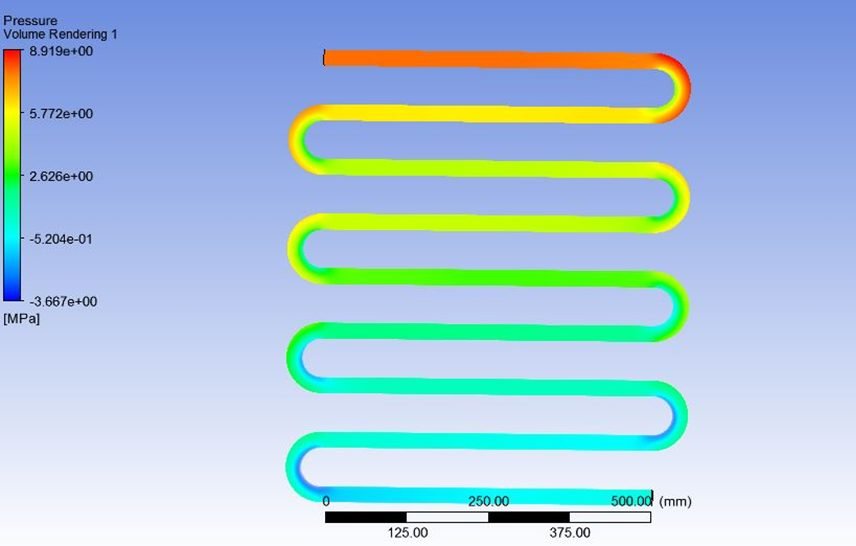
Key Results (Preview)
- Total deformation of the coil under internal pressure: max 0.27097 mm
- Velocity streamlines inside the coil: up to 4.659 m/s
- Pressure distribution along the coil: –3.667 to 8.919 MPa
- The best nanoparticle mix and tube material are given in the full report
Related Projects
Explore more design and analysis projects on similar topics:
- CFD and Thermal Analysis of a Car Radiator Using MgO–Silver and MgO–Graphene Hybrid Nanofluids (SolidWorks and ANSYS Fluent)
- Air Conditioner Efficiency Improvement Using Condensate Water Subcooling
- Li-ion Battery Pack Thermal Management with Paraffin PCM and Copper Tube Water Cooling (SolidWorks and ANSYS)
- CFD, Static and Thermal Analysis of a Steam Boiler Used in Power Plants with Steel, Brass and Steel 316L (SolidWorks and ANSYS)
What You Get
- Design files: SolidWorks CAD model of the condenser
- Analysis files: ANSYS Fluent and Static Structural project files with all results
- Project document: complete report with methodology, results and conclusion
- Class explanation: a session that explains what was done in the project, step by step, so you can understand and present it confidently
Who Is This Project For?
This project suits B.Tech and B.E. final year students, diploma students looking for a strong design and analysis project, and M.Tech students who need a base model they can extend for their thesis. It is also useful for anyone who wants to learn CFD and heat transfer analysis in ANSYS Fluent on a real engineering problem instead of a textbook example.
Frequently Asked Questions
What does an AC condenser do?
The condenser removes heat from the hot, high-pressure refrigerant that leaves the compressor. A fan blows outside air across the tubes and fins, the refrigerant gives its heat to the air and turns from vapour into liquid, and the cooled liquid then moves on to the expansion valve and evaporator.
Why are Al2O3 and TiC nanoparticles added to R22?
Al2O3 and TiC particles have much higher thermal conductivity than the base refrigerant. Mixing a small percentage into R22 can help the fluid carry heat to the tube walls more effectively, which is why this project compares the nanofluid cases with plain R22 in ANSYS Fluent.
Which software is used in this project?
The condenser coil and fins are modelled in SolidWorks. ANSYS Fluent is used for the CFD analysis of temperature, pressure and velocity, and ANSYS Static Structural is used to check deformation and factor of safety of the coil under internal pressure.
Which tube materials are compared?
Two tube materials are analysed: copper and Al-5054. Both are checked under the same internal pressure so that their deformation and safety factor can be compared directly, and the report explains which material and nanofluid combination gives the best overall result.
Get the AC Condenser Heat Transfer Project
Want this project for your final year, mini project or M.Tech work? Message us with your university, branch and deadline, and we will share the exact scope, files and report format.
Enquire about this project on WhatsApp or use the enquiry form on our home page. Browse more mechanical projects or 60+ mechanical engineering project ideas.
Interested in this project? Get the details, files and guidance from our team.
Enquire on WhatsApp