
A robot arm is the part of an industrial robot that reaches, lifts and places objects. Most industrial arms are articulated robots, which means they have rotary joints that let them move in several planes and directions, much like a human arm. Because the arm has to move its own weight along with the load, a heavy arm needs bigger motors, uses more energy and vibrates more. This project uses topology optimization to change a single-arm robot from a square-section arm into a lighter and stiffer circular-section arm.

About the Project
The robot is first modelled in SolidWorks with square arms: the first arm, a rotary arm and a third arm are sketched, extruded and joined with couplings in an assembly. The assembly is imported into ANSYS Workbench, meshed, and tested under real-time boundary conditions: the base joint is fixed, and a force of 550 N with a torque of 105 N-m is applied on the arm.
Three materials are compared:
- Steel: density 7850 kg/m³, yield strength 250 MPa
- Aluminium alloy Al-2048: density 2750 kg/m³, yield strength 415 MPa
- Kevlar: density 1440 kg/m³, yield strength 650 MPa
For each material, the static structural analysis gives total deformation, equivalent stress, strain and safety factor. Topology optimization is then used to study how material is distributed in the arm, and based on the result the square arm is redesigned as a circular arm. The circular arm is analysed again with the same loads and materials, and a modal analysis is carried out on both designs to find the first six natural frequencies, which show how each arm responds to vibration during movement.
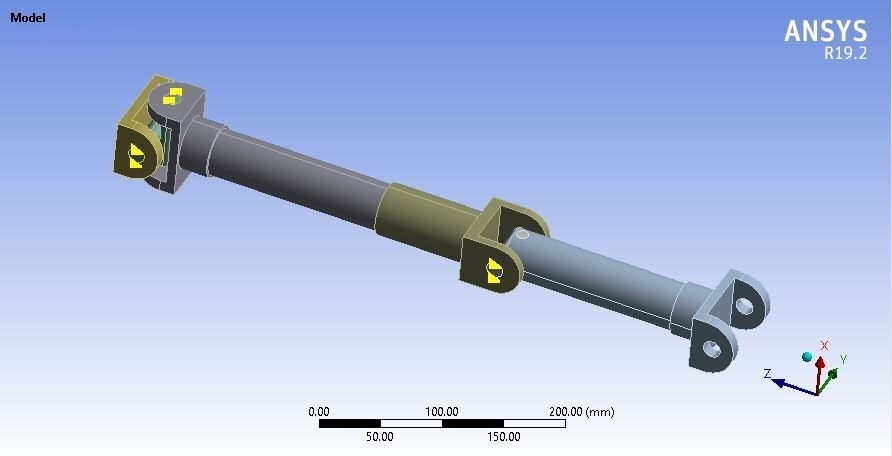
Software Used
- SolidWorks: modelling and assembly of the square and circular arm robots
- ANSYS Static Structural: deformation, stress, strain and safety factor
- ANSYS Topology Optimization: material layout study
- ANSYS Modal: natural frequencies and mode shapes
Analysis Results
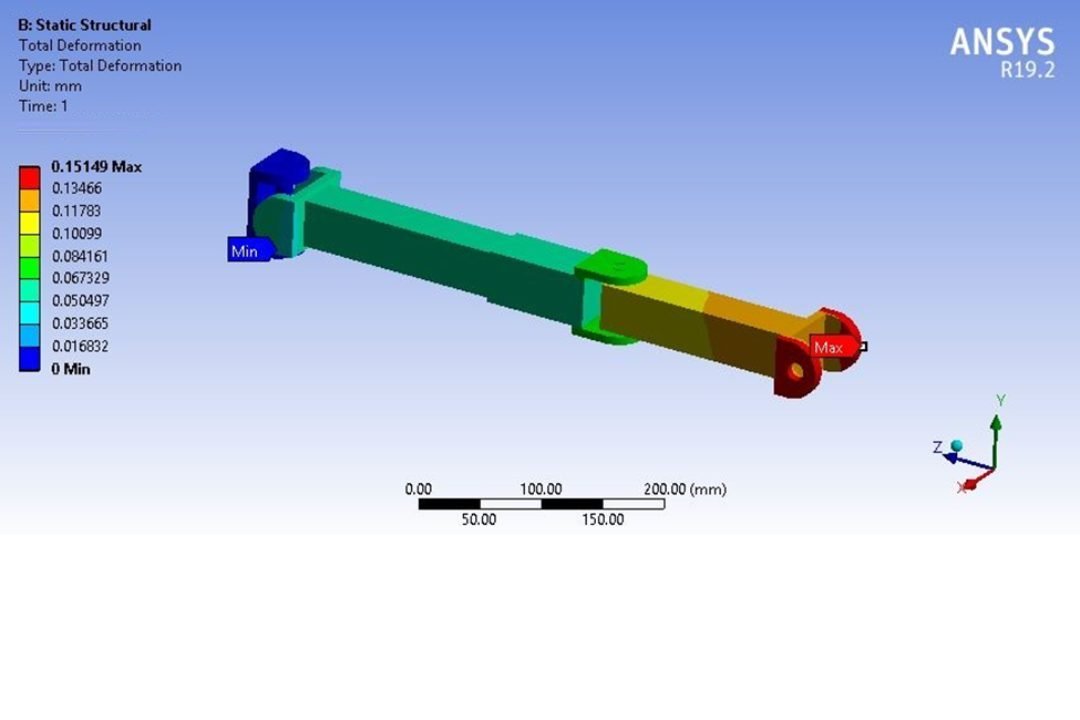
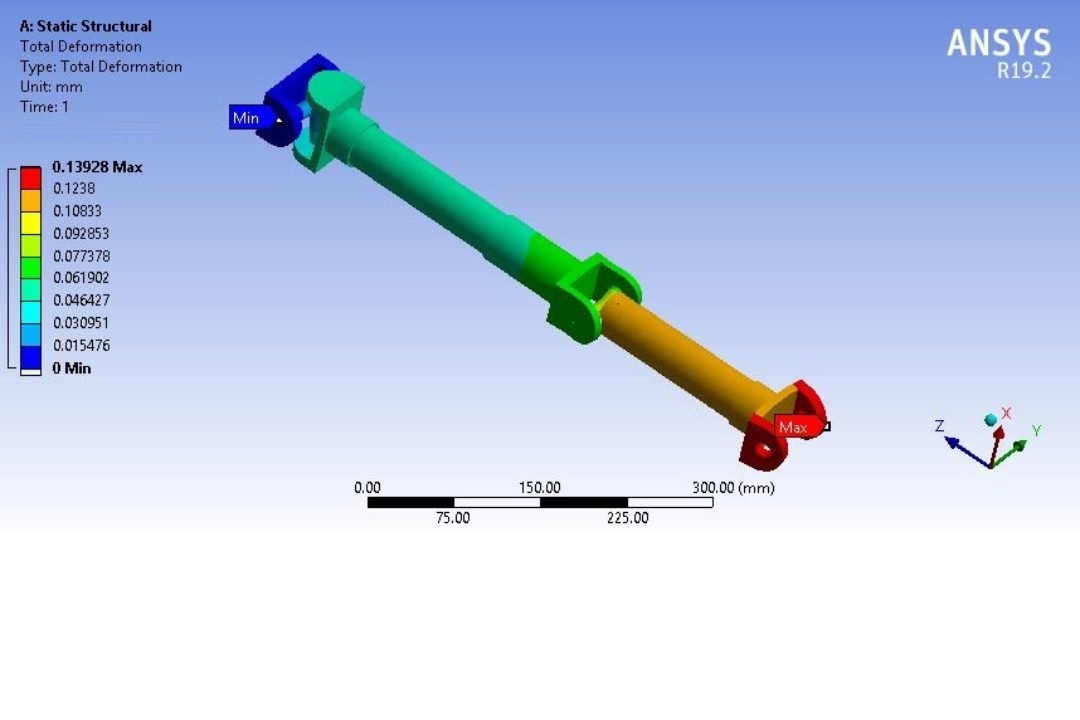
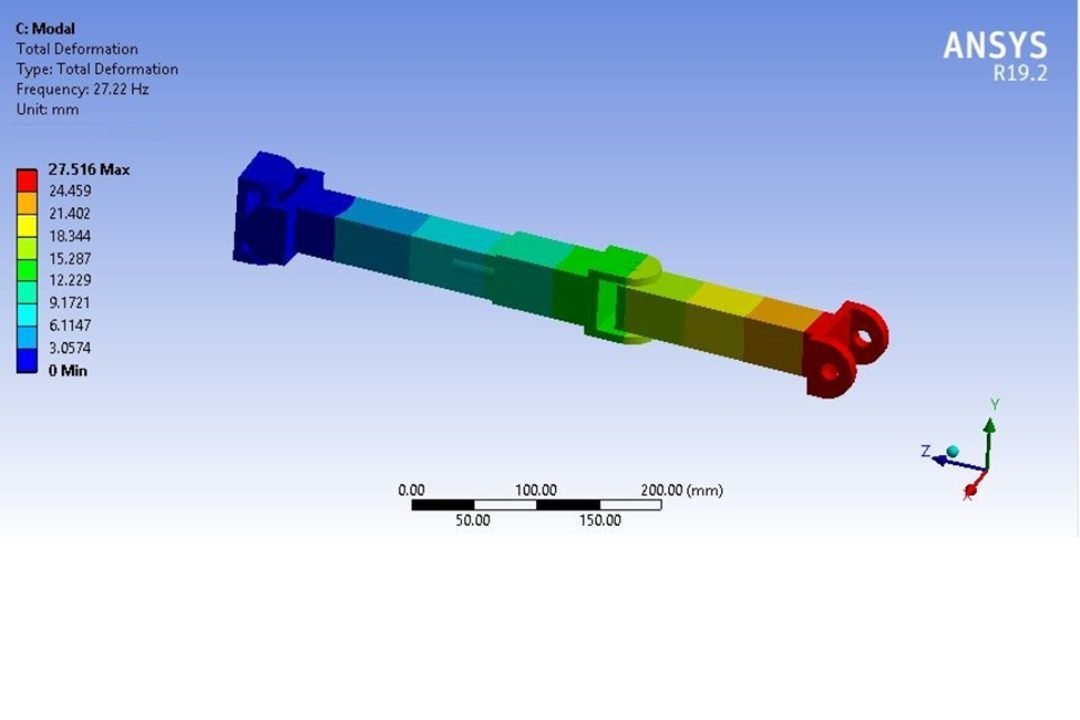
Key Results (Preview)
| Total deformation (mm) | Steel | Al-2048 | Kevlar |
|---|---|---|---|
| Square arm | 0.15149 | 0.4148 | 0.36602 |
| Circular arm (optimized) | 0.13928 | 0.38158 | 0.33646 |
The circular arm deforms less than the square arm for all three materials, and its stress values are also lower, so the optimized design carries the same load more efficiently. The safety factor, strain and modal frequency results for both designs are included in the report, along with which material and arm shape suits which industry.
Where These Robots Are Used
The project report links each design and material to a real application. Robot arms like these are used in food serving, automobile manufacturing lines, and luggage handling in aviation and railways. A heavier steel arm with hydraulic motors suits food serving and heavy-duty work where cost matters more than weight, while a lightweight Kevlar circular arm suits industries such as aviation, where low weight with high strength is the main requirement.
Why This Project Matters
Robotics is one of the fastest-growing fields for mechanical engineers, and companies want graduates who can design a robot structure and prove it is safe with simulation. This project shows a complete workflow: design in CAD, analyse under real loads, use topology optimization to find a better shape, and confirm the improvement with structural and vibration results. It works well as a final year project and as a base for an M.Tech thesis on lightweight robot design.
Related Projects
Explore more design and analysis projects on similar topics:
- Topology Optimization of a Mobile Transport Robot Using Steel 4340, Al 7075 and CFRP (SolidWorks and ANSYS)
- Omni Wheel Design and Analysis: Two Omni-Directional Wheel Designs in Nylon and PBT (SolidWorks and ANSYS)
- Design and Analysis of a Versatile Drone and Rover for Crop Care and Farm Optimization (SolidWorks and ANSYS)
- Stair Climbing Robot Trolley Design and Analysis – Steel, SS 304, SS 316 and Al-7075
What You Get
- Design files: SolidWorks parts and assemblies of the square arm robot and the optimized circular arm robot
- Analysis files: ANSYS Workbench static structural, modal and topology optimization files with all results
- Project document: complete report with methodology, results and conclusion
- Class explanation: a session that explains what was done in the project, step by step, so you can understand and present it confidently
Who Is This Project For?
This project suits B.Tech and B.E. final year students, diploma students looking for a strong design and analysis project, and M.Tech students who need a base model they can extend for their thesis. It is also useful for anyone who wants to learn robot arm design, topology optimization and modal analysis in ANSYS on a real engineering problem instead of a textbook example.
Frequently Asked Questions
What is an articulated robot arm?
An articulated robot arm has rotary joints that let it move in several planes and directions, similar to a human arm. It can range from a simple two-joint arm to a complex arm with six or more joints, and it is the most common type of industrial robot.
Why change the arm from square to circular section?
Topology optimization showed that material in a square section is not used efficiently under the arm loads. A circular section spreads the load more evenly, which reduces deformation and stress for the same loading and helps make the arm lighter and more stable.
What loads are applied on the robot arm?
The base joint is fixed, and a force of 550 N with a torque of 105 N-m is applied on the arm. The same loads are used for the square and circular designs and for all three materials so that the results can be compared fairly.
Which materials are studied?
Steel, aluminium alloy Al-2048 and Kevlar are studied. Steel is strong and cheap, Al-2048 is lighter, and Kevlar is very light with high strength, so each suits different industries such as food serving, automobile manufacturing or aviation.
Get the Robot Arm Topology Optimization Project
Want this project for your final year, mini project or M.Tech work? Message us with your university, branch and deadline, and we will share the exact scope, files and report format.
Enquire about this project on WhatsApp or use the enquiry form on our home page. Browse more mechanical projects or 60+ mechanical engineering project ideas.
Interested in this project? Get the details, files and guidance from our team.
Enquire on WhatsApp