
A steam boiler is a closed vessel in which water is heated until it turns into steam. In a thermal power plant, this high-pressure steam drives a turbine connected to a generator; after the turbine, the steam is cooled and condensed back into water, which returns to the boiler to start the cycle again. Because the boiler works at very high pressure and temperature, its walls and tubes must be strong enough not to burst and must also transfer heat efficiently. This project studies a steam boiler with three different materials using static, thermal and CFD analysis to find the most suitable material.
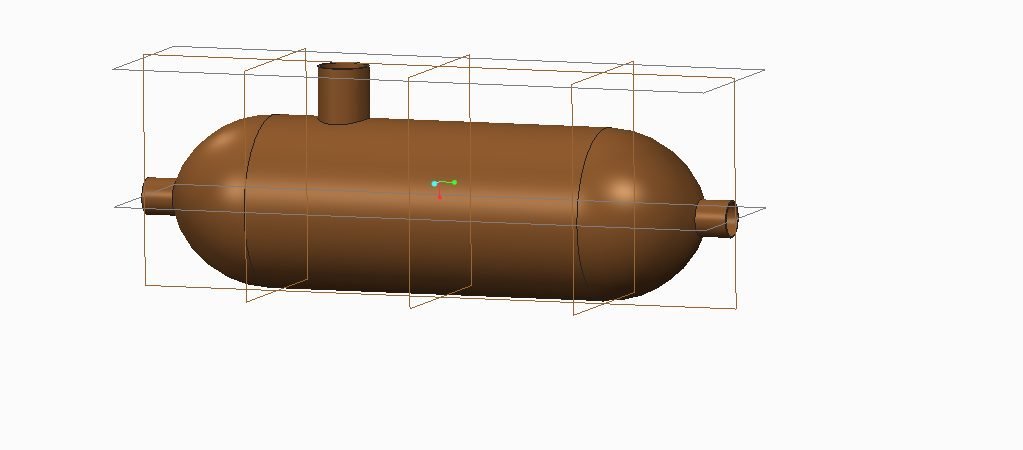
How a Steam Boiler Works
Fuel such as coal, gas or biomass is burned in a furnace, and the hot combustion gases pass over or through a set of tubes. Water or steam flows on the other side of the tube walls and absorbs the heat. In a fire tube boiler, the hot gases flow inside the tubes surrounded by water, while in a water tube boiler, water flows inside the tubes surrounded by hot gases. Either way, the boiler shell and tubes must hold the internal steam pressure safely, and the tube material should allow heat to pass through without large losses to the surroundings.
About the Project
The boiler shell, internal tubes and nozzles are modelled in CAD using real-time dimensions and assembled into a complete boiler. The assembly is imported into FEA and meshed. Three types of analysis are then carried out for three materials: steel, brass and Steel 316L.
- Static structural analysis: an internal pressure of 45 MPa is applied on the inner surface of the boiler to find total deformation, stress, strain and safety factor.
- Steady-state thermal analysis: temperature and heat flux are calculated to see how much heat each material lets out of the vessel.
- CFD analysis: steam flow through the boiler is simulated at four inlet velocities, 15, 30, 45 and 60 m/s, to find pressure, temperature, velocity and heat transfer coefficient.
The heat transfer coefficients found in the CFD analysis are also used as inputs to the thermal analysis, so the two studies are linked.
Software Used
- CAD: 3D modelling of the boiler shell, tubes and assembly
- FEA: deformation, stress, strain and safety factor
- FEA: temperature and heat flux
- CFD software: CFD analysis of steam flow at different velocities
Analysis Results
Key Results (Preview)
| Result | Steel | Brass | Steel 316L |
|---|---|---|---|
| Total deformation (mm) | 0.076327 | 0.12959 | 0.079202 |
| Equivalent stress (MPa) | 164.19 | 164.73 | 164.06 |
| Safety factor | 1.5226 | 1.7604 | 1.8286 |
| Heat flux (W/mm²) | 0.65343 | 0.99548 | 0.34676 |
The boiler can withstand 45 MPa of internal pressure with all three materials. The heat flux results show large differences: a material with high heat flux loses more heat from the vessel to the atmosphere, which reduces efficiency. The CFD results at each velocity and the final recommended material, with its advantages and limitations, are explained in the report.
Why This Project Matters
Boilers are at the heart of thermal power plants, sugar mills, refineries, textile and food industries. Choosing the right material affects safety, efficiency and maintenance cost over decades of service. This project combines pressure vessel design, heat transfer and fluid flow in one complete study, which makes it an excellent final year or M.Tech project for thermal and mechanical engineering students.
Related Projects
Explore more design and analysis projects on similar topics:
- Radiant Heat Exchanger Heater – Static and Thermal Analysis with Steel, SAE 1020 and Steel 416
- Heat Exchanger with Circular and Tapered Inserts – CFD Analysis with Nanofluids
- CFD Analysis of Circular, Square and Triangular Corrugated Pipes at 278 K and 318 K
- Double Tube Heat Exchanger with Tapered Fins and Angled Plates: CFD with TiO₂ Nanofluid
What Support You Get
- Design guidance: how to build the CAD model yourself – CAD models of the boiler shell, tubes and full assembly (with STEP files)
- Analysis guidance: how to set up and run the analysis yourself – FEA static structural, steady-state thermal and CFD software CFD files at all four steam velocities
- Report guidance: how to structure your own report – methodology, results and conclusion
- Live class: a step-by-step explanation of the method while you work on your own licensed software, so you can understand it and present your work confidently
Studying abroad? We guide you too – learn to build projects like this in our live classes, on your own licensed software.
Who Is This Project For?
This project is a good learning example for B.Tech and B.E. final year students, diploma students who want to learn design and analysis, and M.Tech students who want to learn a method they can extend in their own thesis. It is also useful for anyone who wants to learn pressure vessel analysis, thermal analysis and CFD of steam flow in FEA on a real engineering problem instead of a textbook example.
Frequently Asked Questions
What is the difference between a fire tube and a water tube boiler?
In a fire tube boiler, hot combustion gases flow inside the tubes and the water surrounds them. In a water tube boiler, water flows inside the tubes and the hot gases flow around them. Water tube boilers handle higher pressures and are common in large power plants.
What internal pressure is applied in the static analysis?
An internal pressure of 45 MPa is applied on the inner surface of the steam boiler. The analysis checks the total deformation, stress, strain and safety factor for each material at this pressure.
At which steam velocities is the CFD analysis done?
The steam flow is simulated in CFD software at four inlet velocities: 15 m/s, 30 m/s, 45 m/s and 60 m/s. The heat transfer coefficients from these CFD runs are also used as inputs to the thermal analysis.
Which materials are compared for the boiler?
Steel, brass and Steel 316L are compared. The study looks at both strength under pressure and heat flux, because a material that loses too much heat to the atmosphere reduces the efficiency of the boiler.
Learn the Steam Boiler CFD and Thermal Analysis Project With Us
Want to learn this project for your final year, mini project or M.Tech work? Message us with your university, branch and deadline, and we will share a learning plan – live classes and step-by-step guidance while you build it yourself.
Enquire about this project on WhatsApp or use the enquiry form on our home page. Browse more mechanical projects or 60+ mechanical engineering project ideas.
Interested in this project? Get the details, files and guidance from our team.
Enquire on WhatsApp