
A shock absorber is the part of a vehicle’s suspension that smooths out bumps and shocks from the road. In a motorcycle or scooter, a helical coil spring carries the load and absorbs the impact, while a damper inside converts the energy of the motion into heat so the vehicle does not keep bouncing. The spring decides how stiff or soft the ride feels and how much load the vehicle can carry. This project designs a two-wheeler shock absorber spring, creates two modified versions by changing its geometry, and compares two materials.

How Spring Geometry Affects Performance
The behaviour of a helical spring depends on a few key dimensions: the pitch (the distance between neighbouring coils), the coil (wire) diameter, the mean coil diameter and the number of turns. A thicker wire makes the spring stiffer and lowers the stress for the same load, while a larger pitch changes how much the spring can compress before the coils touch. By adjusting these values, designers can tune ride comfort, load capacity and spring life.
About the Project
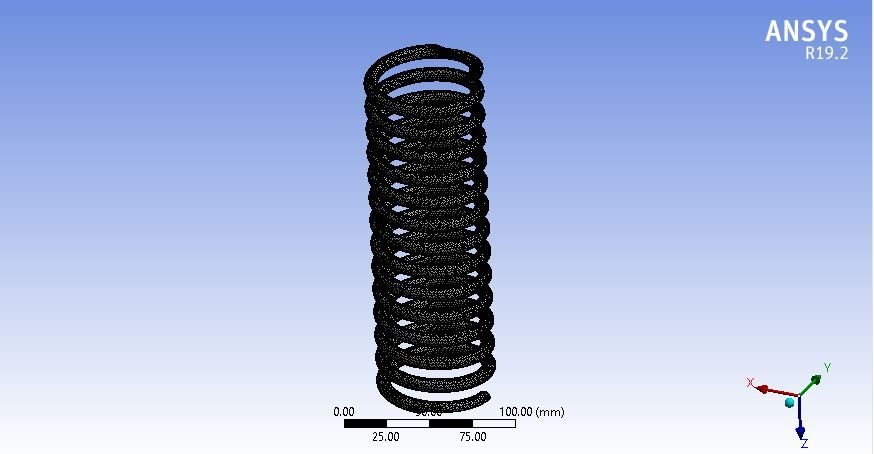
Three spring designs are modelled in SolidWorks using the helix and sweep features:
- Existing design: 15 mm pitch with 8 mm coil diameter, taken from earlier research work
- Modified design 1: 15.5 mm pitch with 7.5 mm coil diameter
- Modified design 2: 16 mm pitch with 8.25 mm coil diameter
The springs are imported into ANSYS Workbench and meshed. One end is fixed and a force is applied on the other end to represent the load from the bike weight with one and two riders. Two materials are compared:
- Steel (existing material): yield strength 249.97 MPa
- Steel AISI 416: a stainless steel with yield strength 300.01 MPa
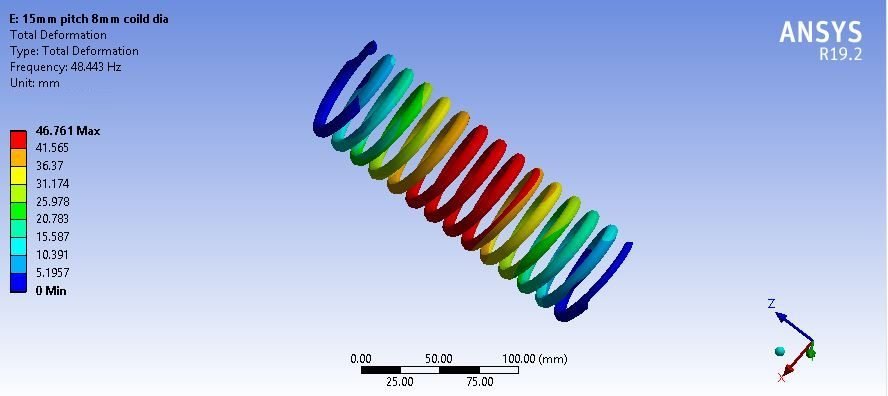
For every design and material, a static structural analysis gives total deformation, stress, strain and safety factor, and a modal analysis gives the first six natural frequencies, which show how the spring will respond to vibration from the road.
Software Used
- SolidWorks: helical spring modelling
- ANSYS Static Structural: deformation, stress, strain and safety factor
- ANSYS Modal: natural frequencies and mode shapes
Analysis Results


Key Results (Preview)
Existing design (15 mm pitch, 8 mm coil diameter):
| Result | Steel | Steel 416 |
|---|---|---|
| Total deformation (mm) | 1.6221 | 1.6818 |
| Equivalent stress (MPa) | 155.98 | 156.23 |
| Safety factor | 1.6027 | 1.9363 |
Both modified designs give better safety factor values than the existing design. Changing the pitch and coil diameter together changes the deformation and stress in different ways, which is explained with the full results, the modal frequencies and the recommended design in the project report.
Why This Project Matters
India has one of the largest two-wheeler markets in the world, and suspension comfort and durability are key selling points. Spring design is also a standard topic in machine design courses. This project links spring theory to real 3D models and simulation, and it clearly shows how small geometry changes affect performance, making it a great project for mechanical and automobile students.
Related Projects
Explore more design and analysis projects on similar topics:
- Design and Analysis of a 360 Degree Wheel Rotation Vehicle to Overcome Parking Problems: Chassis, Sprocket and U-Clamp (SolidWorks and ANSYS)
- Train Wheel Design and Transient Analysis: Steel, Steel 440C, Steel 416 and SAE 1020 (SolidWorks and ANSYS)
- Car Bumper Design and Impact Analysis – Polyetherimide, SiO₂ and Al₂O₃
- V6 Engine Camshaft Design and Analysis: Forged Steel vs Al-3003, EN-9 and Al-7475 (SolidWorks and ANSYS)
What You Get
- Design files: SolidWorks models of all three helical spring designs
- Analysis files: ANSYS Workbench static structural and modal analysis files for each design and material
- Project document: complete report with methodology, results and conclusion
- Class explanation: a session that explains what was done in the project, step by step, so you can understand and present it confidently
Who Is This Project For?
This project suits B.Tech and B.E. final year students, diploma students looking for a strong design and analysis project, and M.Tech students who need a base model they can extend for their thesis. It is also useful for anyone who wants to learn helical spring design, static structural analysis and modal analysis in ANSYS on a real engineering problem instead of a textbook example.
Frequently Asked Questions
What does the spring in a shock absorber do?
The coil spring carries the weight of the vehicle and rider and absorbs the impact from bumps. The damper inside the shock absorber then turns the energy of the spring’s motion into heat, so the vehicle does not keep bouncing.
Which spring designs are compared?
Three designs are compared: the existing design with 15 mm pitch and 8 mm coil diameter, a design with 15.5 mm pitch and 7.5 mm coil diameter, and a design with 16 mm pitch and 8.25 mm coil diameter.
Which materials are used?
Steel with a yield strength of 249.97 MPa is the existing material, and Steel AISI 416 with a yield strength of 300.01 MPa is studied as the new material for all three spring designs.
What results does the project give?
Static structural analysis gives total deformation, stress, strain and safety factor for each design and material, and modal analysis gives the first six natural frequencies of each spring.
Get the Shock Absorber Spring Analysis Project
Want this project for your final year, mini project or M.Tech work? Message us with your university, branch and deadline, and we will share the exact scope, files and report format.
Enquire about this project on WhatsApp or use the enquiry form on our home page. Browse more mechanical projects or 60+ mechanical engineering project ideas.
Interested in this project? Get the details, files and guidance from our team.
Enquire on WhatsApp