
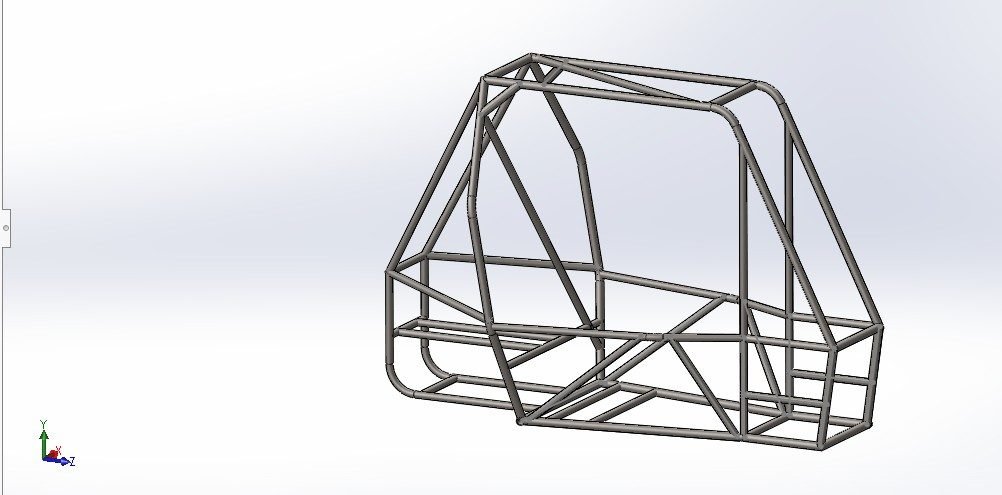
An all-terrain vehicle (ATV) is a small, single-seat off-road vehicle built for rough terrain, jumps, steep slopes and endurance driving. Its chassis, usually a tubular roll cage, holds the engine, suspension and driver, and must protect the driver in crashes and rollovers. Student teams design and build ATVs for competitions such as BAJA SAE, where the chassis must meet strict safety rules while staying light and affordable. This project designs a standard ATV chassis and analyses it with four materials.
Designing an ATV Roll Cage
The roll cage is a 3D space frame of welded tubes. The main hoop and front hoop protect the driver’s head, side members protect against side impacts, and lower frame members carry the powertrain and suspension. Designers usually check the frame against front, rear and side impacts and rollover, expressing the impact loads as multiples of the vehicle weight (G-forces). The design process is iterative: model, analyse, improve, and analyse again.
About the Project
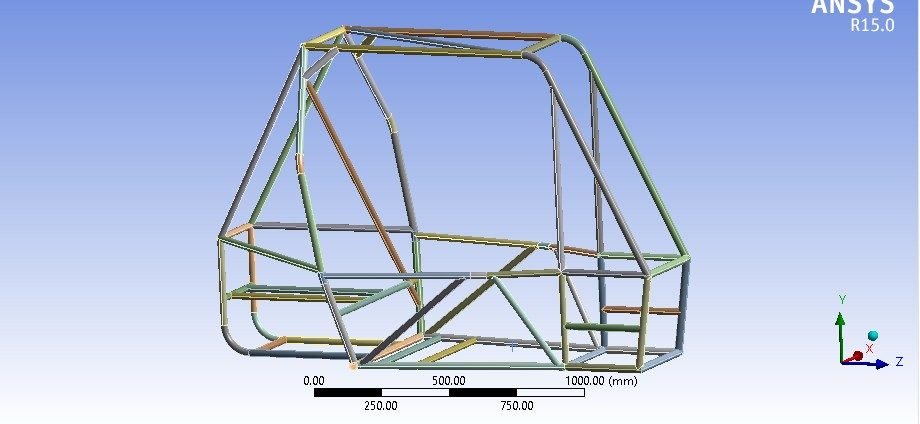
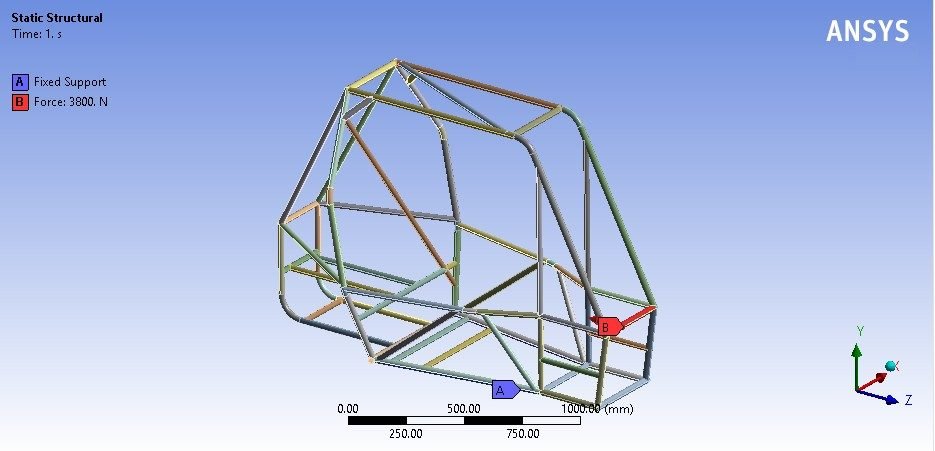
The chassis is modelled in SolidWorks and analysed in ANSYS Workbench. The bottom mounting area is fixed and an impact force of 3800 N is applied. Four materials are compared:
- Steel (existing material, yield strength 250 MPa as used in the report)
- Steel 440C (450 MPa)
- EN-9 (355 MPa)
- Al2O3 (325 MPa)
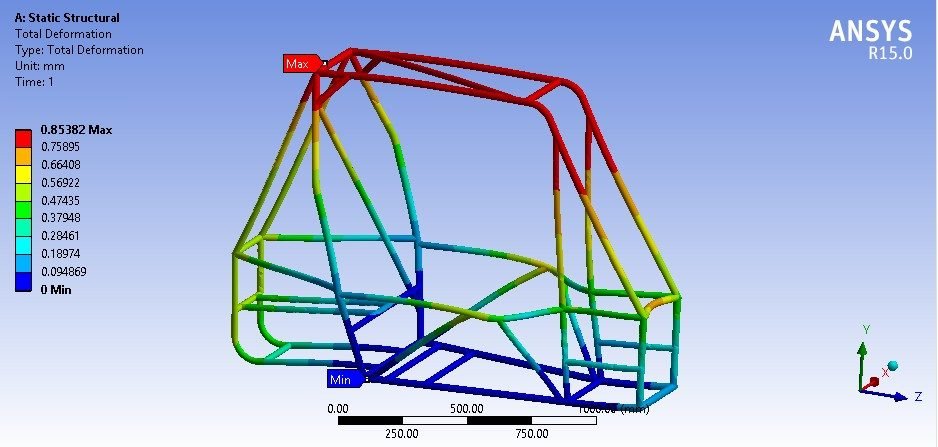
A static structural analysis calculates deformation, stress, strain and safety factor, and a modal analysis calculates the first six natural frequencies of the chassis.
Software Used
- SolidWorks: 3D chassis modelling
- ANSYS Workbench: static structural and modal analysis
Analysis Results
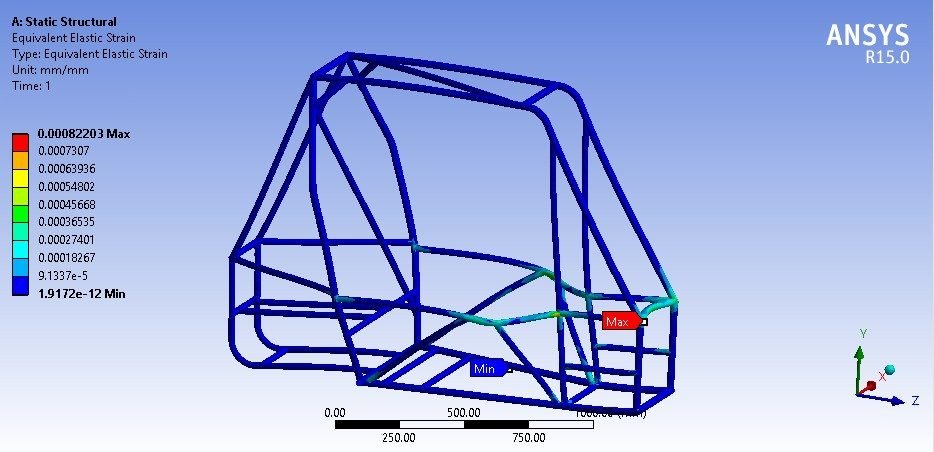
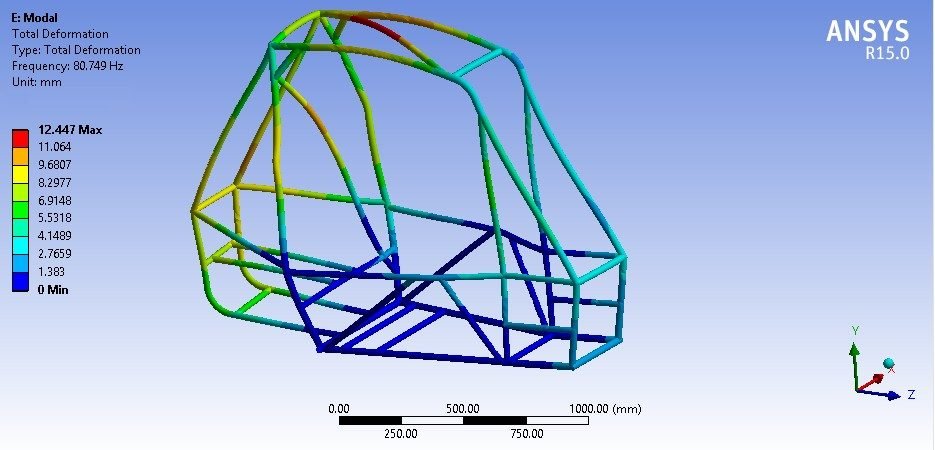
Key Results (Preview)
| Material | Deformation (mm) | Stress (MPa) | Safety factor | Mode 1 (Hz) |
|---|---|---|---|---|
| Steel | 0.85382 | 154.38 | 1.6194 | 31.855 |
| Al2O3 | 2.3342 | 152.46 | 2.1317 | 32.363 |
| Steel 440C | 0.85281 | 159.56 | 2.8203 | 32 |
| EN-9 | 0.81322 | 155.05 | 2.2896 | 32.645 |
All four materials stay safe at 3800 N, and the new materials give slightly higher natural frequencies than the existing steel. The full comparison, including cost and weight considerations and the final material recommendation, is explained in the project report.
Key Concepts Covered
- Space frame design: using triangulated tubes for a stiff, light chassis.
- Impact loads: how front, rear and side impacts are expressed as multiples of vehicle weight (G-forces).
- Safety factor: comparing the maximum stress with each material’s yield strength.
- Modal analysis: why chassis natural frequencies should stay away from engine and road excitation.
- Material selection: weighing strength, weight, cost and weldability for a real vehicle.
Project Workflow
- Study ATV chassis layouts and safety requirements.
- Model the roll cage tube by tube in SolidWorks.
- Import the chassis into ANSYS, mesh it and assign each material.
- Fix the bottom area, apply the 3800 N impact force and solve.
- Run the modal analysis for the first six modes.
- Compare the four materials in the report.
Why This Project Matters
Chassis design is one of the most practical and popular project areas for automobile and mechanical students, especially those involved in BAJA, SUPRA or go-kart events. This project teaches roll-cage modelling, impact loading and vibration analysis in one complete workflow.
Related Projects
Explore more design and analysis projects on similar topics:
- Piranha (Dune) Buggy Frame Design, Impact Analysis and Weight Estimation: AISI 4130 Steel vs CFRP (SolidWorks and ANSYS)
- Optimization and Analysis of a Heavy-Duty Truck Chassis with C, I and Box Sections: Steel 710, Steel 4130 and Al-7075 (CATIA and ANSYS)
- Manual Forklift Chassis Design and Analysis: Mild Steel, Steel 440C and Steel 304
- Design and Analysis of a Kia Carnival Wheel Rim with Al-6082 and Al-Li Alloy Under Multiple Passenger Loads (SolidWorks and ANSYS)
What You Get
- Design files: SolidWorks 3D model of the ATV chassis (with STEP and IGES files)
- Analysis files: ANSYS Workbench static structural and modal analysis files for all four materials
- Project document: complete report with methodology, results and conclusion
- Class explanation: a session that explains what was done in the project, step by step, so you can understand and present it confidently
Who Is This Project For?
This project suits B.Tech and B.E. final year students, diploma students looking for a strong design and analysis project, and M.Tech students who need a base model they can extend for their thesis. It is also useful for anyone who wants to learn roll-cage design, impact loading and modal analysis in ANSYS on a real engineering problem instead of a textbook example.
Frequently Asked Questions
What is an ATV chassis?
It is the tubular roll-cage frame of an all-terrain vehicle that carries the engine, suspension and driver and protects the driver in crashes.
What load is applied in the analysis?
The bottom mounting area is fixed and an impact force of 3800 N is applied to the chassis.
Which materials are compared?
Steel (the existing material), Steel 440C, EN-9 and Al2O3 are compared.
Why is modal analysis done on a chassis?
Engines and rough terrain cause vibration. Modal analysis finds the chassis natural frequencies so that resonance can be avoided.
Get the ATV Chassis Project
Want this project for your final year, mini project or M.Tech work? Message us with your university, branch and deadline, and we will share the exact scope, files and report format.
Enquire about this project on WhatsApp or use the enquiry form on our home page. Browse more mechanical projects or 60+ mechanical engineering project ideas.
Interested in this project? Get the details, files and guidance from our team.
Enquire on WhatsApp