
When a vehicle drives over bumps and rough roads, its suspension moves up and down continuously, and a conventional shock absorber simply turns that motion into heat. The report notes that only about 26% of the energy in a vehicle’s fuel actually goes into driving it; the rest is lost in various ways, including in the suspension. Regenerative shock absorbers aim to recover part of this wasted energy and turn it into electricity. This project designs a shock-absorber-based power generation system and analyses its key parts.

Working Principle
The system combines a spring with a rack and pinion mechanism. When the suspension is compressed, the rack moves in a straight line and turns the pinion (a spur gear). The rotation is passed to a generator, described in the report as a doubly fed induction generator, which produces electricity. The electrical energy is then stored in a battery or ultracapacitor for later use. In this way, ordinary up-and-down motion of the vehicle becomes a small but useful source of power, for example for lights or electronic systems.
About the Project
The spring, rack, spur gear and the complete test-rig frame are modelled in SolidWorks. The main load-carrying parts are analysed in ANSYS Workbench using static structural analysis:
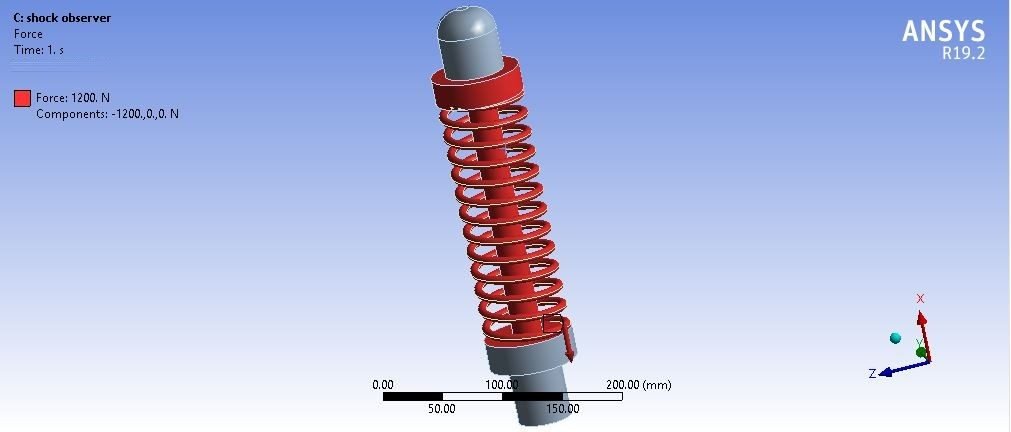
- The shock absorber spring is loaded with a force of 1200 N.
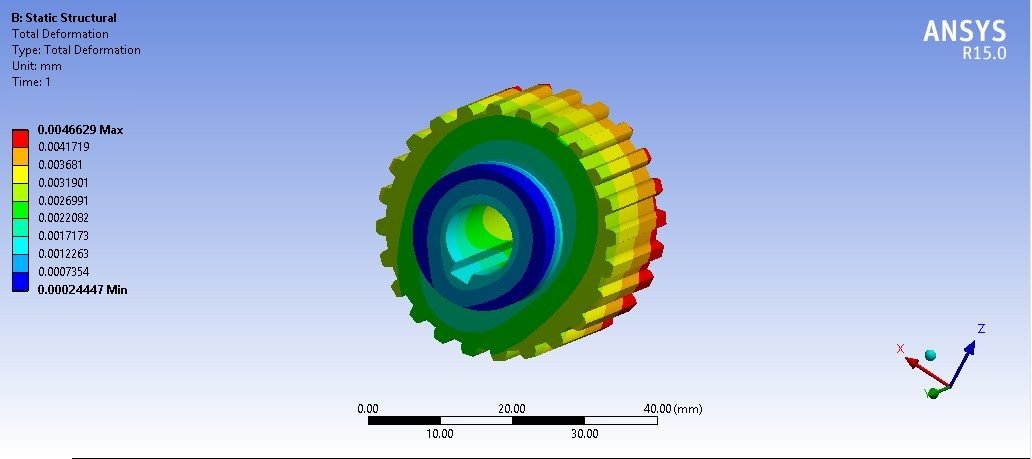
- The rack and spur gear are analysed with a pressure of 42 MPa and a rotational velocity of 1500 rpm.
Two materials are compared for each part: mild steel and aluminium alloy Al-2024. The results include total deformation, equivalent stress, strain and factor of safety.
Software Used
- SolidWorks: 3D modelling of the parts and assembly
- ANSYS Workbench: static structural analysis
Analysis Results


Key Results (Preview)
Shock absorber spring under 1200 N:
| Material | Deformation (mm) | Equivalent stress (MPa) | Factor of safety |
|---|---|---|---|
| Mild steel | 4.3457 | 132.71 | 1.8839 |
| Al-2024 | 10.427 | 120.01 | 2.7081 |
The aluminium spring deflects much more because it is less stiff, which changes how much motion reaches the rack. The rack and gear results and the final material recommendation are explained in the project report.
Project Workflow
- Study the energy lost in vehicle suspensions and existing energy-harvesting ideas.
- Design the spring, rack, spur gear and test-rig frame in SolidWorks.
- Assemble the parts to check the motion of the rack and pinion mechanism.
- Import each load-carrying part into ANSYS and mesh it.
- Apply 1200 N to the spring, and 42 MPa with 1500 rpm to the rack and gear.
- Solve for deformation, stress, strain and safety factor with mild steel and Al-2024.
- Compare the materials and explain the power generation concept in the report.
Why This Project Matters
Energy harvesting is a growing field in electric and hybrid vehicles, where every bit of recovered energy extends range. This project brings together mechanisms, electrical generation and finite element analysis, making it a great innovative final-year project for mechanical, automobile and EEE students.
Related Projects
Explore more design and analysis projects on similar topics:
- Foot Step Power Generation Using Rack and Pinion: Design and Analysis
- Piranha (Dune) Buggy Frame Design, Impact Analysis and Weight Estimation: AISI 4130 Steel vs CFRP (SolidWorks and ANSYS)
- Optimization and Analysis of a Heavy-Duty Truck Chassis with C, I and Box Sections: Steel 710, Steel 4130 and Al-7075 (CATIA and ANSYS)
- Manual Forklift Chassis Design and Analysis: Mild Steel, Steel 440C and Steel 304
What You Get
- Design files: SolidWorks 3D models of the spring, rack, spur gear and full test-rig assembly
- Analysis files: ANSYS Workbench static structural analysis files for the spring, rack and gear with both materials
- Project document: complete report with methodology, results and conclusion
- Class explanation: a session that explains what was done in the project, step by step, so you can understand and present it confidently
Who Is This Project For?
This project suits B.Tech and B.E. final year students, diploma students looking for a strong design and analysis project, and M.Tech students who need a base model they can extend for their thesis. It is also useful for anyone who wants to learn energy harvesting concepts, mechanism design and structural analysis in ANSYS on a real engineering problem instead of a textbook example.
Frequently Asked Questions
How does a shock absorber generate power?
Suspension movement drives a rack and pinion. The rack moves up and down and turns a gear connected to a generator, which produces electricity that is stored in a battery or ultracapacitor.
Which parts are analysed in ANSYS?
The shock absorber spring, the rack and the spur gear are analysed with static structural analysis.
What loads are used in the analysis?
The spring is loaded with 1200 N, and the rack and spur gear are analysed with a pressure of 42 MPa and a rotational velocity of 1500 rpm.
Which materials are compared?
Mild steel and aluminium alloy Al-2024 are compared for each part.
Get the Shock Absorber Power Generation Project
Want this project for your final year, mini project or M.Tech work? Message us with your university, branch and deadline, and we will share the exact scope, files and report format.
Enquire about this project on WhatsApp or use the enquiry form on our home page. Browse more mechanical projects or 60+ mechanical engineering project ideas.
Interested in this project? Get the details, files and guidance from our team.
Enquire on WhatsApp