
A shock absorber is the part of a vehicle’s suspension that smooths out bumps and shocks from the road. In a motorcycle or scooter, a helical coil spring carries the load and absorbs the impact, while a damper inside converts the energy of the motion into heat so the vehicle does not keep bouncing. The spring decides how stiff or soft the ride feels and how much load the vehicle can carry. This project designs a two-wheeler shock absorber spring, creates two modified versions by changing its geometry, and compares two materials.
How Spring Geometry Affects Performance
The behaviour of a helical spring depends on a few key dimensions: the pitch (the distance between neighbouring coils), the coil (wire) diameter, the mean coil diameter and the number of turns. A thicker wire makes the spring stiffer and lowers the stress for the same load, while a larger pitch changes how much the spring can compress before the coils touch. By adjusting these values, designers can tune ride comfort, load capacity and spring life.
About the Shock Absorber Spring Project
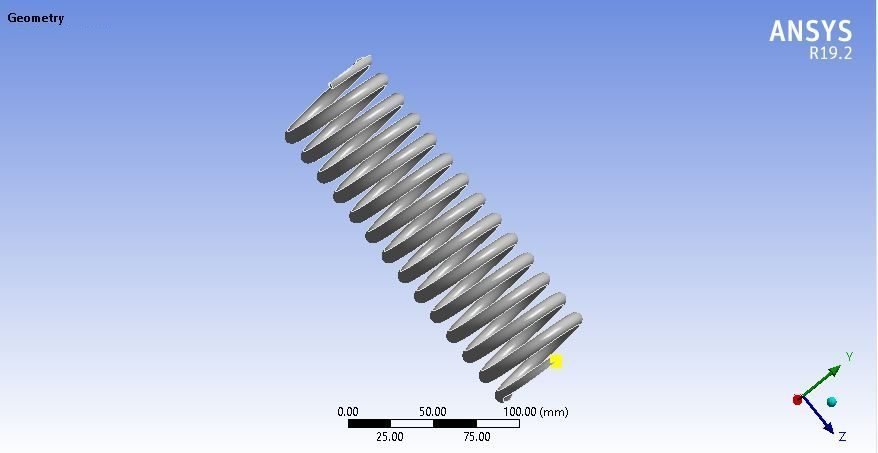
Three spring designs are modelled in CAD using the helix and sweep features:
- Existing design: 15 mm pitch with 8 mm coil diameter, taken from earlier research work
- Modified design 1: 15.5 mm pitch with 7.5 mm coil diameter
- Modified design 2: 16 mm pitch with 8.25 mm coil diameter
The springs are imported into FEA and meshed. One end is fixed and a force is applied on the other end to represent the load from the bike weight with one and two riders. Two materials are compared:
- Steel (existing material): yield strength 249.97 MPa
- Steel AISI 416: a stainless steel with yield strength 300.01 MPa
For every design and material, a static structural analysis gives total deformation, stress, strain and safety factor, and a modal analysis gives the first six natural frequencies, which show how the spring will respond to vibration from the road.
Software Used
- CAD: helical spring modelling
- FEA: deformation, stress, strain and safety factor
- FEA: natural frequencies and mode shapes
Analysis Results
Key Results (Preview)
Existing design (15 mm pitch, 8 mm coil diameter):
| Result | Steel | Steel 416 |
|---|---|---|
| Total deformation (mm) | 1.6221 | 1.6818 |
| Equivalent stress (MPa) | 155.98 | 156.23 |
| Safety factor | 1.6027 | 1.9363 |
Both modified designs give better safety factor values than the existing design. Changing the pitch and coil diameter together changes the deformation and stress in different ways, which is explained with the full results, the modal frequencies and the recommended design in our live class or recorded video for this project.
Why the Shock Absorber Spring Project Matters
India has one of the largest two-wheeler markets in the world, and suspension comfort and durability are key selling points. Spring design is also a standard topic in machine design courses. This project links spring theory to real 3D models and simulation, and it clearly shows how small geometry changes affect performance, making it a great project for mechanical and automobile students.
Related Projects
Explore more design and analysis projects on similar topics:
- Design and Analysis of a 360 Degree Wheel Rotation Vehicle to Overcome Parking Problems: Chassis, Sprocket and U-Clamp (CAD and FEA)
- Train Wheel Design and Transient Analysis: Steel, Steel 440C, Steel 416 and SAE 1020 (CAD and FEA)
- Car Bumper Design and Impact Analysis – Polyetherimide, SiO₂ and Al₂O₃
- V6 Engine Camshaft Design and Analysis: Forged Steel vs Al-3003, EN-9 and Al-7475 (CAD and FEA)
What Support You Get
- Design guidance: how to build the CAD model yourself – CAD models of all three helical spring designs
- Analysis guidance: how to set up and run the analysis yourself – FEA static structural and modal analysis files for each design and material
- Report guidance: how to structure your own report – methodology, results and conclusion
- Live class: a step-by-step explanation of the method while you work on your own licensed software, so you can understand it and present your work confidently
Studying abroad? We guide you too – learn to build projects like this in our live classes, on your own licensed software.
Who Is This Project For?
This shock absorber spring project is a good learning example for B.Tech and B.E. final year students, diploma students who want to learn design and analysis, and M.Tech students who want to learn a method they can extend in their own thesis. It is also useful for anyone who wants to learn helical spring design, static structural analysis and modal analysis in FEA on a real engineering problem instead of a textbook example.
Frequently Asked Questions
What does the spring in a shock absorber do?
The coil spring carries the weight of the vehicle and rider and absorbs the impact from bumps. The damper inside the shock absorber then turns the energy of the spring’s motion into heat, so the vehicle does not keep bouncing.
Which spring designs are compared?
Three designs are compared: the existing design with 15 mm pitch and 8 mm coil diameter, a design with 15.5 mm pitch and 7.5 mm coil diameter, and a design with 16 mm pitch and 8.25 mm coil diameter.
Which materials are used?
Steel with a yield strength of 249.97 MPa is the existing material, and Steel AISI 416 with a yield strength of 300.01 MPa is studied as the new material for all three spring designs.
What results does the project give?
Static structural analysis gives total deformation, stress, strain and safety factor for each design and material, and modal analysis gives the first six natural frequencies of each spring.
Learn the Shock Absorber Spring Project With Us
Want to learn the shock absorber spring project for your final year, mini project or M.Tech work? Message us with your university, branch and deadline, and we will share a learning plan – live classes and step-by-step guidance while you build it yourself.
Enquire about this project on WhatsApp or use the enquiry form on our home page. Browse more mechanical projects or 60+ mechanical engineering project ideas.
Interested in this project? Get the details, files and guidance from our team.
Enquire on WhatsApp