
A go-kart is a small open-wheel vehicle with no suspension, so the chassis does almost everything: it carries the driver, engine, steering and brakes, and it acts as the suspension by flexing slightly in corners. It must also protect the driver in a collision. A good kart frame is therefore stiff, strong and as light as possible, because lower weight means faster acceleration, better braking and lower fuel use. The key measure is the strength-to-weight ratio. This project designs a go-kart frame and compares the existing steel with two lighter materials.
Frame Design
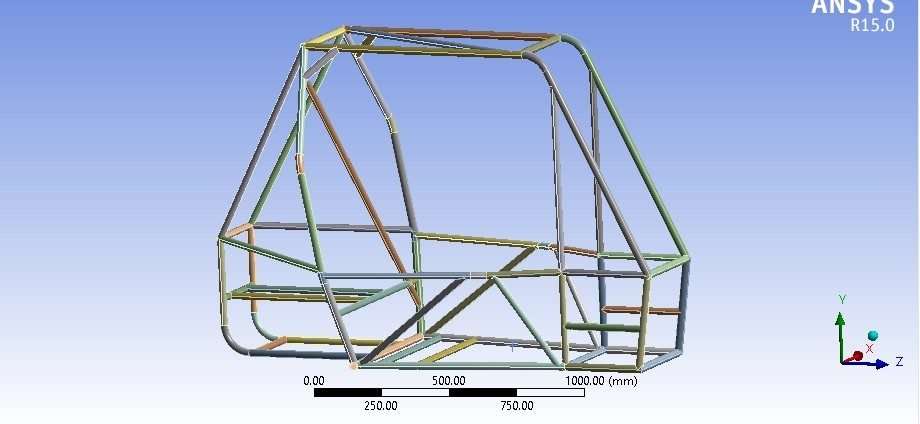
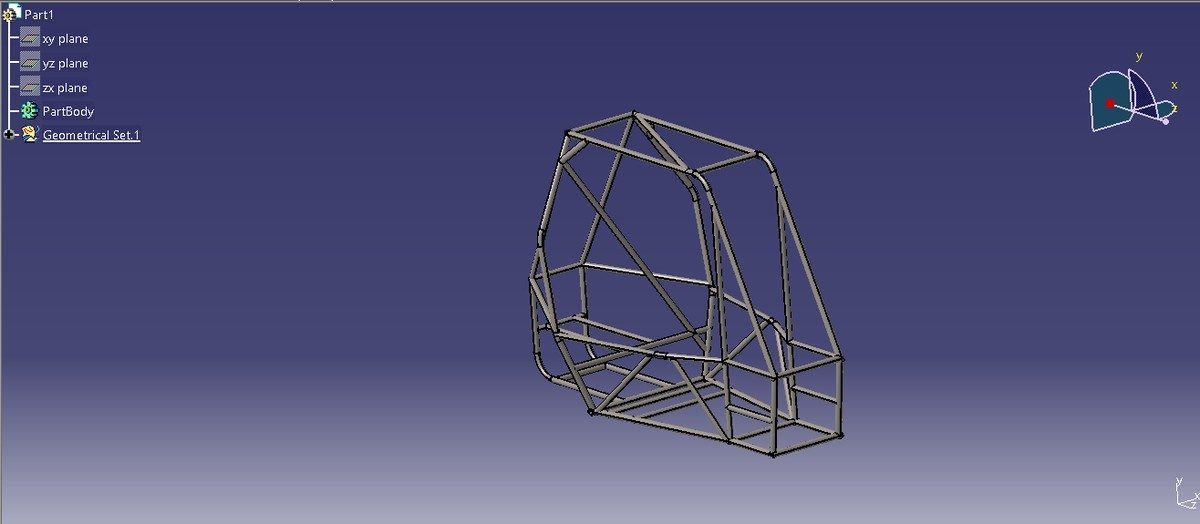
The frame is designed in CATIA. First, a wireframe of points and lines is built from the main dimensions of the kart, covering the wheelbase, track width, driver position and roll protection. Tubular sections are then swept along the lines to form the complete frame.
Design Loads
Impact loads are worked out from the weight acting on the frame (G = m × g = 30 × 9.81 = 294.3 N) multiplied by standard g-factors for each crash case:
| Load case | g-factor | Load |
|---|---|---|
| Front impact | 4 G | 1177.2 N |
| Rear impact | 3 G | 882.9 N |
| Side impact | 2 G | 588.78 N |
| Roll-over | 1.5 G | 441.45 N |
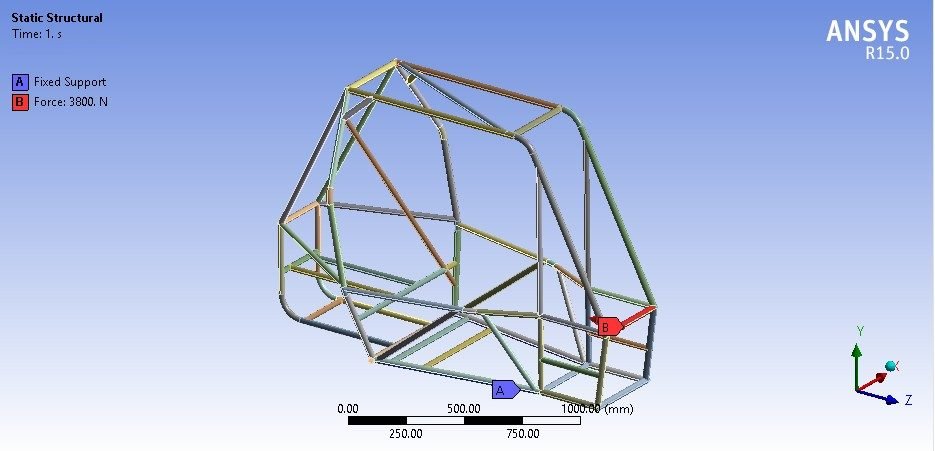
For the ANSYS study, the frame is fixed at its supports and an impact force of 3800 N is applied.
About the Project
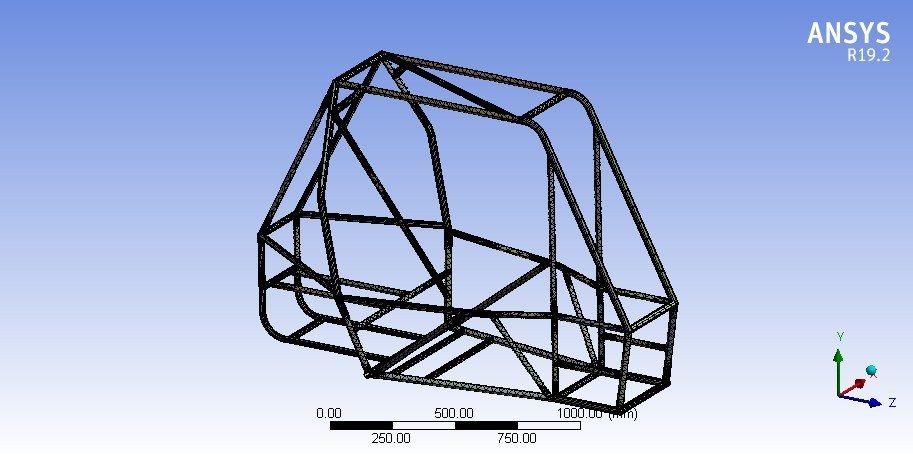
The CATIA model is imported into ANSYS Workbench for:
- Static structural analysis under the 3800 N impact force, giving deformation, stress, strain and safety factor.
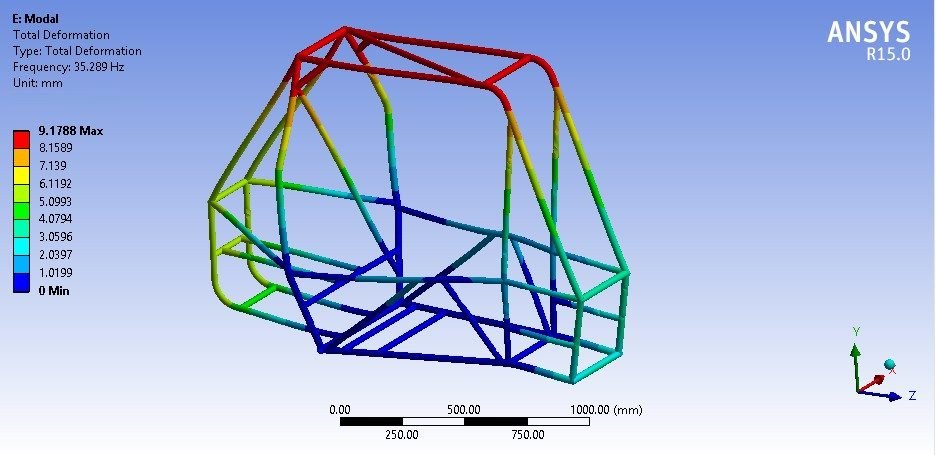
- Modal analysis to find the first six natural frequencies of the frame.
Three materials are compared: steel (the existing material, yield 250 MPa), Al-6061 aluminium alloy (yield 276 MPa) and Kevlar (yield 650 MPa).
Software Used
- CATIA: wireframe and tubular frame design
- ANSYS Workbench: static structural and modal analysis
Analysis Setup
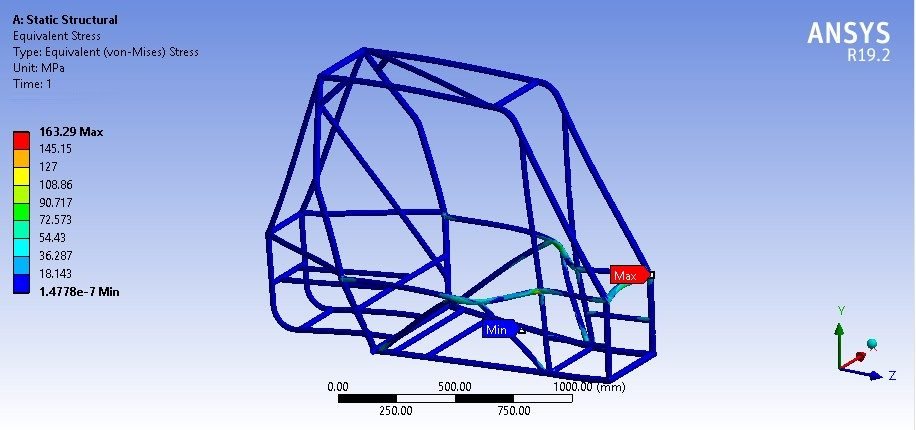
Static Structural Results
| Result | Steel | Al-6061 | Kevlar |
|---|---|---|---|
| Deformation (mm) | 0.82664 | 2.3979 | 1.992 |
| Equivalent stress (MPa) | 163.29 | 161.47 | 163.87 |
| Strain | 0.00083895 | 0.0024048 | 0.0020305 |
| Safety factor | 1.531 | 1.7093 | 3.9667 |
Modal Analysis Results
| Mode | Steel (Hz) | Al-6061 (Hz) | Kevlar (Hz) |
|---|---|---|---|
| 1 | 31.855 | 32.363 | 32.645 |
| 2 | 35.289 | 35.856 | 36.162 |
| 3 | 48.589 | 49.383 | 49.787 |
| 4 | 76.849 | 78.101 | 78.745 |
| 5 | 77.146 | 82.037 | 82.748 |
| 6 | 81.097 | 93.475 | 95.384 |
The weight and cost comparison and the final material choice are explained in the project report.
Why Material Choice Matters for Kart Frames
Steel tube is the traditional kart frame material because it is cheap, easy to weld and tough. Aluminium alloy 6061 has about one third of steel’s density, so it can cut frame weight sharply, though it is less stiff. Kevlar is a high-strength aramid fibre composite that is very light and absorbs impact energy well. Comparing all three under the same impact load and checking their natural frequencies shows the real trade-off between weight, strength and stiffness.
Real-World Applications
- Karting competitions: college go-kart events and racing.
- Recreational karts: amusement parks and rental tracks.
- Electric karts: lightweight frames for battery karts.
- Small vehicle frames: ATVs, buggies and utility carts.
Key Concepts Covered
- Strength-to-weight ratio in vehicle design.
- Impact load cases: front, rear, side and roll-over.
- Natural frequency of vehicle frames and road excitation.
- Composites vs metals: Kevlar, aluminium and steel.
Project Workflow
- Study go-kart rules and frame layouts.
- Calculate the impact loads.
- Design the frame in CATIA.
- Run static and modal analysis for steel, Al-6061 and Kevlar.
- Compare results, weight and cost in the report.
Why This Project Matters
Go-kart design is one of the most popular hands-on projects for mechanical and automobile students, and it links directly to student competitions.
Related Projects
Explore more design and analysis projects on similar topics:
- All-Terrain Vehicle (ATV) Chassis Design and Analysis: Steel vs Steel 440C, EN-9 and Al2O3 (Static and Modal, ANSYS)
- Piranha (Dune) Buggy Frame Design, Impact Analysis and Weight Estimation: AISI 4130 Steel vs CFRP (SolidWorks and ANSYS)
- Optimization and Analysis of a Heavy-Duty Truck Chassis with C, I and Box Sections: Steel 710, Steel 4130 and Al-7075 (CATIA and ANSYS)
- Manual Forklift Chassis Design and Analysis: Mild Steel, Steel 440C and Steel 304
What You Get
- Design files: CATIA wireframe and tubular frame model of the go-kart chassis
- Analysis files: ANSYS Workbench static structural (impact) and modal analysis files for three materials
- Project document: complete report with methodology, results and conclusion
- Class explanation: a session that explains what was done in the project, step by step, so you can understand and present it confidently
Who Is This Project For?
This project suits B.Tech and B.E. final year students, diploma students looking for a strong design and analysis project, and M.Tech students who need a base model they can extend for their thesis. It is also useful for anyone who wants to learn CATIA frame modelling and ANSYS static and modal analysis on a real engineering problem instead of a textbook example.
Frequently Asked Questions
Which software is used for the go-kart chassis?
The frame is designed in CATIA and analysed in ANSYS Workbench.
What impact load is applied?
An impact force of 3800 N is applied for the static structural analysis.
Which materials are compared?
Steel (existing), Al-6061 aluminium alloy and Kevlar.
Why is modal analysis done?
To find the natural frequencies of the frame so that it does not resonate with vibration from the engine and road.
Get the Go-Kart Chassis Project
Want this project for your final year, mini project or M.Tech work? Message us with your university, branch and deadline, and we will share the exact scope, files and report format.
Enquire about this project on WhatsApp or use the enquiry form on our home page. Browse more mechanical projects or 60+ mechanical engineering project ideas.
Interested in this project? Get the details, files and guidance from our team.
Enquire on WhatsApp