
Ropeways and cable cars carry people and materials across valleys, rivers, mountains and construction sites where roads are difficult to build. Their most important component is the wire rope. A wire rope is made of many thin steel wires twisted together in a helical pattern, which makes it flexible enough to wind around pulleys yet strong enough to carry heavy loads. If a rope is weak, overloaded or vibrates excessively, the whole system becomes unsafe. This project models a helical ropeway rope and studies how different steels change its strength and vibration behaviour.

How a Helical Wire Rope Works
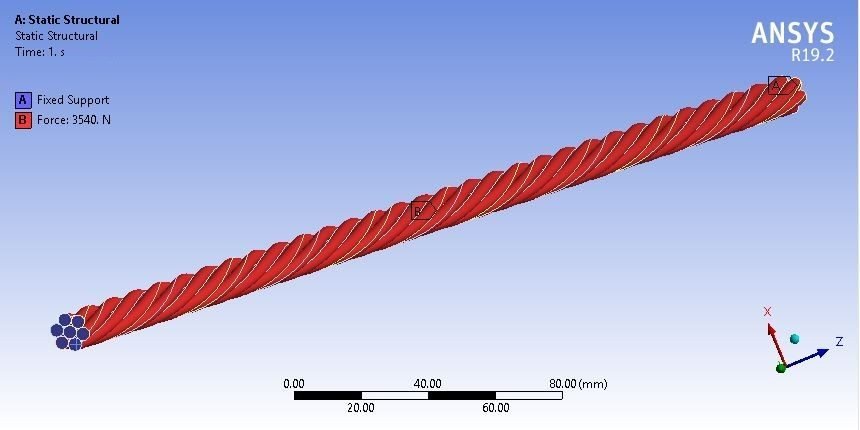
In a stranded rope, each wire follows a helix around the rope’s axis. When the rope is pulled, the helical wires share the load and tighten against each other, giving a high load capacity while still allowing bending. The rope in this project uses a simple 7-wire construction: one central wire surrounded by six wires twisted around it. Each wire has a diameter of 5 mm, and the rope length studied is 1.5 m.

About the Project
The rope is created in SolidWorks using a sketch of the strand cross-section and a twisted sweep along the rope length. It is then analysed in ANSYS Workbench. One end is fixed and a tensile force of 3540 N is applied at the other end. Five cases are compared:
- SS 304 (yield strength 300 MPa as used in the report)
- SS 416 (650 MPa)
- Steel 440C (450 MPa)
- S45C carbon steel (710 MPa)
- A combined rope, where different wires are given different materials
A static structural analysis gives deformation, stress, strain and safety factor, and a modal analysis gives the first six natural frequencies.

Software Used
- SolidWorks: strand sketch and helical sweep modelling
- ANSYS Workbench: static structural and modal analysis
Analysis Results


Key Results (Preview)
| Rope | Deformation (mm) | Stress (MPa) | Safety factor | Mode 1 (Hz) |
|---|---|---|---|---|
| SS 304 | 0.45433 | 197.13 | 1.5218 | 517.46 |
| SS 416 | 0.43115 | 197.17 | 3.2967 | 527.77 |
| Steel 440C | 0.41774 | 198.2 | 2.2704 | 536.12 |
| S45C | 0.4363 | 196.99 | 3.6043 | 522.32 |
| Combined materials | 0.43747 | 277.93 | 1.6191 | 530.85 |
The single-material ropes carry almost the same stress, so their safety factors follow their yield strengths. Mixing materials in one rope raises the stress noticeably. The higher modes and the final material recommendation are explained in the project report.
Key Concepts Covered
- Helical sweep modelling: building twisted strands from a cross-section sketch and a path.
- Tension loading: how a pulled rope shares load between its wires.
- Safety factor and yield strength: why ropes with similar stress can have very different safety margins.
- Natural frequency: how material stiffness and density change rope vibration.
Project Workflow
- Study ropeway systems and wire rope construction.
- Sketch the 7-wire strand cross-section in SolidWorks.
- Create the helical rope with a twisted sweep over 1.5 m.
- Mesh the rope in ANSYS and assign each material.
- Fix one end, apply 3540 N at the other, and solve the static analysis.
- Run the modal analysis for the first six modes.
- Compare all five cases in the report.
Why This Project Matters
Wire ropes are used in cranes, elevators, bridges, ropeways and mining. Modelling a helical rope is also a great exercise in advanced CAD features. This project is a good final-year choice for mechanical and civil engineering students interested in lifting and transport systems.
Related Projects
Explore more design and analysis projects on similar topics:
- Friction Stir Welding Tool Design and Analysis – Circular, Hexagonal, Tapered and Truncated Pins
- Thread Milling Cutter Design and Analysis: Rectangular, Triangular and Rhombic Profiles
- Hydraulic Scissor Lift Design and Analysis for an 80 kN Load
- Pneumatic Sheet Metal Bending and Cutting Machine: Design and Analysis for Aluminium and Galvanized Iron Sheets (SolidWorks and ANSYS)
What You Get
- Design files: SolidWorks 3D model of the helical 7-strand rope
- Analysis files: ANSYS Workbench static structural and modal analysis files for all five rope cases
- Project document: complete report with methodology, results and conclusion
- Class explanation: a session that explains what was done in the project, step by step, so you can understand and present it confidently
Who Is This Project For?
This project suits B.Tech and B.E. final year students, diploma students looking for a strong design and analysis project, and M.Tech students who need a base model they can extend for their thesis. It is also useful for anyone who wants to learn helical sweep modelling, static and modal analysis of wire ropes in ANSYS on a real engineering problem instead of a textbook example.
Frequently Asked Questions
What is a helical wire rope?
It is a rope made of steel wires twisted around a central wire in a helix. The twist lets the wires share the load while keeping the rope flexible.
What load is applied to the rope?
One end of the rope is fixed and a tensile force of 3540 N is applied at the other end.
Which materials are compared?
SS 304, SS 416, Steel 440C and S45C are compared, along with a rope that combines different materials in different wires.
Why is modal analysis done for a ropeway rope?
Ropes can vibrate due to wind and moving loads. Modal analysis finds the natural frequencies so that resonance can be avoided.
Get the Helical Ropeway Rope Project
Want this project for your final year, mini project or M.Tech work? Message us with your university, branch and deadline, and we will share the exact scope, files and report format.
Enquire about this project on WhatsApp or use the enquiry form on our home page. Browse more mechanical projects or 60+ mechanical engineering project ideas.
Interested in this project? Get the details, files and guidance from our team.
Enquire on WhatsApp