
A clutch connects and disconnects the engine from the rest of the transmission. When the driver presses the clutch pedal, the engine keeps running while the wheels are free, which allows smooth starting, stopping and gear changing. When the pedal is released, friction between the clutch plates transmits the engine torque to the gearbox. A multi-plate clutch uses several friction plates stacked together, so it can transmit high torque in a small diameter. That is why it is used in motorcycles, racing cars, heavy-duty vehicles and automatic transmissions, where high torque must pass through limited space.

How a Multi-Plate Clutch Works
A multi-plate clutch has two sets of plates arranged alternately: drive plates connected to the engine side, and driven plates with friction linings connected to the gearbox shaft. Springs press the stack together, and the friction at every pair of surfaces adds up, so more plates mean more torque capacity. During engagement, the plates slip briefly and produce heat, so the friction material must carry pressure, resist wear and survive high temperatures, while the base plates must stay strong and conduct heat away.
About the Project
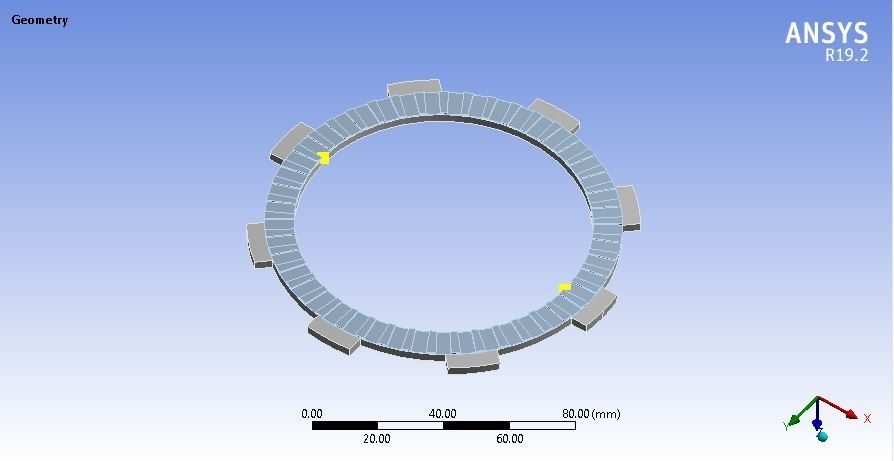
The clutch is first designed with standard formulas for the torque transmitted and the axial force and pressure on the friction lining, based on the uniform wear and uniform pressure theories. The plates are then modelled in SolidWorks and assembled into a multi-plate clutch. The model is imported into ANSYS Workbench, meshed and analysed with four material combinations:
- Grey cast iron base plate with carbon-carbon friction lining
- Grey cast iron base plate with Kevlar friction lining
- Aluminium alloy base plate with carbon-carbon friction lining
- Aluminium alloy base plate with Kevlar friction lining
Three types of analysis are carried out:
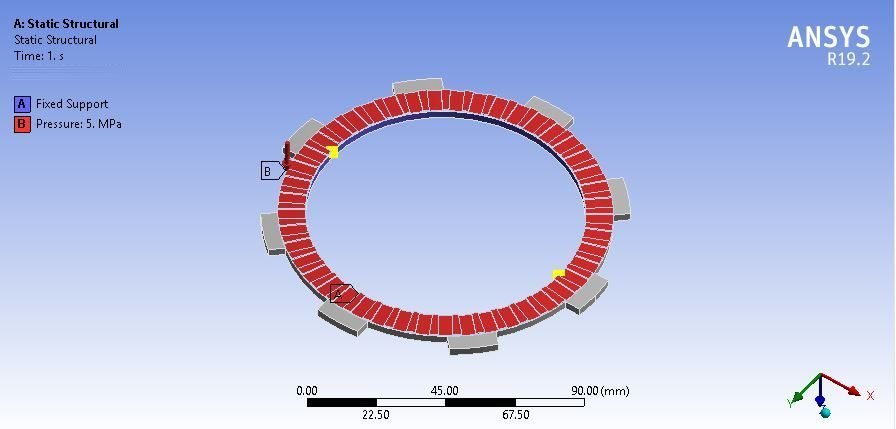
- Static structural: a pressure of 5 MPa on the friction surface, giving deformation, stress, strain and safety factor
- Modal: the first six natural frequencies of each combination
- Steady-state thermal: convection at the base plate (bulk temperature 28 °C, film coefficient 5e-6 W/mm²·°C) and at the friction plate (bulk temperature 350 °C, film coefficient 2.48e-4 W/mm²·°C), giving temperature and heat flux

Software Used
- SolidWorks: clutch plate modelling and assembly
- ANSYS Static Structural: deformation, stress, strain and safety factor
- ANSYS Modal: natural frequencies
- ANSYS Steady-State Thermal: temperature and heat flux
Analysis Results

Key Results (Preview)
| Combination | Deformation (mm) | Stress (MPa) | Safety factor |
|---|---|---|---|
| Grey cast iron + carbon-carbon | 0.031689 | 122.43 | 2.042 |
| Grey cast iron + Kevlar | 0.026009 | 141.67 | 2.0226 |
| Al-alloy + carbon-carbon | 0.042966 | 110.22 | 1.5394 |
| Al-alloy + Kevlar | 0.033675 | 172.94 | 2.4937 |
All four combinations can carry a pressure of 5 MPa. The modal and thermal results, and which combination suits high-performance use and which suits low-cost regular use, are explained in the project report.
Why This Project Matters
Clutches are found in almost every vehicle with a manual or automatic transmission, and friction material research is active because of the push for better durability and lower weight. This project combines clutch design theory with structural, vibration and thermal analysis, making it a complete and practical project for automobile and mechanical students.
Related Projects
Explore more design and analysis projects on similar topics:
- Regenerative Braking System with Flywheel – Design, Static and Modal Analysis
- Electromagnetic Braking System: Design, Calculations and Component Analysis
- Two-Wheeler Disc Brake Rotor: Structural, Thermal and Modal Analysis
- Tractor Rear Axle Shaft Design and Analysis: Mild Steel, Ni-Chrome and Invar
What You Get
- Design files: SolidWorks models of the clutch plates and the multi-plate clutch assembly, with clutch design calculations
- Analysis files: ANSYS Workbench static structural, modal and steady-state thermal files for all four material combinations
- Project document: complete report with methodology, results and conclusion
- Class explanation: a session that explains what was done in the project, step by step, so you can understand and present it confidently
Who Is This Project For?
This project suits B.Tech and B.E. final year students, diploma students looking for a strong design and analysis project, and M.Tech students who need a base model they can extend for their thesis. It is also useful for anyone who wants to learn clutch design, friction material selection and structural and thermal analysis in ANSYS on a real engineering problem instead of a textbook example.
Frequently Asked Questions
What is the difference between a single plate and a multi-plate clutch?
A single plate clutch has one friction plate, so it needs a larger diameter to carry high torque. A multi-plate clutch stacks several friction plates, so it can transmit high torque in a smaller diameter, which suits motorcycles, racing cars and heavy vehicles.
Why are Kevlar and carbon-carbon used as friction materials?
Both can carry high pressure, resist wear and work at high temperatures. Kevlar is a strong, light aramid fibre, and carbon-carbon is a carbon fibre composite used in racing and aircraft brakes because it handles very high temperatures well.
What pressure is applied in the static analysis?
A pressure of 5 MPa is applied on the friction surface of the clutch plates, and the deformation, stress, strain and safety factor are calculated for all four material combinations.
Why is thermal analysis needed for a clutch?
Each time the clutch engages, the plates slip briefly and produce heat. Thermal analysis shows the temperature distribution and heat flux, which tell how well each material combination removes heat and avoids overheating.
Get the Multi-Plate Clutch Design and Analysis Project
Want this project for your final year, mini project or M.Tech work? Message us with your university, branch and deadline, and we will share the exact scope, files and report format.
Enquire about this project on WhatsApp or use the enquiry form on our home page. Browse more mechanical projects or 60+ mechanical engineering project ideas.
Interested in this project? Get the details, files and guidance from our team.
Enquire on WhatsApp