
When a rider applies the brake, the pads clamp the rotating brake disc and friction slows the wheel. In that moment the disc carries two kinds of load at once: the mechanical load from the pad force and braking torque, and the thermal load from the heat that friction produces. Because these act together on a disc with holes and a complex shape, a simple hand calculation cannot give the full picture, so the finite element method is used. A good disc must be strong, must get rid of heat quickly, and must not vibrate at frequencies that cause noise or resonance.

Disc Rotor Design
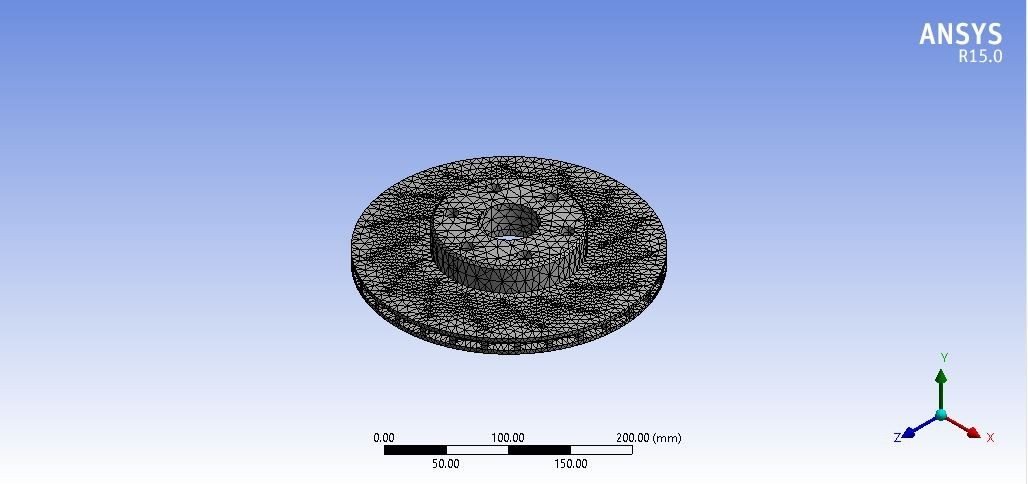
The rotor is built in Creo step by step: a revolved disc profile, the central mounting hole and bolt holes, and a pattern of drilled holes across the braking surface. The drilled holes reduce weight, help cooling and clear water and dust from the pad contact area.

About the Project
The model is imported into ANSYS Workbench and analysed in three ways:
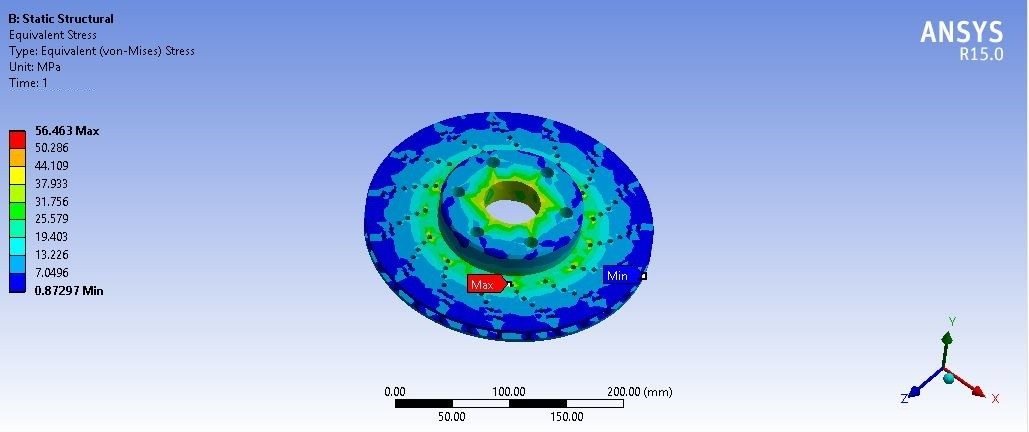
- Static structural analysis: the disc is fixed at its mounting, and a force of 25000 N with a moment of 2 × 10⁶ N-mm is applied.
- Steady-state thermal analysis: a temperature of 22 °C with convection at 127 °C (film coefficient 1 × 10⁻⁵ W/mm²·°C).
- Modal analysis: the first six natural frequencies.
Two materials are compared: grey cast iron, the existing disc material (yield 240 MPa, thermal conductivity 54 W/m-K), and an aluminium alloy (yield 280 MPa, thermal conductivity 155 W/m-K).
Software Used
- Creo: disc rotor modelling
- ANSYS Workbench: static structural, steady-state thermal and modal analysis
Analysis Setup

Static Structural Results
| Result | Grey cast iron | Aluminium alloy |
|---|---|---|
| Deformation (mm) | 0.088468 | 0.14583 |
| Equivalent stress (MPa) | 56.463 | 55.041 |
| Safety factor | 4.2506 | 5.0871 |
Thermal Results
| Result | Grey cast iron | Aluminium alloy |
|---|---|---|
| Total temperature (°C) | 24.126 | 22.751 |
| Total heat flux (W/mm²) | 0.0022231 | 0.0022527 |

Modal Analysis Results
| Mode | Grey cast iron (Hz) | Aluminium alloy (Hz) |
|---|---|---|
| 1 | 1494.5 | 1968 |
| 2 | 1494.8 | 1968.6 |
| 3 | 1497.3 | 1981.7 |
| 4 | 1642.5 | 2132.8 |
| 5 | 1642.6 | 2133 |
| 6 | 2182.5 | 2805.3 |

The weight comparison and the final material recommendation are explained in the project report.
Why Material Choice Matters for Brake Discs
Grey cast iron has been the standard disc material for decades because it is cheap, easy to cast, damps vibration well and resists wear. Its drawback is weight: a heavy disc adds unsprung mass to the wheel, which hurts handling and ride comfort, and it takes more energy to spin up and slow down. Aluminium alloys are about one third of the density of cast iron and conduct heat almost three times better, so they can spread braking heat quickly. However, aluminium softens at lower temperatures than iron, so its strength, stiffness and natural frequencies must be checked carefully before it can replace cast iron. Comparing both materials under the same loads shows these trade-offs clearly.
Real-World Applications
- Motorcycles and scooters: front and rear disc brakes.
- Cars: drilled and vented brake rotors.
- Bicycles and e-bikes: lightweight disc rotors.
- Racing: lightweight rotors for better handling.
Key Concepts Covered
- Combined loading: force and torque acting together on the disc.
- Heat dissipation: conduction and convection from the braking surface.
- Drilled rotors: weight saving and cooling.
- Natural frequency: avoiding brake noise and resonance.
Project Workflow
- Study disc brakes and rotor designs.
- Model the drilled rotor in Creo.
- Apply force and moment and run static analysis.
- Run thermal and modal analysis for both materials.
- Compare results in the report.
Why This Project Matters
Brakes are a safety-critical system, and lighter rotors improve both handling and fuel economy. This project covers structural, thermal and vibration analysis in one study.
Related Projects
Explore more design and analysis projects on similar topics:
- Aircraft Disc Brake Rotor Design and Analysis: Al Metal Matrix Composite vs Al-7075 and CFRP (Structural, Thermal and Modal, ANSYS)
- Design and Analysis of a Pulsar Disc Brake Rotor: Structural and Thermal Analysis with Steel, Cast Iron and Al-7068 (SolidWorks and ANSYS)
- Single Plate Clutch Design and Analysis: Steel vs SS-304, SAE 1137 and Al-2048 (Static and Modal, Creo and ANSYS)
- Design and Analysis of a 360 Degree Wheel Rotation Vehicle to Overcome Parking Problems: Chassis, Sprocket and U-Clamp (SolidWorks and ANSYS)
What You Get
- Design files: Creo step-by-step model of the drilled disc brake rotor with mounting holes and hole pattern
- Analysis files: ANSYS Workbench static structural, steady-state thermal and modal analysis files for both materials
- Project document: complete report with methodology, results and conclusion
- Class explanation: a session that explains what was done in the project, step by step, so you can understand and present it confidently
Who Is This Project For?
This project suits B.Tech and B.E. final year students, diploma students looking for a strong design and analysis project, and M.Tech students who need a base model they can extend for their thesis. It is also useful for anyone who wants to learn Creo modelling and ANSYS structural, thermal and modal analysis on a real engineering problem instead of a textbook example.
Frequently Asked Questions
Which loads are applied to the disc brake rotor?
A force of 25000 N and a moment of 2 × 10⁶ N-mm for static analysis, and convection at 127 °C for thermal analysis.
Which materials are compared?
Grey cast iron, the existing material, and an aluminium alloy.
What analyses are carried out?
Static structural, steady-state thermal and modal analysis in ANSYS Workbench.
Which software is used for modelling?
The drilled rotor is modelled step by step in Creo.
Get the Disc Brake Rotor Project
Want this project for your final year, mini project or M.Tech work? Message us with your university, branch and deadline, and we will share the exact scope, files and report format.
Enquire about this project on WhatsApp or use the enquiry form on our home page. Browse more mechanical projects or 60+ mechanical engineering project ideas.
Interested in this project? Get the details, files and guidance from our team.
Enquire on WhatsApp