
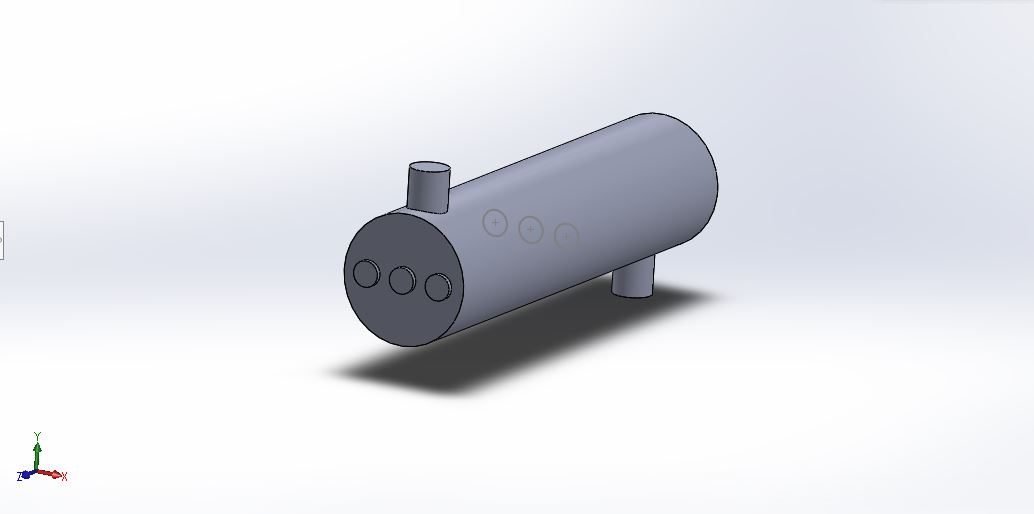
A heat exchanger transfers heat between two fluids at different temperatures without mixing them. The most common type in industry is the shell and tube heat exchanger, where one fluid flows through a bundle of tubes and the other flows around them inside a shell. A twisted tube heat exchanger uses tubes with an oval cross-section that is twisted along their length. The twisted shape makes the fluid swirl inside the tubes and around them, which breaks up the slow boundary layer near the wall and increases heat transfer, while the tubes support each other without baffles. This project models a twisted tube heat exchanger and tests whether adding zinc oxide (ZnO) nanoparticles to water improves its performance.
Why Twisted Tubes and Nanofluids?
In a plain tube, the fluid near the wall moves slowly and acts like an insulating layer. Twisting the tube creates secondary flow and swirl, which mixes the fluid and brings more of it into contact with the hot or cold wall. Nanofluids add a second improvement: tiny solid particles with higher thermal conductivity than water raise the effective conductivity of the coolant. Combining both ideas can give a compact heat exchanger with high heat transfer, which is useful in power plants, chemical industries, HVAC systems and oil coolers.
About the Twisted Tube Heat Exchanger Project
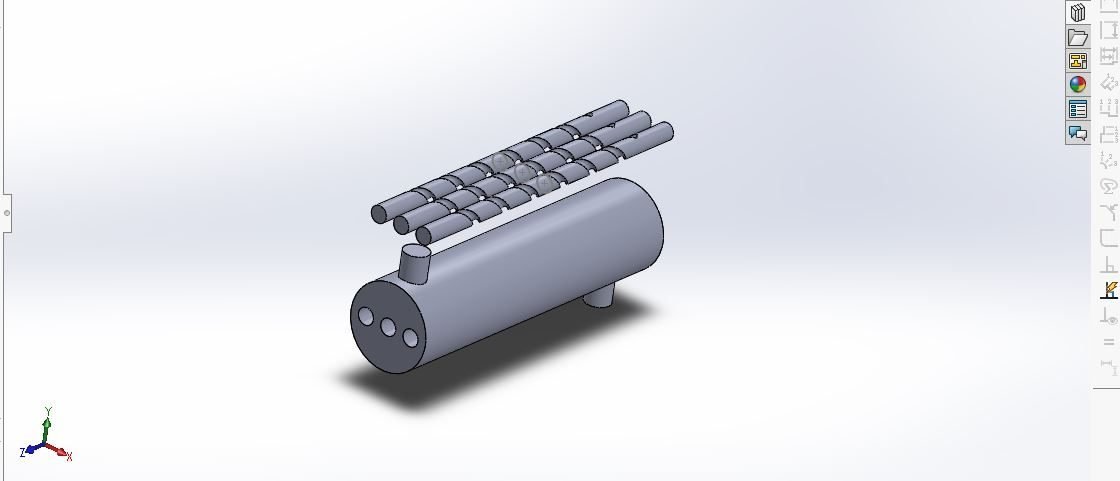
The shell, nozzles and twisted tube bundle are modelled in CAD and assembled. A static structural analysis in FEA first checks the heat exchanger under an internal pressure of 3 MPa, comparing steel (yield strength 250 MPa, thermal conductivity 60.5 W/m-K) and Steel 440C (yield strength 450 MPa, thermal conductivity 24.2 W/m-K).
The CFD analysis is then carried out in CFD software with separate hot and cold domains and the following boundary conditions:
- Cold fluid inlet: 25 °C, mass flow rate 0.166 kg/s
- Hot fluid inlet: 55 °C, mass flow rate 0.08 kg/s
Three working fluids are compared: plain water, water with 0.1% ZnO nanoparticles, and water with 0.15% ZnO nanoparticles. For each case, the pressure, temperature and velocity in both domains, the inlet and outlet temperatures and the heat transfer coefficient are calculated.
Software Used
- CAD: shell, twisted tube and assembly modelling
- FEA: deformation, stress and safety factor under 3 MPa
- CFD software: CFD analysis of pressure, temperature and velocity
Analysis Results
Key Results (Preview)
| Outlet temperatures (K) | Water | Water + 0.1% ZnO | Water + 0.15% ZnO |
|---|---|---|---|
| Cold outlet | 305.86624 | 316.531 | 316.2758 |
| Hot outlet | 305.75061 | 301.70057 | 301.59581 |
The static analysis shows the heat exchanger is safe up to 3 MPa, and the small pressure rise caused by the nanoparticles stays well within the yield limit. The heat transfer coefficient results and the recommended nanofluid concentration are explained in our live class or recorded video for this project.
Why the Twisted Tube Heat Exchanger Project Matters
Heat exchangers use a large share of industrial energy, so even small efficiency gains matter. Twisted tube designs and nanofluids are both active research areas, and this project combines them in a single CFD study. It teaches two-domain CFD setup, heat transfer evaluation and structural checking, which makes it a strong project for thermal engineering students and a good base for M.Tech research.
Related Projects
Explore more design and analysis projects on similar topics:
- CFD Analysis of Parallel and Counter Flow Double Pipe Heat Exchanger with Al2O3 Nanofluids (CAD and CFD software)
- Improving the Heat Transfer Rate of an AC Condenser Using Al2O3 & TiC Nanofluids (CFD and Structural Analysis)
- CFD and Thermal Analysis of a Car Radiator Using MgO–Silver and MgO–Graphene Hybrid Nanofluids (CAD and CFD software)
- Air Conditioner Efficiency Improvement Using Condensate Water Subcooling
What Support You Get
- Design guidance: how to build the CAD model yourself – CAD models of the shell, twisted tube bundle and full heat exchanger assembly
- Analysis guidance: how to set up and run the analysis yourself – FEA static structural files and CFD software CFD files for water and both ZnO nanofluids
- Report guidance: how to structure your own report – methodology, results and conclusion
- Live class: a step-by-step explanation of the method while you work on your own licensed software, so you can understand it and present your work confidently
Studying abroad? We guide you too – learn to build projects like this in our live classes, on your own licensed software.
Who Is This Project For?
This twisted tube heat exchanger project is a good learning example for B.Tech and B.E. final year students, diploma students who want to learn design and analysis, and M.Tech students who want to learn a method they can extend in their own thesis. It is also useful for anyone who wants to learn heat exchanger design, CFD analysis with two fluid domains and nanofluid heat transfer in CFD software on a real engineering problem instead of a textbook example.
Frequently Asked Questions
What is a twisted tube heat exchanger?
It is a shell and tube heat exchanger in which the tubes have an oval cross-section twisted along their length. The twist makes the fluid swirl, which increases heat transfer, and the tubes touch and support each other so baffles are not needed.
Why are ZnO nanoparticles added to water?
Zinc oxide nanoparticles have higher thermal conductivity than water. Mixing them into water in small amounts, 0.1% and 0.15% in this project, can raise the heat transfer coefficient of the coolant.
What boundary conditions are used in the CFD analysis?
The cold fluid enters at 25 °C with a mass flow rate of 0.166 kg/s, and the hot fluid enters at 55 °C with a mass flow rate of 0.08 kg/s, in separate cold and hot domains.
Which materials are checked in the static analysis?
Steel and Steel 440C are compared under an internal pressure of 3 MPa to make sure the heat exchanger shell and tubes are safe, giving deformation, stress, strain and safety factor.
Learn the Twisted Tube Heat Exchanger Project With Us
Want to learn the twisted tube heat exchanger project for your final year, mini project or M.Tech work? Message us with your university, branch and deadline, and we will share a learning plan – live classes and step-by-step guidance while you build it yourself.
Enquire about this project on WhatsApp or use the enquiry form on our home page. Browse more mechanical projects or 60+ mechanical engineering project ideas.
Interested in this project? Get the details, files and guidance from our team.
Enquire on WhatsApp