
In an internal combustion engine, the cylinder head closes the top of the cylinder and houses the valves, ports and spark plug. It sits directly above the combustion chamber, so it faces high gas pressure and extreme heat on every cycle. Motorcycles, scooters, small generators and many aircraft piston engines are air-cooled: instead of a water jacket, they use fins on the cylinder and head to increase the surface area and release heat to the air. The shape of these fins changes both how strong the head is and how well it cools. This project compares straight fins and V-shape fins with four materials.
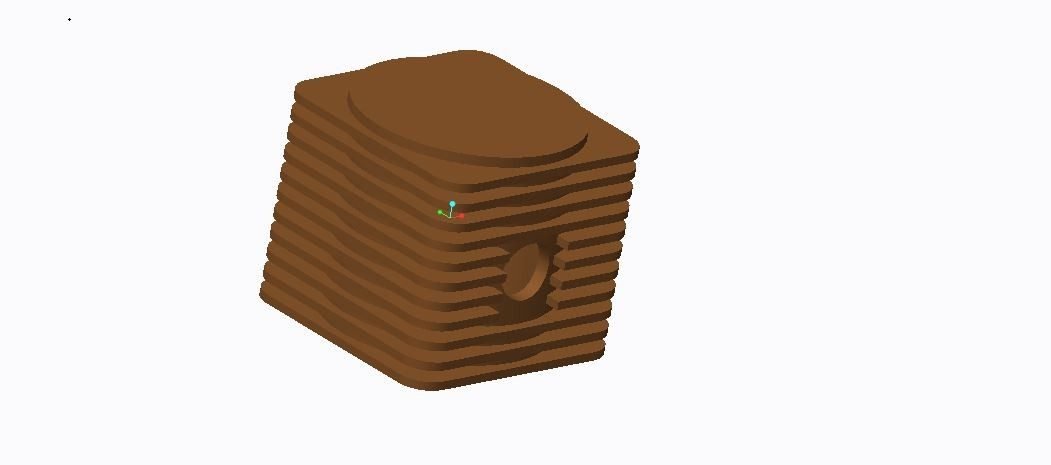
Why Fin Geometry Matters
Fins increase the area exposed to the air, which increases heat transfer by convection. Their pitch, thickness, length and shape decide how much air flows between them and how much heat each fin carries. A V-shape fin layout changes the airflow path and the stress distribution compared with conventional straight fins. Material choice also matters: aluminium conducts heat very well and is light, cast iron is cheap and wear resistant, and nickel-copper alloys such as Monel-400 are strong and corrosion resistant.
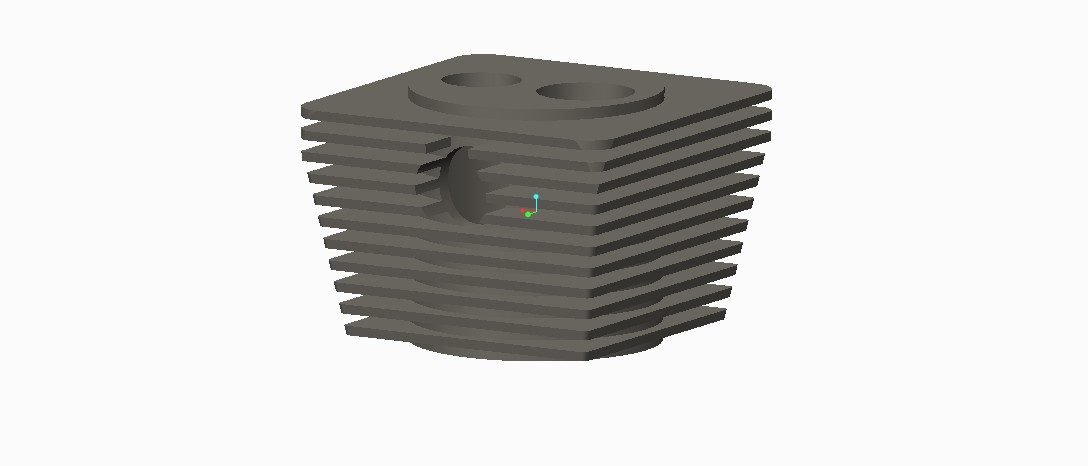
About the Project
Two cylinder heads, one with straight fins and one with V-shape fins, are modelled in SolidWorks with a cylinder wall thickness of 5 mm and a fin root thickness of 3 mm. Both are analysed in ANSYS Workbench:
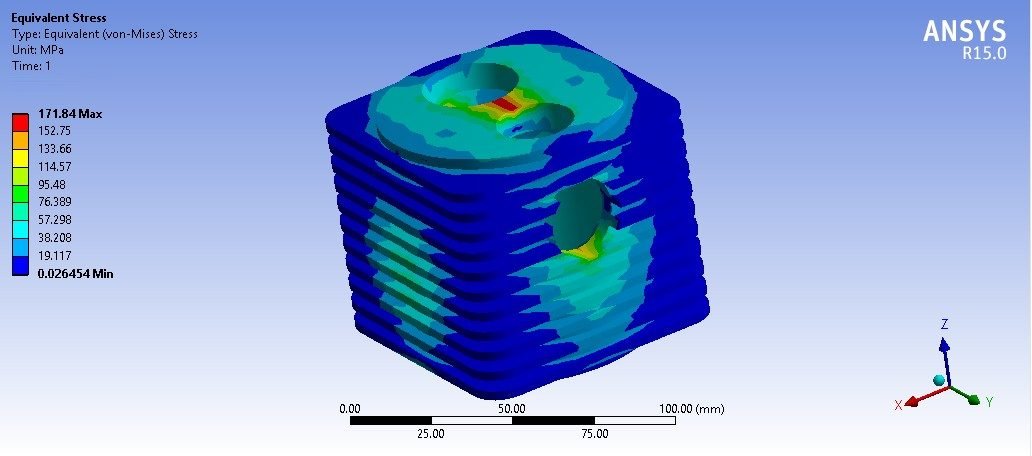
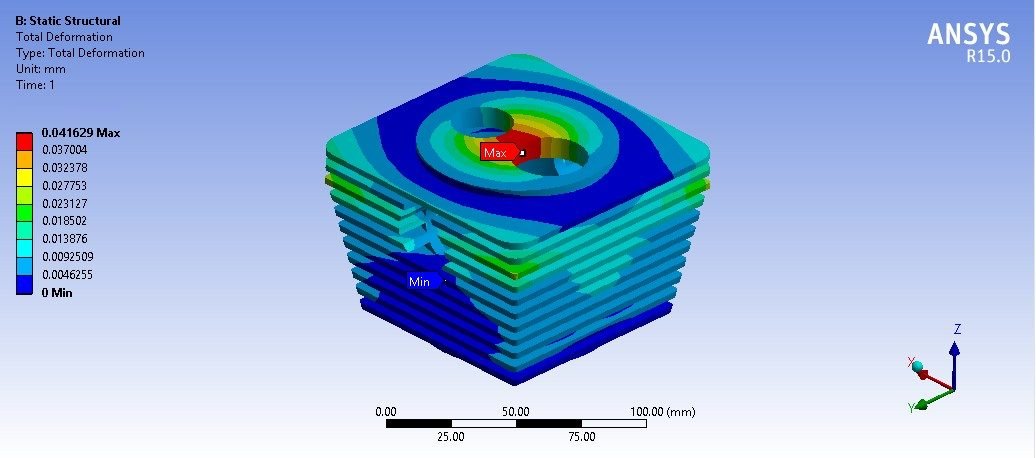
- Static structural analysis: an internal pressure of 9 MPa is applied with the head fixed.
- Steady-state thermal analysis: hot gas convection on the inner surfaces and heat loss on the outer surfaces.
Four materials are compared: steel (existing material), Al-6061, cast iron and Monel-400.
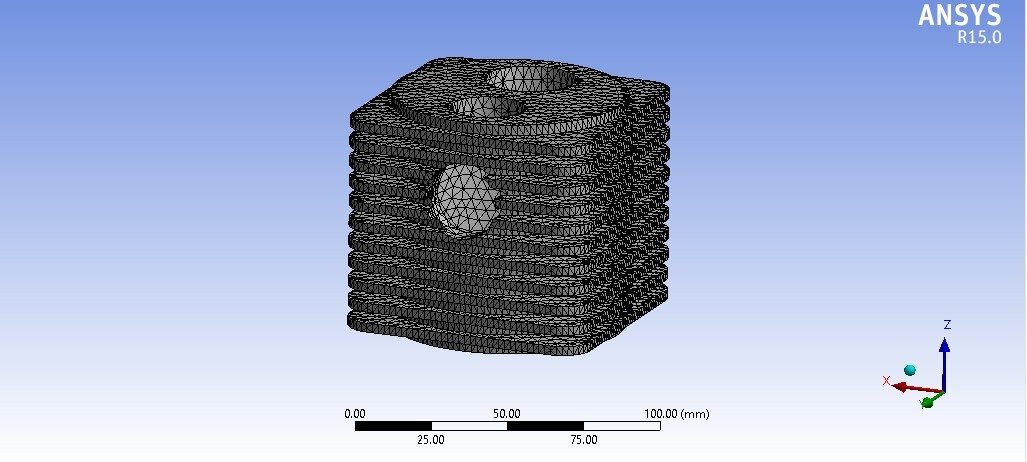
Software Used
- SolidWorks: cylinder head and fin modelling
- ANSYS Workbench: static structural and steady-state thermal analysis
Analysis Results
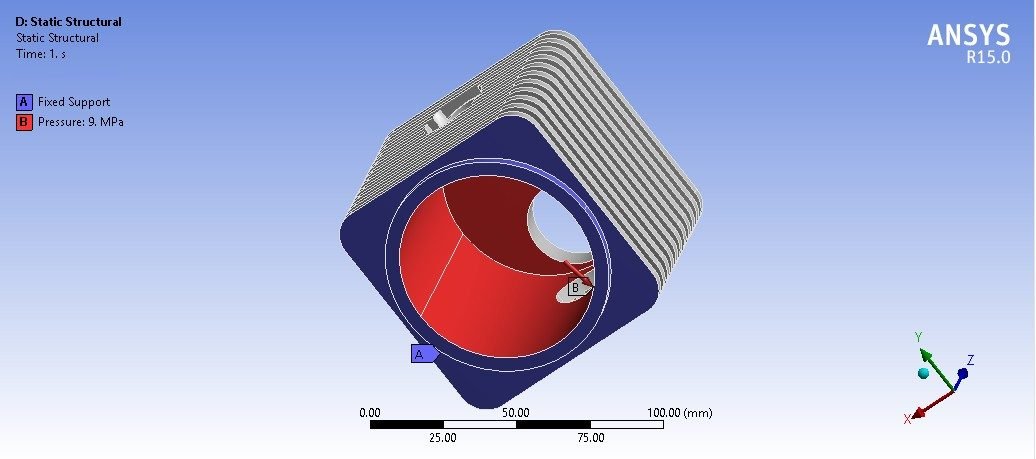
Key Results (Preview)
| Material | Stress, straight fins (MPa) | Stress, V-fins (MPa) | Safety factor, straight | Safety factor, V-fins |
|---|---|---|---|---|
| Steel | 171.84 | 165.24 | 1.4548 | 1.513 |
| Al-6061 | 173.68 | 167.24 | 1.5892 | 1.6503 |
| Cast iron | 170.56 | 163.85 | 1.794 | 1.8676 |
| Monel-400 | 173.08 | 166.59 | 1.9933 | 2.071 |
For every material, the V-shape fin design carries lower stress and has a higher safety factor than the straight fin design. The deformation and thermal results, and the final design and material recommendation, are explained in the project report.
Real-World Applications
- Motorcycles and scooters: air-cooled single and twin cylinder engines.
- Small generators and pumps: portable engines that cannot carry a radiator.
- Light aircraft: air-cooled piston engines.
Key Concepts Covered
- Extended surfaces (fins): increasing area to improve convection.
- Design comparison: how fin shape changes stress.
- Combined loading: checking both pressure and heat on one part.
Project Workflow
- Study air-cooled engines and fin design.
- Model the straight-fin and V-shape-fin heads in SolidWorks.
- Run the static analysis at 9 MPa for all four materials.
- Run the thermal analysis for both designs.
- Compare designs and materials in the report.
Why This Project Matters
Engine cooling is a core automobile topic, and this project combines geometry optimisation with material selection. It is a strong final-year choice for mechanical and automobile engineering students.
Related Projects
Explore more design and analysis projects on similar topics:
- Engine Cylinder Curved Fins: Design, Static, Thermal and CFD Analysis
- Catalytic Converter with Honeycomb Substrate: Design and CFD Emission Analysis
- Exhaust Manifold Design Optimisation and Analysis: Two Designs, Four Materials (Static, Thermal and CFD in ANSYS)
- Radiant Heat Exchanger Heater – Static and Thermal Analysis with Steel, SAE 1020 and Steel 416
What You Get
- Design files: SolidWorks 3D models of the straight-fin and V-shape-fin cylinder heads
- Analysis files: ANSYS Workbench static structural and steady-state thermal analysis files for both designs and all four materials
- Project document: complete report with methodology, results and conclusion
- Class explanation: a session that explains what was done in the project, step by step, so you can understand and present it confidently
Who Is This Project For?
This project suits B.Tech and B.E. final year students, diploma students looking for a strong design and analysis project, and M.Tech students who need a base model they can extend for their thesis. It is also useful for anyone who wants to learn fin design for air-cooled engines, static and thermal analysis in ANSYS on a real engineering problem instead of a textbook example.
Frequently Asked Questions
Why do air-cooled engines have fins?
Fins increase the surface area of the cylinder and head, so more heat can be released to the surrounding air by convection.
Which fin designs are compared?
A conventional straight-fin cylinder head and a V-shape-fin cylinder head are compared.
Which materials are studied?
Steel (the existing material), Al-6061, cast iron and Monel-400.
What pressure is applied in the static analysis?
An internal pressure of 9 MPa is applied to both cylinder head designs.
Get the Cylinder Head with Fins Project
Want this project for your final year, mini project or M.Tech work? Message us with your university, branch and deadline, and we will share the exact scope, files and report format.
Enquire about this project on WhatsApp or use the enquiry form on our home page. Browse more mechanical projects or 60+ mechanical engineering project ideas.
Interested in this project? Get the details, files and guidance from our team.
Enquire on WhatsApp