
A disc brake stops a vehicle by pressing brake pads, held in a caliper, against both sides of a rotating disc (the rotor). The friction between pad and disc turns the vehicle’s kinetic energy into heat, and that heat has to leave the disc quickly, otherwise the brake fades and becomes less effective. In this project, the front disc brake rotor of a Bajaj Pulsar is designed and analysed to check its strength under braking loads and its ability to get rid of heat, and the rotor is then optimized to improve heat transfer.

How a Disc Brake Works
When the rider pulls the brake lever, hydraulic pressure pushes the caliper pistons, which squeeze the pads onto the disc. The disc is bolted to the wheel hub, so slowing the disc slows the wheel. Compared with drum brakes, disc brakes give better stopping performance because the disc is open to the air and cools faster, which makes it less likely to fade under repeated braking. That is why almost all modern motorcycles use disc brakes at the front.
About the Project
The existing Pulsar disc rotor is modelled in SolidWorks and imported into ANSYS. A static structural analysis is carried out with a brake pad pressure of 1.5 MPa, a braking torque of 70000 N-mm and three rotational speeds that match real riding conditions:
- 1150 rpm (about 50 km/h)
- 1850 rpm (about 80 km/h)
- 2550 rpm (about 110 km/h, the top speed of the Pulsar)
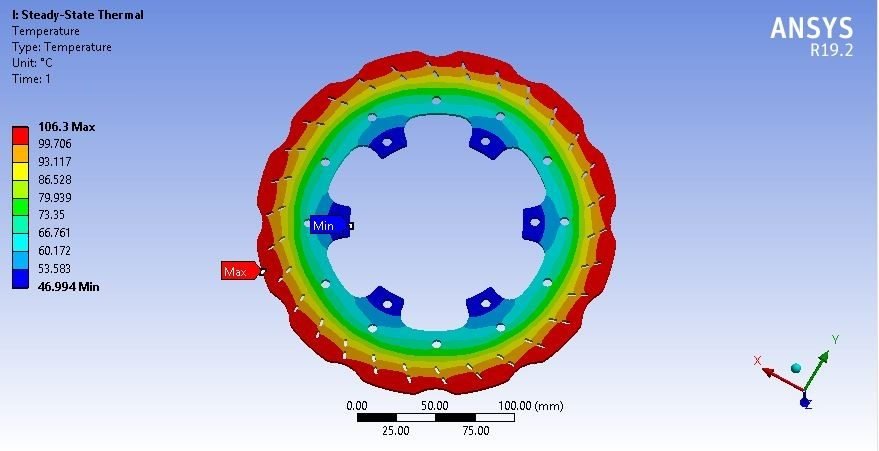
A steady-state thermal analysis follows, with heat flux of 2.3e-2 W/mm² applied where the pads touch the disc and convection on the remaining surfaces (bulk temperature 25 °C). Three materials are compared:
- Steel: density 7850 kg/m³, yield strength 275 MPa, thermal conductivity 60.5 W/m-K
- Cast iron: density 7200 kg/m³, yield strength 306 MPa, thermal conductivity 72 W/m-K
- Al-7068: density 2850 kg/m³, yield strength 590 MPa, thermal conductivity 190 W/m-K
To increase the heat transfer rate, the rotor is then optimized with extra holes and groove cuts, and the full structural and thermal analysis is repeated on the new design so the existing and optimized rotors can be compared.

Software Used
- SolidWorks: 3D modelling of the existing and optimized disc rotors
- ANSYS Static Structural: deformation, stress, strain and safety factor
- ANSYS Steady-State Thermal: temperature distribution and heat flux
Analysis Results


Key Results (Preview)
Existing design at 2550 rpm (110 km/h):
| Result | Steel | Cast iron | Al-7068 |
|---|---|---|---|
| Total deformation (mm) | 0.068556 | 1.2622 | 0.18721 |
| Equivalent stress (MPa) | 182.17 | 183.15 | 180.56 |
| Safety factor | 1.5095 | 1.6707 | 3.2675 |
The analysis shows that the Pulsar disc can safely take 1.5 MPa of pad pressure even at 2550 rpm. The optimized rotor with holes and grooves gives higher heat flux than the existing design, which means it removes heat faster. The thermal results for every material, the comparison at all three speeds and the final recommended material and design are explained in the project report.
Why This Project Matters
Brake performance is directly linked to rider safety. A rotor that is too heavy wastes fuel and slows acceleration, while a rotor that cannot shed heat loses braking power on long downhill rides or during repeated hard stops. This project teaches how to balance strength, weight and cooling in one component, and it is a strong choice for automobile and mechanical students who want a practical, vehicle-related design and analysis project.
Related Projects
Explore more design and analysis projects on similar topics:
- Single Plate Clutch Design and Analysis: Steel vs SS-304, SAE 1137 and Al-2048 (Static and Modal, Creo and ANSYS)
- Modelling and Analysis of a Multi-Plate Clutch with Kevlar and Carbon-Carbon Friction Materials (SolidWorks and ANSYS)
- Regenerative Braking System with Flywheel – Design, Static and Modal Analysis
- Optimization and Analysis of a Heavy-Duty Truck Chassis with C, I and Box Sections: Steel 710, Steel 4130 and Al-7075 (CATIA and ANSYS)
What You Get
- Design files: SolidWorks models of the existing Pulsar disc rotor and the optimized rotor with holes and groove cuts
- Analysis files: ANSYS static structural and steady-state thermal files for all materials and speeds
- Project document: complete report with methodology, results and conclusion
- Class explanation: a session that explains what was done in the project, step by step, so you can understand and present it confidently
Who Is This Project For?
This project suits B.Tech and B.E. final year students, diploma students looking for a strong design and analysis project, and M.Tech students who need a base model they can extend for their thesis. It is also useful for anyone who wants to learn disc brake design, static structural analysis and thermal analysis in ANSYS on a real engineering problem instead of a textbook example.
Frequently Asked Questions
Why are holes and grooves cut in a disc brake rotor?
Holes and grooves increase the surface area of the rotor and let air flow through it, so heat leaves the disc faster. They also help clear water, dust and gas from between the pad and disc, which keeps braking consistent during hard or repeated stops.
What loads are applied on the Pulsar disc brake?
A brake pad pressure of 1.5 MPa and a braking torque of 70000 N-mm are applied at three speeds: 1150 rpm (about 50 km/h), 1850 rpm (about 80 km/h) and 2550 rpm (about 110 km/h). A heat flux of 2.3e-2 W/mm² is used for the thermal analysis.
Which materials are compared for the disc rotor?
Steel, cast iron and Al-7068 are compared. Steel and cast iron are traditional rotor materials, while Al-7068 is a high-strength aluminium alloy that is much lighter, so the study shows the trade-off between strength, heat transfer and weight.
What is the difference between structural and thermal analysis here?
The structural analysis checks whether the disc can carry the braking pressure and torque without failing, giving deformation, stress and safety factor. The thermal analysis checks how hot the disc gets and how quickly it removes heat, giving temperature and heat flux.
Get the Pulsar Disc Brake Design and Analysis Project
Want this project for your final year, mini project or M.Tech work? Message us with your university, branch and deadline, and we will share the exact scope, files and report format.
Enquire about this project on WhatsApp or use the enquiry form on our home page. Browse more mechanical projects or 60+ mechanical engineering project ideas.
Interested in this project? Get the details, files and guidance from our team.
Enquire on WhatsApp