
A differential is the gear unit that sends engine or motor power to the two driven wheels while allowing them to turn at different speeds. When a vehicle takes a turn, the outer wheel travels a longer path than the inner wheel, so it has to spin faster. Without a differential, one wheel would be forced to slip, causing tyre wear and poor handling. In an electric vehicle (EV), the differential is a key part of the power transmission system, and its weight, strength and cost directly affect the vehicle’s range and price. This project redesigns an EV differential and compares four materials to find the best balance of strength, weight and durability. This electric vehicle differential project is explained step by step below.
How a Differential Works
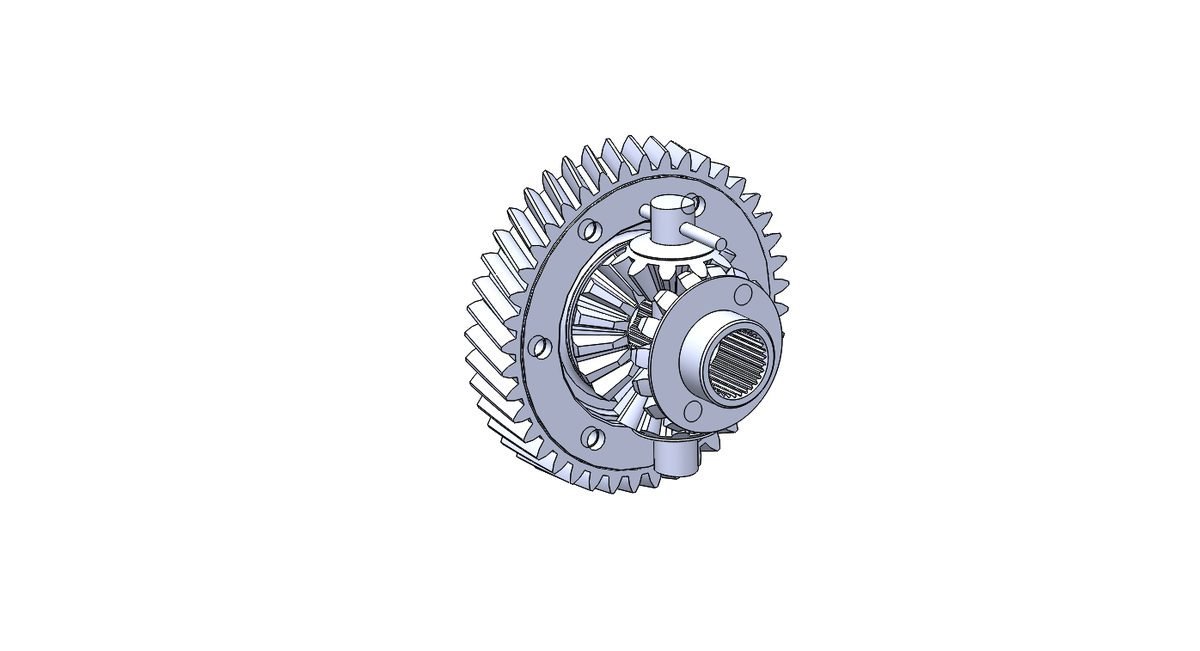
The motor drives a small pinion gear, which turns a large ring gear. The ring gear is attached to the differential case, which carries a set of small bevel (spider) gears. These bevel gears mesh with the side gears connected to each axle. When the vehicle moves straight, the whole assembly rotates together and both wheels turn at the same speed. During a turn, the bevel gears rotate on their own shafts, letting one side gear speed up while the other slows down. Because the gear teeth carry the full driving torque, they must be strong enough not to fail under load.
About the Electric Vehicle Differential Project
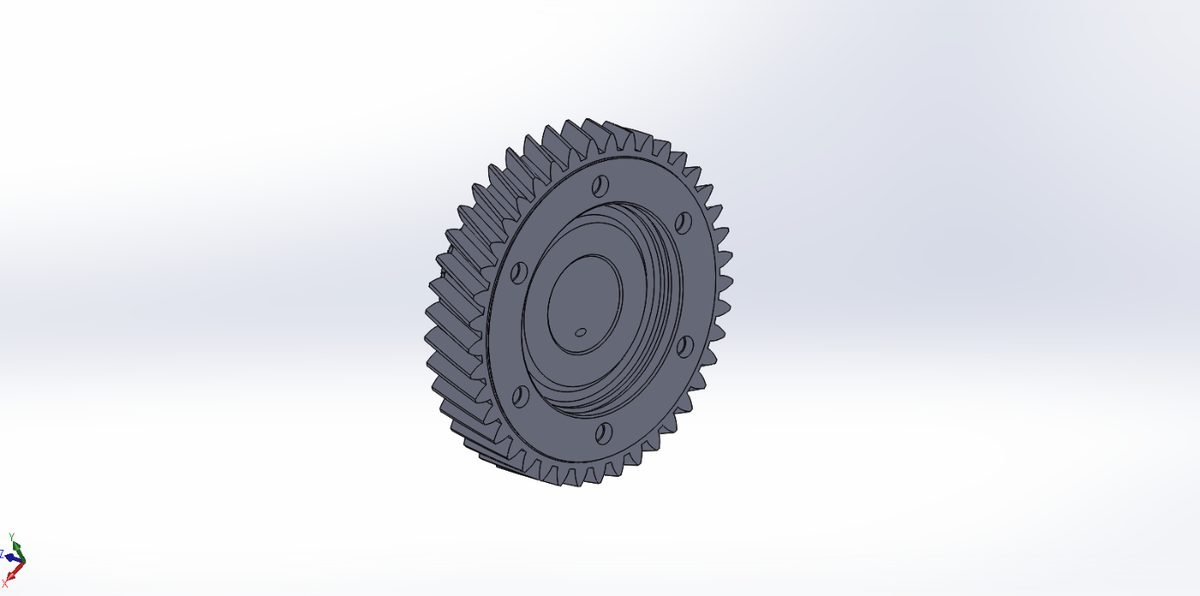
The complete differential gear set, including the ring gear, pinion, bevel gears and case, is modelled in CAD. The assembly is imported into FEA, meshed, and analysed under a static load of 10 MPa and a rotational speed of 2000 rpm, which simulate real operating conditions. The same boundary conditions are used for every material so the results can be compared fairly. Two sets of components are analysed: the bevel gear assembly and the ring and pinion gear pair.
Four materials are studied:
- Mild steel (existing material): density 7850 kg/m³, yield strength 250 MPa
- 8620 alloy steel: density 7850 kg/m³, yield strength 370 MPa, a common gear steel
- Al-356: a lightweight cast aluminium alloy
- Al-7075: a high-strength aluminium alloy used in aerospace
For each material, the total deformation, equivalent stress, strain and safety factor are calculated and compared with the existing mild steel design.

Software Used
- CAD: 3D modelling and assembly of the differential
- FEA Static Structural: deformation, stress, strain and safety factor
Analysis Results
Key Results (Preview)
Bevel gear assembly at 10 MPa and 2000 rpm:
| Result | Mild steel | 8620 steel | Al-356 | Al-7075 |
|---|---|---|---|---|
| Total deformation (mm) | 0.005680 | 0.005532 | 0.016079 | 0.015922 |
| Equivalent stress (MPa) | 146.56 | 146.85 | 145.75 | 145.75 |
| Safety factor | 1.7058 | 2.5195 | 1.7976 | 3.4511 |
All four materials carry the static load with stresses below their yield limits. The steels deform the least, while the aluminium alloys are much lighter. The ring and pinion results, the full comparison and the recommended material for different types of EV are explained in our live class or recorded video for this project.
Why the Electric Vehicle Differential Project Matters
India and the rest of the world are moving quickly towards electric mobility, and EV makers are looking for every way to reduce weight and cost without losing reliability. A lighter differential means more range from the same battery. This project combines gear design, material selection and finite element analysis, which are exactly the skills automobile and EV companies look for in fresh mechanical engineers.
Related Projects
Explore more design and analysis projects on similar topics:
- Static and Dynamic Analysis of a Gearbox Casing Cover: Cast Iron vs Al-7075 and CFRP (CAD and FEA)
- Tractor Rear Axle Shaft Design and Analysis: Mild Steel, Ni-Chrome and Invar
- Hybrid Ceramic Ball Bearing Design and Analysis: SiC and Zirconia Balls with Stainless Steel and SAE 1020 Races (CAD and CAE)
- High-Speed Helical Gear Design and Analysis – 15°, 20° and 45° Helix Angles
What Support You Get
- Design guidance: how to build the CAD model yourself – CAD parts and assembly of the EV differential (ring gear, pinion, bevel gears and casing)
- Analysis guidance: how to set up and run the analysis yourself – FEA static structural files for all four materials with deformation, stress, strain and safety factor results
- Report guidance: how to structure your own report – methodology, results and conclusion
- Live class: a step-by-step explanation of the method while you work on your own licensed software, so you can understand it and present your work confidently
Studying abroad? We guide you too – learn to build projects like this in our live classes, on your own licensed software.
Who Is This Project For?
This electric vehicle differential project is a good learning example for B.Tech and B.E. final year students, diploma students who want to learn design and analysis, and M.Tech students who want to learn a method they can extend in their own thesis. It is also useful for anyone who wants to learn gear design, power transmission and static structural analysis in FEA on a real engineering problem instead of a textbook example.
Frequently Asked Questions
Why does a vehicle need a differential?
When a vehicle turns, the outer wheel travels farther than the inner wheel and must spin faster. The differential lets the two driven wheels rotate at different speeds while still sending power to both, preventing tyre slip, wear and poor handling.
What loads are applied on the EV differential?
A static load of 10 MPa and a rotational speed of 2000 rpm are applied to simulate operating conditions. The same boundary conditions are used for every material so that the results can be compared directly.
Which materials are compared?
Mild steel is taken as the existing material, and 8620 alloy steel, Al-356 and Al-7075 are studied as alternatives. The comparison covers stiffness, strength, safety factor and the weight saving offered by the aluminium alloys.
Which parts of the differential are analysed?
Two sets of components are analysed: the bevel (spider) gear assembly and the ring and pinion gear pair. For each, the total deformation, equivalent stress, strain and safety factor are calculated.
Learn the Electric Vehicle Differential Project With Us
Want to learn the electric vehicle differential project for your final year, mini project or M.Tech work? Message us with your university, branch and deadline, and we will share a learning plan – live classes and step-by-step guidance while you build it yourself.
Enquire about this project on WhatsApp or use the enquiry form on our home page. Browse more mechanical projects or 60+ mechanical engineering project ideas.
Interested in this project? Get the details, files and guidance from our team.
Enquire on WhatsApp