
An engine mount bracket is the part that connects an engine to the frame of a car or the structure of an aircraft. It may look like a simple metal piece, but it has several important jobs: it holds the full weight of the engine, keeps it correctly aligned with the gearbox and drive shafts, and helps absorb the vibrations and shocks that the engine produces or that come from the road or air. If the bracket is too weak it can crack, and if it vibrates at the wrong frequency it can pass noise and shaking into the whole vehicle. This project designs an engine mount bracket and compares three materials for strength, stiffness and vibration behaviour.
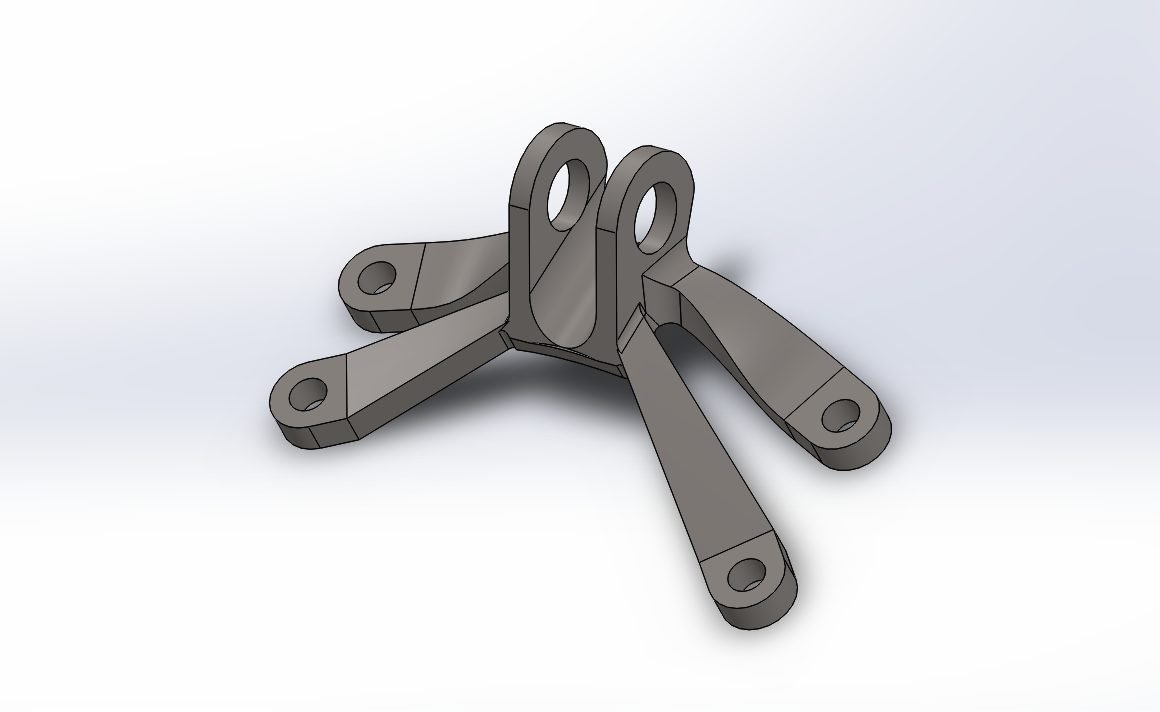
Why Engine Mount Brackets Matter
- Vibration isolation: reduces the engine vibration and noise reaching the vehicle body, improving comfort and the life of other parts
- Structural support: carries the engine weight and the torque reaction during acceleration and braking
- Shock absorption: protects the engine during travel over rough roads or in turbulent flight
- Alignment: keeps the engine in the correct position relative to the drivetrain
About the Project
The engine mount bracket is designed in CAD with a central mounting lug and four arms with bolt holes, a shape commonly used in aircraft and high-performance vehicles. The model is imported into FEA and meshed. The bolt holes are fixed and a force of 5000 N is applied at the engine mounting point to simulate operating load.
Three materials are compared:
- AISI 4140: a chromium-molybdenum alloy steel known for toughness and fatigue strength
- Al 7075: a high-strength aluminium alloy used in aircraft structures
- Ti-6Al-4V: the most widely used titanium alloy, with an excellent strength-to-weight ratio
Two analyses are carried out for each material:
- Static structural analysis: total deformation, equivalent stress, equivalent elastic strain and safety factor
- Modal analysis: the first six natural frequencies and mode shapes, to check that the bracket does not resonate with engine vibrations
Software Used
- CAD: 3D modelling of the engine mount bracket
- FEA: deformation, stress, strain and safety factor
- FEA: natural frequencies and mode shapes
Analysis Results
Key Results (Preview)
| Result | AISI 4140 | Al 7075 | Ti-6Al-4V |
|---|---|---|---|
| Total deformation (mm) | 0.17657 | 0.52535 | 0.32901 |
| Equivalent stress (MPa) | 338.97 | 336.81 | 336.25 |
| Safety factor | 1.9324 | 1.4934 | 2.6171 |
All three materials carry the 5000 N load with similar stress levels, but their stiffness and safety margins differ clearly. The modal frequencies for each material and the recommended material for different applications are given in our live class or recorded video for this project.
Why This Project Matters
Brackets and mounts are found in every vehicle, aircraft and machine, and design engineers in automotive and aerospace companies spend much of their time making them lighter and stronger. This project is a clean, practical example of the full workflow: model a part, apply real loads, compare materials and check vibration. It is easy to understand, easy to present, and a great first design and analysis project for mechanical, automobile and aeronautical students.
Related Projects
Explore more design and analysis projects on similar topics:
- Reciprocating Compressor Valve Plate Design and Analysis: Five Slot Designs Compared (CAD and CAE)
- V6 Engine Design in CAD with Ceramic-Coated Piston Concept
- V6 Engine Camshaft Design and Analysis: Forged Steel vs Al-3003, EN-9 and Al-7475 (CAD and FEA)
- Two-Wheeler Piston and Connecting Rod: Static and Thermal Analysis with Design Optimisation
What Support You Get
- Design guidance: how to build the CAD model yourself – CAD model of the engine mount bracket (with STEP file)
- Analysis guidance: how to set up and run the analysis yourself – FEA static structural and modal analysis files for all three materials
- Report guidance: how to structure your own report – methodology, results and conclusion
- Live class: a step-by-step explanation of the method while you work on your own licensed software, so you can understand it and present your work confidently
Studying abroad? We guide you too – learn to build projects like this in our live classes, on your own licensed software.
Who Is This Project For?
This project is a good learning example for B.Tech and B.E. final year students, diploma students who want to learn design and analysis, and M.Tech students who want to learn a method they can extend in their own thesis. It is also useful for anyone who wants to learn bracket design, material comparison and static and modal analysis in FEA on a real engineering problem instead of a textbook example.
Frequently Asked Questions
What does an engine mount bracket do?
It connects the engine to the vehicle frame or aircraft structure, carries the engine weight and torque reaction, keeps the engine aligned with the drivetrain, and helps reduce vibration and shock passing into the vehicle body.
What load is applied in the analysis?
The bolt holes of the bracket are fixed and a force of 5000 N is applied at the engine mounting point. The same load is used for all three materials.
Which materials are compared?
AISI 4140 chromium-molybdenum steel, Al 7075 aluminium alloy and Ti-6Al-4V titanium alloy are compared. Together they cover a tough steel, a light aerospace aluminium and a high strength-to-weight titanium alloy.
Why is modal analysis done on the bracket?
An engine produces vibration at certain frequencies. If the bracket’s natural frequency is close to these, it can resonate, causing noise and cracks. Modal analysis finds the first six natural frequencies so this can be avoided.
Learn the Engine Mount Bracket Analysis Project With Us
Want to learn this project for your final year, mini project or M.Tech work? Message us with your university, branch and deadline, and we will share a learning plan – live classes and step-by-step guidance while you build it yourself.
Enquire about this project on WhatsApp or use the enquiry form on our home page. Browse more mechanical projects or 60+ mechanical engineering project ideas.
Interested in this project? Get the details, files and guidance from our team.
Enquire on WhatsApp