
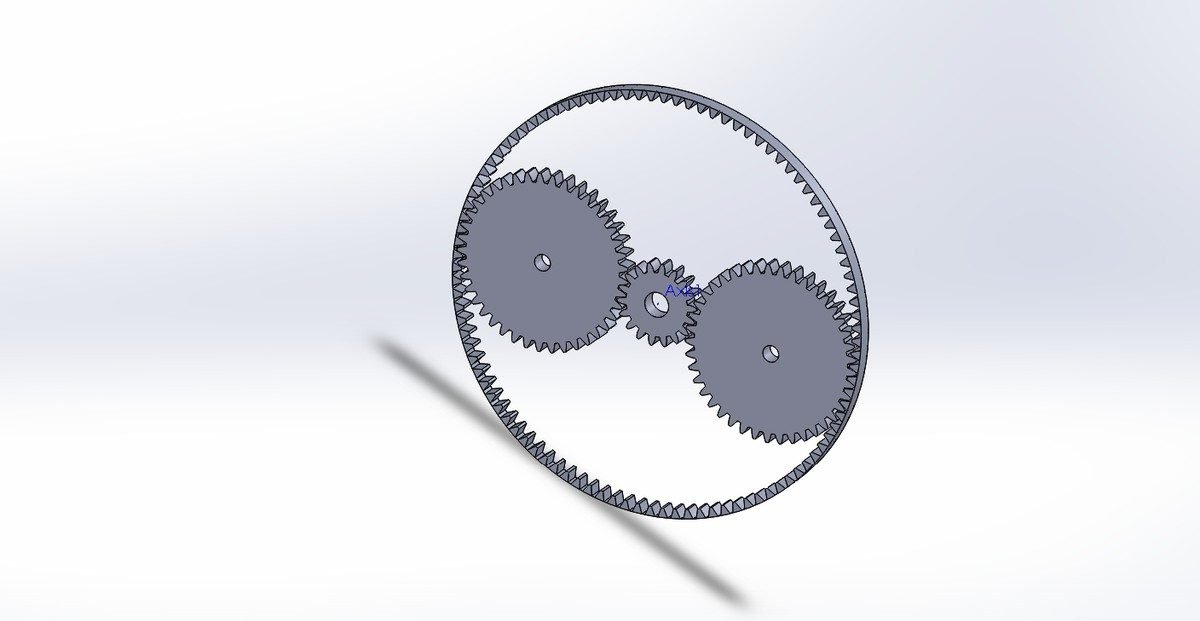
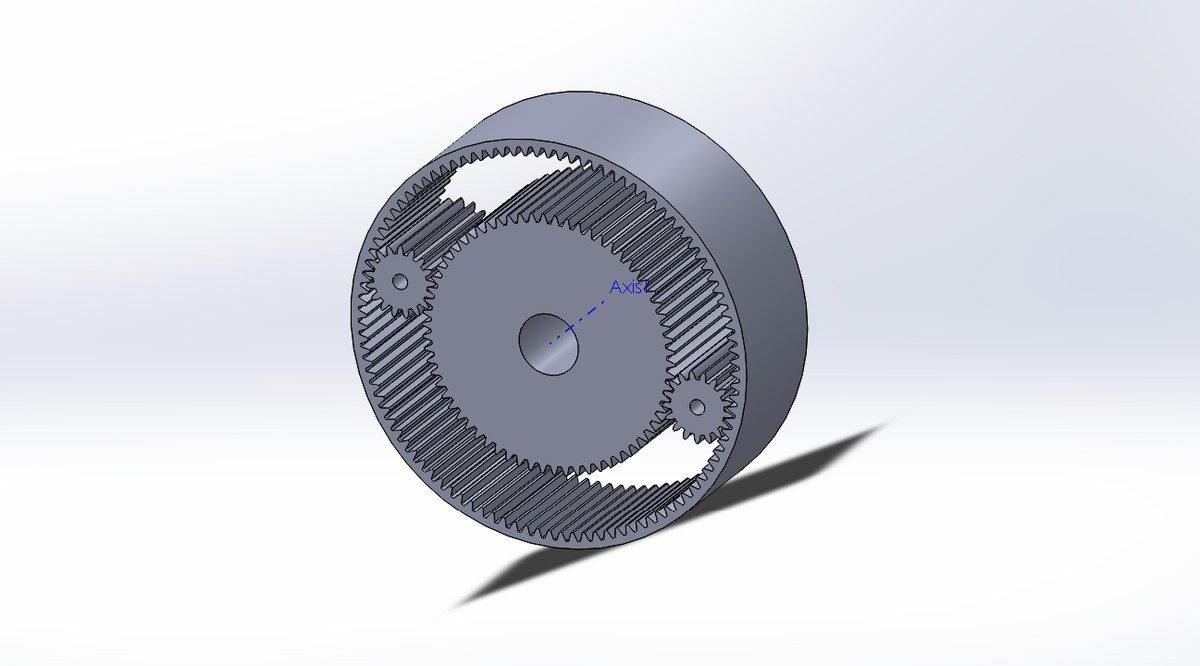
A planetary (epicyclic) gearbox gets its name from the way its gears move. A central sun gear drives several planet gears, which roll inside an internally toothed ring gear while their carrier turns. Because the load is shared between several planets, a planetary gearbox can transmit high torque in a very compact, coaxial package. That is why planetary gears are used in automatic transmissions, wind turbines, robots, cranes and electric vehicle drives. Stacking several stages in series multiplies the reduction ratio.
Gearbox Design
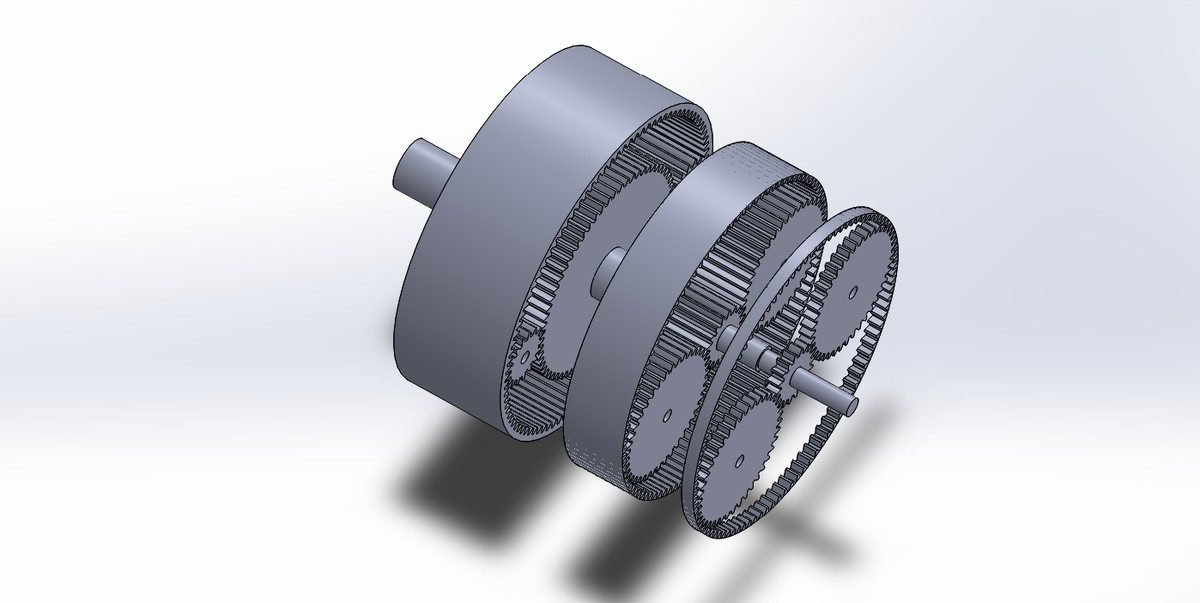
This project designs a three-stage planetary gearbox in CAD. Each stage has its own sun gear, planet gears and internal ring gear, sized from the final gear specifications. The stages are connected by shafts and enclosed in a casing to form the complete gearbox assembly.
About the Project
The gear stage is analysed in FEA:
- Static structural analysis: a contact pressure of 12 MPa on the gear teeth and a torque of 20800 N-mm with rotational velocity, to find deformation, stress, strain and safety factor.
- Modal analysis: the first six natural frequencies of the gear set.
Two materials are compared: steel 4340, a high-strength nickel-chromium-molybdenum gear steel (yield 470 MPa), and Al-7075, a high-strength aluminium alloy (yield 503 MPa).
Software Used
- CAD: sun, planet and ring gear modelling and three-stage assembly
- FEA: static structural and modal analysis
Analysis Setup
Static Structural Results
| Result | Steel 4340 | Al-7075 |
|---|---|---|
| Deformation (mm) | 0.033911 | 0.093471 |
| Equivalent stress (MPa) | 289.43 | 289.16 |
| Strain | 0.0015024 | 0.0041769 |
| Safety factor | 1.6239 | 1.7395 |
Modal Analysis Results
| Mode | Steel 4340 (Hz) | Al-7075 (Hz) |
|---|---|---|
| 1 | 1423.8 | 1437.4 |
| 2 | 1533.8 | 1548.5 |
| 3 | 2462.6 | 2452.1 |
| 4 | 2890.5 | 2917.5 |
| 5 | 3325 | 3356.2 |
| 6 | 3651.9 | 3638.5 |
The weight comparison and the final material recommendation are explained in our live class or recorded video for this project.
Why Material Choice Matters for Gears
Gear steels like 4340 are hard, tough and resist surface wear and pitting, which is why they dominate power transmission. Aluminium alloys are about one third of the weight, which matters in aircraft, robots and portable equipment, but they are less stiff and wear faster. Comparing stress, deflection and natural frequency for both materials shows where a lightweight gearbox becomes practical.
How a Three-Stage Planetary Gearbox Works
In each stage the ring gear is held fixed, the sun gear is the input and the planet carrier is the output. The carrier turns slower than the sun, so torque increases. When the output carrier of one stage drives the sun gear of the next, the reduction ratios multiply. Three stages in series can therefore give a very large overall reduction in a short, compact housing. Because several planets share the load, each gear tooth carries only part of the torque, which keeps stresses low compared with a simple spur gear pair of the same size.
Real-World Applications
- Automatic transmissions in cars.
- Wind turbine gearboxes.
- Robotics and servo drives.
- EV reduction drives and hub motors.
Key Concepts Covered
- Epicyclic gear trains: sun, planet, ring and carrier.
- Multi-stage reduction and torque multiplication.
- Gear contact stress.
- Modal analysis of gear sets.
Project Workflow
- Study planetary gear trains and fix the gear specifications.
- Model sun, planet and ring gears for three stages in CAD.
- Assemble the stages with shafts and casing.
- Run static and modal analysis for steel 4340 and Al-7075.
- Compare results in the report.
Why This Project Matters
Planetary gearboxes are everywhere in modern machines. This project gives students hands-on experience with gear design and FEA.
Related Projects
Explore more design and analysis projects on similar topics:
- Design and Analysis of a Spur Gear: Grey Cast Iron vs High-Speed Steel M2 (CAD and FEA)
- Design and Analysis of an Electric Vehicle Differential: Mild Steel vs 8620 Steel, Al-356 and Al-7075 (CAD and FEA)
- Static and Dynamic Analysis of a Gearbox Casing Cover: Cast Iron vs Al-7075 and CFRP (CAD and FEA)
- Design and Analysis of a Pulsar Disc Brake Rotor: Structural and Thermal Analysis with Steel, Cast Iron and Al-7068 (CAD and FEA)
What Support You Get
- Design guidance: how to build the CAD model yourself – CAD models of the sun, planet and internal ring gears for three stages, shafts, casing and the full assembly
- Analysis guidance: how to set up and run the analysis yourself – FEA static structural and modal analysis files for steel 4340 and Al-7075
- Report guidance: how to structure your own report – methodology, results and conclusion
- Live class: a step-by-step explanation of the method while you work on your own licensed software, so you can understand it and present your work confidently
Studying abroad? We guide you too – learn to build projects like this in our live classes, on your own licensed software.
Who Is This Project For?
This project is a good learning example for B.Tech and B.E. final year students, diploma students who want to learn design and analysis, and M.Tech students who want to learn a method they can extend in their own thesis. It is also useful for anyone who wants to learn gear modelling in CAD and FEA static and modal analysis on a real engineering problem instead of a textbook example.
Frequently Asked Questions
What is a planetary gearbox?
A gearbox where a central sun gear drives planet gears that roll inside an internal ring gear, giving high torque in a compact package.
How many stages does this gearbox have?
Three stages, each with its own sun, planet and ring gears.
What loads are applied?
A contact pressure of 12 MPa and a torque of 20800 N-mm with rotational velocity.
Which materials are compared?
Steel 4340 and Al-7075.
Learn the Three-Stage Planetary Gearbox Project With Us
Want to learn this project for your final year, mini project or M.Tech work? Message us with your university, branch and deadline, and we will share a learning plan – live classes and step-by-step guidance while you build it yourself.
Enquire about this project on WhatsApp or use the enquiry form on our home page. Browse more mechanical projects or 60+ mechanical engineering project ideas.
Interested in this project? Get the details, files and guidance from our team.
Enquire on WhatsApp