
A vertical axis wind turbine (VAWT) is a wind turbine whose main shaft stands upright, at a right angle to the wind. Unlike the large three-blade turbines seen on wind farms, a VAWT does not need to turn to face the wind, works in wind from any direction, and can be placed close to the ground or on rooftops. These features make it a good choice for cities and small-scale power generation. How much power a VAWT produces depends strongly on the shape of its blades, so this project compares four different blade airfoils using CFD. This VAWT blade project is explained step by step below.
Why the Airfoil Shape Matters
Each blade of a lift-type VAWT, such as a Darrieus or H-rotor turbine, has the cross-section of an aircraft wing, called an airfoil. As air flows over the airfoil, the pressure on one side becomes lower than on the other, which creates a lift force, while friction and pressure losses create a drag force. A good turbine blade gives high lift and low drag over a wide range of angles, because the angle between the blade and the wind keeps changing as the rotor turns. Choosing the right airfoil is therefore one of the most important steps in VAWT design.
About the VAWT Blade Project
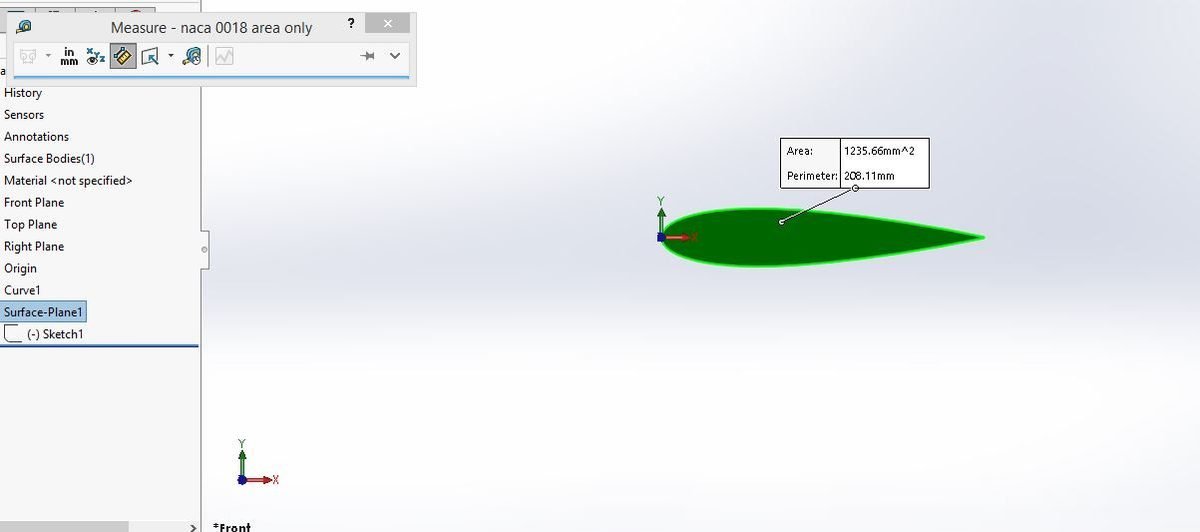
Four airfoil profiles are created in CAD from their coordinate files:
- NACA 0018: a symmetric airfoil widely used in Darrieus turbines
- NACA 63418: a cambered six-series airfoil
- S1046: a symmetric airfoil designed for vertical axis wind turbines
- S1210: a high-lift cambered airfoil
Each airfoil is placed inside a fluid domain and analysed in CFD software. The study is carried out at three wind speeds, 8 m/s, 10 m/s and 12 m/s, and at several angles of attack between -15° and 15°, so the airfoils can be compared across the conditions a real VAWT blade sees during one rotation. For each case, the pressure contour, velocity contour, coefficient of lift (Cl) and coefficient of drag (Cd) are found. Turbine assembly designs are also included so the airfoil results can be related to the complete rotor.
Software Used
- CAD: airfoil profiles from coordinates and VAWT assembly models
- CFD software: CFD analysis of pressure, velocity, lift and drag
Analysis Results
Key Results (Preview)
The pressure contours show high pressure at the leading edge, where the air meets the blade, and a low-pressure region over the upper surface that produces lift. The velocity contours show the air speeding up over the curved surface and slowing down in the wake behind the blade. By comparing the lift and drag coefficients of all four airfoils at every wind speed and angle of attack, the project identifies which airfoil gives the best lift-to-drag performance for a vertical axis wind turbine. The full Cl and Cd tables and the final airfoil selection are given in the project files.
Why the VAWT Blade Project Matters
Renewable energy is a major focus for governments and industry, and small wind turbines for homes, street lights and remote sites are a growing market. Engineers who can use CFD to compare blade shapes before building anything save both time and money. This project gives hands-on experience with airfoil geometry, CFD setup, meshing and the lift and drag results that every wind turbine and aerospace engineer works with, making it a strong choice for mechanical, aeronautical and energy students.
Related Projects
Explore more design and analysis projects on similar topics:
- Aircraft Engine Cooling Fan with NACA 0012 and 0016 Blades – Static, Modal and CFD Analysis
- Engine Cooling Fan Design and Analysis: Static, Modal and CFD
- Steam Turbine Blade with NACA 4412 and 6515: Coupled Field and CFD Analysis
- Gas Turbine Blade Design with NACA 2412, 4412 and 8412: Static, Thermal and CFD
What Support You Get
- Design guidance: how to build the CAD model yourself – CAD airfoil profiles (NACA 0018, NACA 63418, S1046, S1210), airfoil coordinate files and VAWT assembly designs
- Analysis guidance: how to set up and run the analysis yourself – CFD software CFD files for every airfoil, wind speed and angle of attack, with all contour plots and lift and drag results
- Report guidance: how to structure your own report – methodology, results and conclusion
- Live class: a step-by-step explanation of the method while you work on your own licensed software, so you can understand it and present your work confidently
Studying abroad? We guide you too – learn to build projects like this in our live classes, on your own licensed software.
Who Is This Project For?
This VAWT blade project is a good learning example for B.Tech and B.E. final year students, diploma students who want to learn design and analysis, and M.Tech students who want to learn a method they can extend in their own thesis. It is also useful for anyone who wants to learn airfoil CFD analysis, lift and drag calculation and wind turbine blade design in CFD software on a real engineering problem instead of a textbook example.
Frequently Asked Questions
What is the difference between a VAWT and a HAWT?
A horizontal axis wind turbine (HAWT) has its shaft pointing into the wind and must turn to face it. A vertical axis wind turbine (VAWT) has an upright shaft, works with wind from any direction and can be installed close to the ground or on rooftops.
Why compare four different airfoils?
The blade airfoil decides how much lift and drag the blade produces, which directly affects the power a VAWT can generate. Comparing NACA 0018, NACA 63418, S1046 and S1210 under the same conditions shows which shape gives the best lift-to-drag performance.
At what wind speeds is the CFD analysis done?
The airfoils are analysed in CFD software at 8 m/s, 10 m/s and 12 m/s, and at several angles of attack between -15° and 15°, because the angle of the blade to the wind keeps changing as a VAWT rotor turns.
What results does this project give?
For each airfoil, wind speed and angle of attack, the project gives the pressure contour, velocity contour, coefficient of lift (Cl) and coefficient of drag (Cd). These are used to compare the airfoils and select the most suitable one for the turbine.
Learn the VAWT Blade Project With Us
Want to learn the VAWT blade project for your final year, mini project or M.Tech work? Message us with your university, branch and deadline, and we will share a learning plan – live classes and step-by-step guidance while you build it yourself.
Enquire about this project on WhatsApp or use the enquiry form on our home page. Browse more mechanical projects or 60+ mechanical engineering project ideas.
Interested in this project? Get the details, files and guidance from our team.
Enquire on WhatsApp