


Choosing a major project for mechanical engineering is the biggest decision of your final year. Below are 40 major project ideas in seven areas – structural optimisation, electric vehicles, thermal and CFD, turbomachinery, aerospace, materials and vibration – each with a one-line idea and a research angle: the comparison, optimisation or new material that makes it strong enough for a B.Tech or B.E. major project.
Quick answer: Strong mechanical major project topics are EV battery thermal management, topology optimisation of robot arms and frames, nanofluid heat exchangers, centrifugal pump and compressor CFD, thermal barrier coatings and vibration-based fault detection. Each has a clear research gap, can be validated with hand calculations or published data, and gives results examiners can compare. A good major project report follows six chapters: introduction, literature review, methodology, analysis, results and conclusion.
Free PDF: 40 Major Projects for Mechanical Engineering
All 40 ideas with the research angle for each, plus the standard chapters of a major project report – 6 pages, free to share with your project team.
Download the free PDFTop 10 Major Project Topics at a Glance
| Project | Method | Main result to show |
|---|---|---|
| Battery thermal management (EV) | Thermal analysis | PCM vs water cooling |
| Robot arm topology optimisation | Structural optimisation | Weight saved at same stiffness |
| Radiator with nanofluid coolant | CFD | Heat transfer gain over base coolant |
| Centrifugal pump impeller | CFD | Head and efficiency vs blade angles |
| Rocket nozzle | CFD (supersonic) | Mach number and thrust |
| Car bumper impact analysis | Explicit dynamics | Energy absorbed by material |
| Thermal barrier coated piston | Thermal + structural | Crown temperature with coating |
| Natural fibre hybrid composite | Experiment | Tensile and flexural strength |
| Crack detection from vibration | Modal analysis | Frequency shift vs crack depth |
| Machine fault detection with ML | Python + data | Classifier accuracy |
What Examiners Expect from a Major Project
- A clear problem: one sentence that says what you are improving and why it matters.
- A research gap: a literature review of 15 to 25 papers that shows what has not been done yet.
- A sound method: design calculations, a CAD model, correct materials and boundary conditions.
- Validation: a mesh study, a hand calculation or published data that proves your results are right.
- A comparison: two or more materials, designs or conditions, with numbers that show the difference.
- A clear report and viva: results you can explain, with future scope.
Major Projects from Our Project Library
Each of these is a full design-and-analysis project in our library. Open one to see the model and what was analysed, then plan your own version.

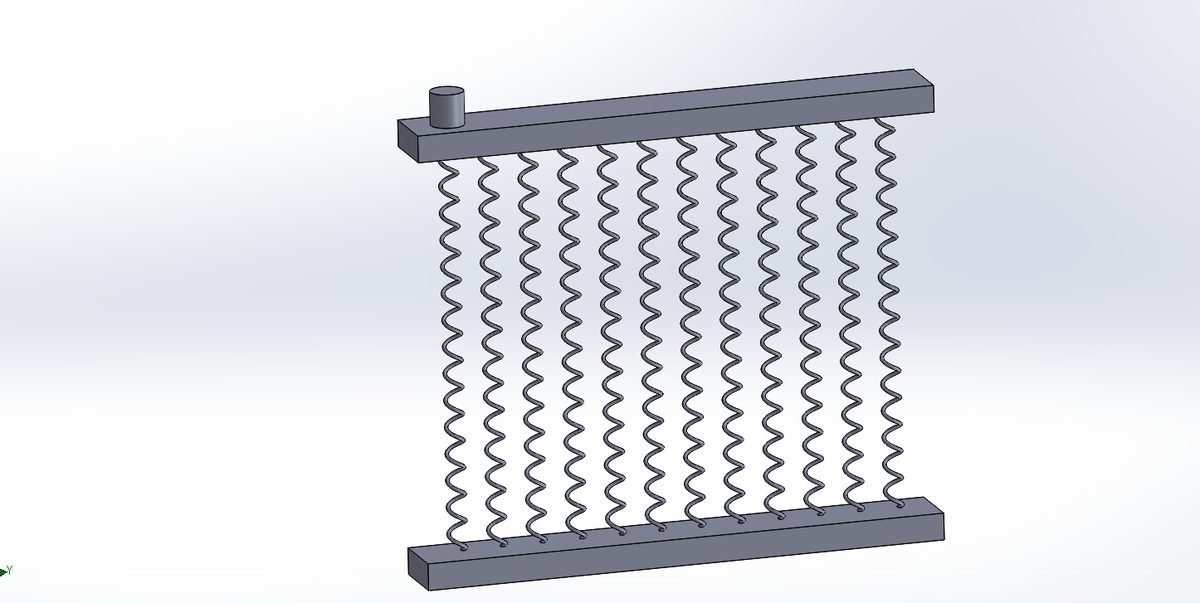
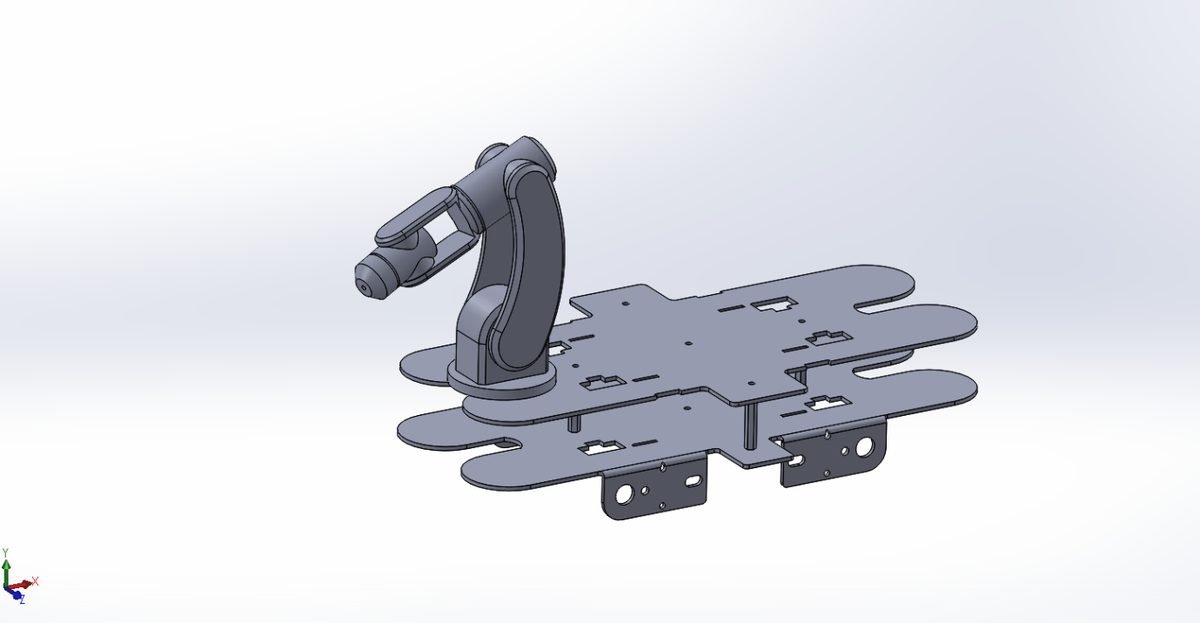
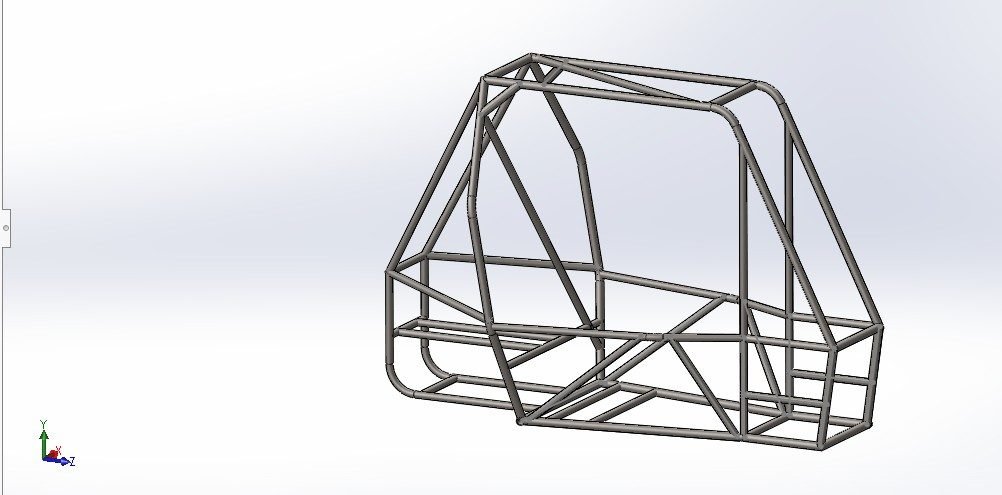
Structural Design and Optimisation Major Projects
Design studies where the analysis decides the shape or material – the core of a strong major project.
- Robot arm topology optimisation: An articulated industrial robot arm under payload. Research angle: Remove material with topology optimisation and compare weight, stress and stiffness before and after.
- Mobile transport robot frame: A driverless robot that carries goods in factories. Research angle: Optimise the chassis for minimum weight at the same payload and deflection limit.
- Truck chassis cross-section study: The frame that carries every major part of a truck. Research angle: Compare C, I and box sections for stress, deflection and weight.
- Multilayer pressure vessel: A thick-walled vessel built from steel and composite layers. Research angle: Compare stress distribution and weight against a mono-block vessel.
- Cryogenic pressure vessel for liquid methane: Stores liquefied natural gas at about −160 °C. Research angle: Combine thermal and structural loads and compare vessel materials.
- High-speed milling machine spindle: The rotating shaft that holds the cutter at high speed. Research angle: Run static and modal analysis and compare EN8 with EN24 for critical speed.
Automobile and Electric Vehicles Major Projects
Vehicle topics with a clear industry link – good for interviews as well as the viva.
- Battery thermal management: Keeps lithium-ion cells in their safe temperature range. Research angle: Compare phase change material with water cooling for maximum cell temperature.
- Electric vehicle differential: Splits motor torque between the two driven wheels. Research angle: Design the gear set and check tooth and housing stresses.
- Car bumper impact analysis: Absorbs energy in a low-speed collision. Research angle: Compare polymer and composite bumper materials under impact.
- Composite propeller shaft: Carries torque from the gearbox to the differential. Research angle: Replace steel with composites and compare static, modal and harmonic results.
- ATV roll cage: The tubular frame that protects the driver of an off-road vehicle. Research angle: Check front, side and rollover impact cases and the factor of safety.
- Non-pneumatic airless tyre: Carries the vehicle without air inside. Research angle: Compare spoke designs and materials for stiffness and stress.
Thermal, CFD and Nanofluids Major Projects
Software-heavy projects with publishable results – ideal if you plan to write a paper.
- Radiator with nanofluid coolant: The heat exchanger that keeps an engine from overheating. Research angle: Compare base coolant with MgO and graphene nanofluids using CFD.
- Microchannel heat sink with nanofluids: Very small channels for high heat flux cooling. Research angle: Study the effect of nanoparticle type and concentration on temperature and pressure drop.
- Twisted tube heat exchanger: A shell-and-tube design with twisted tubes for better mixing. Research angle: Compare with plain tubes and add a ZnO nanofluid.
- Evacuated tube solar collector: The rooftop solar water heater with vacuum glass tubes. Research angle: Compare Al2O3 and ZnO nanofluids for outlet temperature and efficiency.
- Catalytic converter: Cleans harmful gases from vehicle exhaust. Research angle: Model flow through the honeycomb and study pressure drop and conversion.
- Diesel combustion chamber with biofuel: Where air and fuel mix and burn inside the engine. Research angle: Compare diesel with a biofuel blend for temperature and emissions.
Turbomachinery and Energy Major Projects
Rotating machines – a natural fit for students who enjoyed fluid mechanics.
- Centrifugal pump impeller: The rotating heart of a centrifugal pump. Research angle: Vary wrap angle and exit angle and compare head and efficiency with CFD.
- Centrifugal compressor with splitter blades: Raises refrigerant pressure in chillers and turbochargers. Research angle: Compare impellers with and without splitter blades.
- Steam turbine blade: Moving blades that extract work from expanding steam. Research angle: Run coupled CFD and structural analysis and compare two airfoil profiles.
- Gas turbine blade with thermal barrier coating: Blades that face the hottest gas in the engine. Research angle: Compare coated and uncoated blades for temperature and thermal stress.
- Micro gas turbine: A small turbine for distributed power and drones. Research angle: Design the compressor wheel and radial turbine and check stresses at speed.
- Wind turbine blade: Converts wind energy for a water-pumping windmill. Research angle: Compare two airfoil profiles for stress and deflection.
Aerospace Structures Major Projects
Lightweight structures and high-speed flow – strong topics for aeronautical and mechanical students.
- Rocket nozzle: Converts hot gas pressure into thrust. Research angle: Study supersonic flow through a convergent-divergent nozzle with CFD.
- Ultra-light aircraft wing: Ribs and spars that hold the airfoil shape. Research angle: Compare metallic and composite wing structures under flight loads.
- Flexible wing: A wing designed to bend and twist safely in flight. Research angle: Study aeroelastic behaviour of the rib and spar layout.
- Fuselage splice joint: Joins fuselage skin panels and stringers. Research angle: Find stress around fasteners and compare joint designs.
- Aircraft wheel hub: Carries the aircraft weight on landing. Research angle: Optimise the hub for weight and validate with a prototype.
Materials, Coatings and Manufacturing Major Projects
Combine simulation with material science – easy to link with lab tests.
- Thermal barrier coated piston: Protects the piston crown from combustion heat. Research angle: Compare TiN and NiCrAlY coatings for temperature and stress.
- Ceramic-coated combustion chamber: Burns fuel in a gas turbine. Research angle: Compare zirconia and SiC coatings for wall temperature.
- Natural fibre hybrid composite panel: A scooter body panel made from natural fibres. Research angle: Make samples and run tensile and flexural tests.
- Self-healing composite sandwich panel: A smart material that repairs small cracks. Research angle: Study the panel response before and after healing.
- Friction stir welding tool: Joins metals without melting them. Research angle: Compare pin profiles for stress and temperature during welding.
- Bottle mould core and cavity: The steel tool that shapes plastic bottles. Research angle: Design the core and cavity and check stress and deformation in H13 steel.
Vibration, Dynamics and Python Major Projects
Projects that combine theory, simulation and code – a strong mix for research-minded teams.
- Crack detection from vibration: A crack changes the natural frequency of a shaft. Research angle: Relate crack depth and position to the change in frequency.
- Timoshenko beam vibration: Beam vibration including shear and rotary inertia. Research angle: Compare natural frequencies for different boundary conditions with theory.
- Engine crankshaft: Converts piston motion into rotation. Research angle: Compare EN9, SAE 1045 and SAE 1137 under static and dynamic loads.
- Engine cooling fan: Moves air through the radiator. Research angle: Combine static, modal and CFD results to improve the blade.
- Machine fault detection with FFT and ML: Finds faults from vibration spectra. Research angle: Record real data, extract FFT features and train a classifier.
Free PDF: 40 Major Projects for Mechanical Engineering
All 40 ideas with the research angle for each, plus the standard chapters of a major project report – 6 pages, free to share with your project team.
Download the free PDFStandard Chapters of a Major Project Report
| Chapter | What to include |
|---|---|
| 1. Introduction | Background, problem statement, objectives and scope. |
| 2. Literature review | 15 to 25 papers and the research gap you will fill. |
| 3. Methodology | Design calculations, CAD model, materials, boundary conditions. |
| 4. Analysis / testing | FEA, CFD, experiments or code – with a mesh or validation check. |
| 5. Results and discussion | Graphs, tables, comparison and what the numbers mean. |
| 6. Conclusion and future scope | Key findings in numbers and how the work can be extended. |
For page layout, fonts and front matter, follow our mechanical project report format, and prepare with the final year project viva questions.
Major Project vs Mini Project vs Easy Final Year Project
A mini project is a one-semester exercise on one mechanism or one analysis. An easy final year project is a full major project on a simple, familiar topic. The ideas on this page go a step further: each one has a research angle that can lead to a conference or journal paper if you do it well.
Want more options? See 60+ mechanical engineering project ideas, advanced IIT-level mechanical projects, CFD projects and machine learning projects.
Need guidance for your major project? We teach you each step – topic and research gap, CAD, FEA or CFD, validation, report and viva – and you build the project yourself. Engineers R World has supported 1000+ students since 2013. Message us on WhatsApp or send your enquiry from the home page form.
FAQs on Major Projects for Mechanical Engineering
What is a major project in mechanical engineering?
A major project is the main final year project for B.Tech and B.E. mechanical students, usually done over two semesters by a team of 2 to 4. It needs a clear problem, a literature review, a proper method (design, analysis, experiment or code), validated results and a full report, and it is assessed through a final presentation and viva.
Which topics are best for a mechanical major project?
Topics with a clear research angle work best: electric vehicle battery thermal management, topology optimisation of structures, nanofluid heat transfer, turbomachinery CFD, composite materials and vibration-based fault detection. Pick one that matches your interest and the software or lab facilities you can access.
What should a major project report contain?
A standard major project report has an introduction with objectives, a literature review that identifies the research gap, the methodology, the analysis or testing, results and discussion, and a conclusion with future scope, followed by references and appendices. Our free PDF lists these chapters with what to include in each.
Can a major project be only simulation?
Yes. Many universities accept a simulation-based major project using FEA or CFD, provided you validate the results against hand calculations, published data or a simple experiment, and discuss mesh independence. Confirm with your guide.
Where can I download a major project PDF for mechanical engineering?
You can download our free PDF of 40 major projects for mechanical engineering from this page. It includes every idea with its research angle and the standard report chapters, and you are free to share it with your project team.
How is a major project different from a mini project?
A mini project takes one semester and covers one mechanism or one analysis. A major project runs through the final year, is expected to address a real problem or research gap, and needs a full methodology, validation and a detailed report.
Studying abroad? We guide you too – learn Python and engineering through our live classes or recorded video lessons.