
Looking for easy final year projects for mechanical engineering that you can actually finish on time and explain confidently in the viva? Below are 42 easy final year project ideas in seven areas – machine design, automobile, thermal and CFD, renewable energy, agriculture, robotics and Python – each with a one-line idea and the final year scope: the analysis to add so the project is strong enough for a major project.
Quick answer: The easiest final year projects for mechanical engineering are design-and-analysis projects on familiar parts – a two-wheeler disc brake rotor, composite leaf spring, double pipe heat exchanger or engine cylinder fins – because they need only a computer and have a clear load case. For a working model, foot step power generation and a hydraulic scissor lift are simple to build. Easy does not mean weak: add a material comparison or a calculation checked against FEA or CFD.
Free PDF: 42 Easy Final Year Projects for Mechanical Engineering
All 42 ideas with the final year scope for each, plus a 6-month project plan – 6 pages, free to share with your classmates.
Download the free PDFTop 10 Easy Final Year Projects at a Glance
| Project | Type | Main result to show |
|---|---|---|
| Two-wheeler disc brake rotor | Software (FEA) | Structural, thermal and modal results |
| Composite leaf spring | Software (FEA) | Weight saving vs steel |
| Double pipe heat exchanger | Software (CFD) | Parallel vs counter flow |
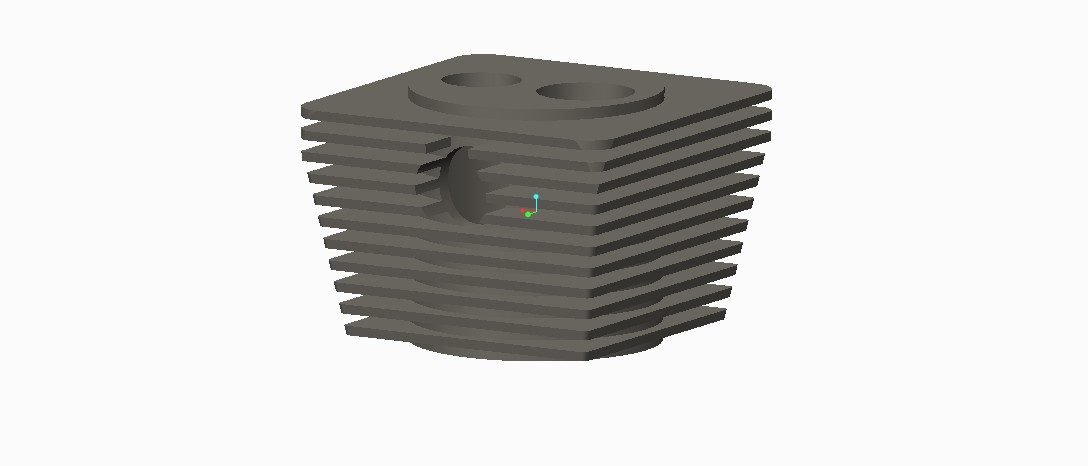
| Engine cylinder head fins | Software (thermal) | Fin shape comparison |
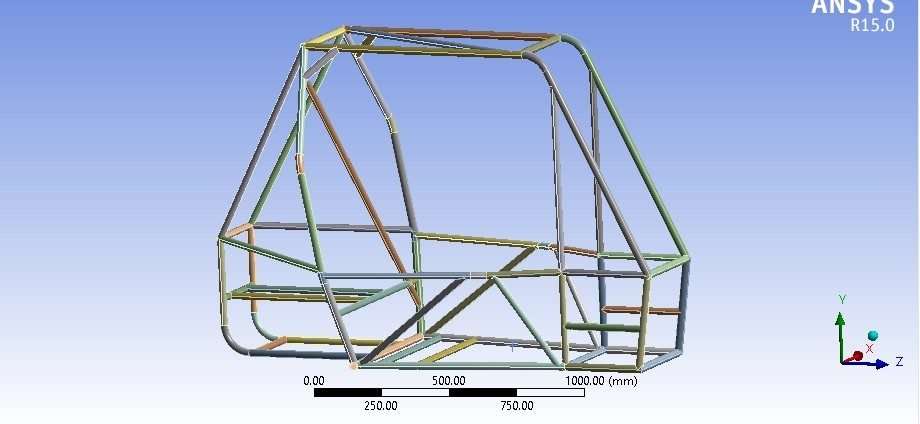
| Go-kart chassis | Software (FEA) | Impact checks, three materials |
| Foot step power generation | Build + calculation | Power per step |
| Hydraulic scissor lift | Software or build | Arm stress at two positions |
| Multipurpose agriculture machine | Build + design | Time saved per acre |
| Rocker bogie mechanism | Build or software | Link stresses on uneven ground |
| Vibration fault detector (Python) | Software (Python) | Fault peaks + ML classifier |
What Makes a Final Year Project “Easy” – and Still Strong?
- A familiar part or machine: examiners already understand it, so you spend the viva on your results, not on explaining the basics.
- One clear load case or operating condition: easy to model and easy to check with a hand calculation.
- Low or zero fabrication: design-and-analysis and Python projects need only a computer.
- A comparison: two materials, two shapes or two flow arrangements turn a simple model into a real study.
- Validation: one hand calculation that matches your FEA, CFD or test result adds a lot of credibility.
Easy Final Year Projects from Our Project Library
Each of these is a full design-and-analysis project in our library. Open one to see the model and what was analysed, then build your own version.


Machine Design and Mechanisms Projects
Textbook machine design topics with a clear load case – easy to model, easy to defend in the viva.
- Hydraulic scissor lift: A platform lifted by a hydraulic cylinder through crossed arms. Final year scope: Find arm stresses at the lowest and highest positions and compare two materials.
- Belt conveyor: Moves material on a belt over idler rollers. Final year scope: Compare belt and roller materials for weight, stress and deflection.
- Crane hook: A curved beam that carries the full crane load. Final year scope: Locate the peak stress at the inner curve and compare forged steel, wrought iron and aluminium.
- Composite leaf spring: Replaces a steel leaf spring with fibre-reinforced plastic. Final year scope: Compare weight saving, stress and deflection against steel.
- Universal joint: Passes torque between two shafts at an angle. Final year scope: Compare steel with composite and ceramic options for the yoke and cross.
- Manual forklift chassis: A welded frame for a hand-operated fork trolley. Final year scope: Check frame bending at full load and suggest a lighter section.
- Pipe bending machine: Bends pipes with a motorised scissor jack instead of a hydraulic jack. Final year scope: Design the jack screw and frame, and check bending force for common pipe sizes.
- Spur gear material comparison: The simplest gear pair, used in almost every machine. Final year scope: Compare grey cast iron and high-speed steel for tooth bending stress.
Automobile Engineering Projects
Familiar vehicle parts – every examiner knows them, so you can focus on your results.
- Two-wheeler disc brake rotor: The disc that carries pad force and braking heat. Final year scope: Run structural, thermal and modal checks and compare rotor materials.
- Go-kart chassis: A tube frame that also acts as the suspension. Final year scope: Check the frame under front, side and rear impact and compare steel, aluminium and Kevlar.
- Single plate clutch: Connects and disconnects the engine and gearbox. Final year scope: Find friction plate stress and temperature for different friction materials.
- Car wheel rim: Carries vehicle weight and passes torque to the tyre. Final year scope: Compare aluminium alloys for stress and weight.
- Piston and connecting rod: Passes combustion force to the crankshaft. Final year scope: Run static and thermal checks on a two-wheeler piston and connecting rod.
- Shock absorber spring: The coil spring that carries bump loads. Final year scope: Compare spring materials for stress and deflection.
- Electromagnetic braking system: Brakes with magnetic force instead of friction pads. Final year scope: Calculate braking torque and check disc temperature and stress.
Thermal and CFD Projects
Software-only projects – no fabrication cost, results are graphs and contour plots.
- Engine cylinder head fins: Fins that cool the hottest part of an air-cooled engine. Final year scope: Compare straight and V-shaped fins for heat transfer.
- Double pipe heat exchanger: The simplest heat exchanger: one pipe inside another. Final year scope: Compare parallel flow and counter flow with CFD and hand LMTD calculations.
- Plate fin heat sink: Cools electronics by natural convection. Final year scope: Study the effect of fin spacing and height on temperature.
- Annular fins with perforations: Circular fins with holes to save material. Final year scope: Check whether perforations improve heat transfer per unit mass.
- Exhaust manifold: Collects hot gases from each cylinder. Final year scope: Improve the shape for smoother flow and check thermal stress.
- Water cooler coil and tank: A refrigerant coil chills drinking water. Final year scope: Compare coil layouts with CFD for faster cooling.
Renewable Energy and Power Generation Projects
Projects with a visible output and a strong social angle.
- Foot step power generation: Turns the force of walking into electricity with a rack and pinion. Final year scope: Estimate power per step and design the spring and plate.
- Shock absorber power generation: Recovers energy from suspension movement. Final year scope: Design the rack and pinion and estimate energy recovered on rough roads.
- Savonius wind turbine: A simple drag-type vertical-axis turbine. Final year scope: Compare single and double stage rotors.
- VAWT blade airfoil study: Vertical-axis turbine blades that work with wind from any direction. Final year scope: Compare airfoil shapes with CFD for lift and torque.
- Dual-axis solar tracker: Turns a panel to follow the sun. Final year scope: Compare energy output against a fixed panel.
- Regenerative braking with flywheel: Stores braking energy in a flywheel for reuse. Final year scope: Size the flywheel and check stress at maximum speed.
Agriculture and Social Impact Projects
Machines that solve a local problem – popular with examiners and project expos.
- Multipurpose agriculture machine: Ploughing, seed sowing and watering in one pass. Final year scope: Design the frame and tool holders and estimate time saved per acre.
- Automatic seed sowing machine: Places seeds at steady spacing and depth. Final year scope: Design the sprocket drive and metering wheel and check the frame.
- Automatic river cleaning machine: A solar-powered machine that collects floating waste. Final year scope: Design the conveyor and hull and estimate collection rate.
- Coconut scraping machine: A motor-driven scraper for hotels and food units. Final year scope: Select the motor and design a safe scraper head.
- Portable grain packing machine: Fills grain into bags faster than by hand. Final year scope: Design the hopper and frame and measure filling time.
- Air-to-water conversion system: Extracts drinking water from air moisture. Final year scope: Estimate water output for different humidity levels.
Robotics and Automation Projects
Mechanical design with simple electronics – good for teams with mixed interests.
- Stair climbing trolley: Tri-star wheels carry loads up steps. Final year scope: Compare frame materials and check wheel loads on a step.
- Rocker bogie mechanism: The six-wheel suspension used on Mars rovers. Final year scope: Compare link materials and check stresses on uneven ground.
- Pipeline inspection robot: Travels inside pipes to look for damage. Final year scope: Design the wheel and body for different pipe diameters.
- Omni wheel: Rollers on the rim let a robot move in any direction. Final year scope: Compare roller materials and check hub stress.
- Agriculture drone rover: A ground robot for smart farming tasks. Final year scope: Design the chassis and check it under payload.
Python-Based Projects
Software-only and fast to start. Each tutorial has full verified code you can extend into a project.
- Spur gear design calculator: Bending and contact stress with module selection. Final year scope: Extend to helical gears and add a material database.
- Engine cycle analyser: Otto and Diesel efficiency with P-V diagrams. Final year scope: Add the dual cycle and compare with real engine test data.
- Vibration fault detector: Finds machine faults from an FFT spectrum. Final year scope: Record real vibration data and add a machine learning classifier.
- Heat exchanger design tool: Sizes a heat exchanger with the LMTD method. Final year scope: Add the effectiveness-NTU method and a cost comparison.
Free PDF: 42 Easy Final Year Projects for Mechanical Engineering
All 42 ideas with the final year scope for each, plus a 6-month project plan – 6 pages, free to share with your classmates.
Download the free PDFA Simple 6-Month Plan for Your Final Year Project
| Month | What to finish |
|---|---|
| 1 | Choose the topic, write a one-line objective and read 10 to 15 papers. |
| 2 | Do the hand calculations and fix the dimensions and materials. |
| 3 | Make the 3D model in CAD. |
| 4 | Run the FEA or CFD study, or build and test the model. |
| 5 | Compare results, draw the graphs and write the report using the mechanical project report format. |
| 6 | Prepare the PPT and practise the final year project viva questions. |
Easy Project vs Mini Project
A mini project is a one-semester exercise on one mechanism or one analysis. An easy final year project is still a full major project – literature review, method, results and report – just on a topic that is simple to understand and finish on time. If you did a good mini project, you can often extend it into your final year project by adding a comparison or an analysis.
Want more options? See 40 major projects for mechanical engineering (with free PDF), 60+ mechanical engineering project ideas, 100+ mechanical projects for students, advanced IIT-level mechanical projects and Python projects for final year students.
Need guidance to complete your final year project? We teach you each step – topic selection, CAD, FEA or CFD, report and viva – and you build the project yourself. Engineers R World has supported 1000+ students since 2013. Message us on WhatsApp or send your enquiry from the home page form.
FAQs on Easy Final Year Projects for Mechanical Engineering
Which is the easiest final year project for mechanical engineering?
Design-and-analysis projects on familiar parts are the easiest to complete: a two-wheeler disc brake rotor, a composite leaf spring, a double pipe heat exchanger or engine cylinder fins. They need only a computer, have a clear load case and give results you can explain easily. If you want a working model, foot step power generation and a hydraulic scissor lift are simple to build.
Can a final year project be easy and still get good marks?
Yes. Examiners look for a clear objective, correct method and results you understand. Add one strong piece of analysis – a material comparison, a design calculation checked against FEA or CFD, or a test – and explain it well in the viva. A simple topic done properly scores better than a complex topic you cannot explain.
Is a design and analysis project accepted as a final year project?
Most universities accept a CAD and FEA or CFD project as a final year project, especially when it compares materials or designs and validates results with hand calculations. Check your college rules and confirm the topic with your guide.
How long does an easy final year mechanical project take?
Plan for about six months: one month for the topic and literature review, one for calculations, one for the 3D model, one for analysis or fabrication, one for results and the report, and the last for the PPT and viva preparation.
Where can I download a PDF of final year mechanical project ideas?
You can download our free PDF of 42 easy final year projects for mechanical engineering from this page. It lists every idea with the final year scope and a 6-month plan, and you are free to share it with your classmates.
What is the difference between an easy project and a mini project?
A mini project is a one-semester exercise on one mechanism or one analysis. An easy final year project is still a full major project – with literature review, method, results and report – but on a topic that is simple to understand and finish on time.
Also see: agriculture projects for mechanical engineering and year-wise mini projects (2nd and 3rd year).
Studying abroad? We guide you too – learn Python and engineering through our live classes or recorded video lessons.